
Get your Signed copy today!
Kindle Edition
Download from Apple iTunes (eBook)
Amazon
Category:
History
Publisher: Notion Press
ISBN-10: 9798891338296
Type: Non-Fiction
Pages: 170
Copyright: Nov 2nd 2023
Price: $2.99 (eBook)
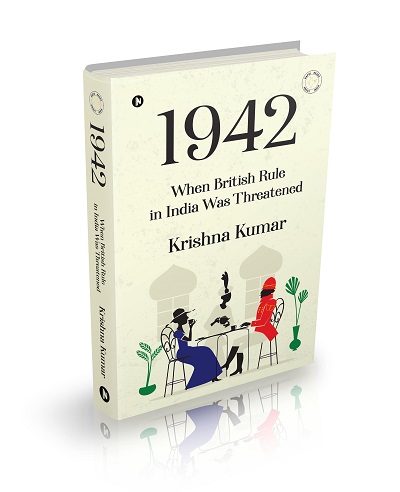
This book provides context, analyzes, and narrates the events of 1942, which shook British India and eventually led to the collapse of the Empire.
Japan attacked Pearl Harbor and Malaya within hours of each other. Thus, the United States also came in World War II as part of the Allies joining Britain and France. Japan had joined Germany and Italy in October 1940.
The British areas started collapsing like a house of cards. Hong Kong surrendered on December 25th, 41, and Malaya followed Singapore. The Japanese took over Burma and bombed Calcutta, Madras, and Vizag.
Under Chatfield doctrine, the defense of these areas was under British India. Besides, there were a large number of Indians in trade to work there.
Ports on India’s East Coast were closed. Almost 100,000 soldiers of the British Indian Army and 400,000 civilians- disease-ridden and demoralized- came to India from Burma, making a tortuous journey with nearly 50-100,000 perishing while trekking through the mosquito-infested jungles.
British started sending their families to the interior and began planning to evacuate from India, fearing Japanese invasion.
The carefully built myth of British superiority lay shattered.
Then, Congress launched the Quit India agitation.
Thus, British Rule in India came under its most severe threat since 1857. This time, it was both internal and external.
But the real threat, which no one realized then, was to come from the Indian National Army formed in Southeast Asia.
Excerpt
The British war prowess in India had given them the image of being invincible. Their training methods, the discipline of the troops, and assured regular monthly payment of the salaries coupled with wins against princes and global deputations (which started in 1790) had created a mystique and aura of the British Indian Army. This aura and the army were powerful tools in controlling the population in British India, and the significant reasons, besides the police force and administration, were that a small number of Britishers could control a vast and spread-out population. The army was used to maintain control over the princely states and assist the administration in suppressing dissent.
The first dent in this aura of invincibility came when Britain itself came under threat by Luftwaffe bombing, the threat of invasion and naval blockades by U-2 Boats, and struggling for survival, lost Singapore, Malaya, Hongkong, and Burma in Asia.
The debacle of Singapore and Malaya in 1942 was a decisive loss to the British and demonstrated a poor strategy and inadequate fighting ability,
The areas from Hong Kong to Burma were very tightly linked with India when under the British.
The British officers were interchanged in these places with India.
Trade in Hong Kong, Singapore, Malaya, and Burma was substantially in the hands of Indian traders.
The defense of these areas was under the responsibility of the Government of India as per the Chatfield Doctrine. The British army at these places had predominantly Indian soldiers but British and Australian officers.
Malaya and Singapore had large numbers of labor and supervisory positions with Indians.
Therefore, what happened in these areas became known to people in India very quickly and also caused an impact in India.
The second dent was the return of troops from Burma and the information coming from there about the treatment of British officers of their Indian troops, along with the inability to face the Japanese. The British had constantly underrated the Japanese and their fighting ability without paying close attention and placing enough value on Samurai Ethos and the Bushido code of the warrior.
When the Japanese took over Burma, tired, dejected, and defeated, almost 100,000 British army soldiers came to India. Some were evacuated by air, some by motor vehicles or ships others, mostly Indians, walked through the dense jungles of Assam. Further, almost 400,000 civilians crossed over to India, many dying due to harsh terrain and indifferent evacuation arrangements.
Burma, till 1937, was part of India and managed from Calcutta. Even in 1942, Rangoon and Mandalay had regular ferry service from Calcutta and a large number of Indians in trade and labor.
Another factor was that the British pooled resources. Each place had resources unique to that place, which were collectively exploited. If Hong Kong was the traditional trading point with China, then Singapore was the point where about 25% of the Empire's trade passed and was a major naval center. Malaya produced most of the tin and rubber for the Empire, and Burma was a significant source of Oil and Rice. .
As there were Indian traders and also workmen everywhere, events of one place necessarily impacted another. Linked to all of them was India, where the people living in these places still maintained active links and often loyalty as well.
The third dent was when the Japanese bombed the Indian cities of Calcutta, Madras, Vizag, and Kakinada. Many Ships were sunk while in the harbor. Evacuation started from Coastal Cities, and ports on the Eastern side were closed for shipping.
After the Bombing of Madras, the British started to make plans to even evacuate from India, worried that the Japanese attack might come into full force. Because of focus on Northwest area for defense of India, the British were simply not organized for meeting an onslaught from Northeast.
At the same time, to continue with British rule, the British strategy was to offer Indians increased involvement in administration, and Sir Stafford Cripps was sent to India.
The failure of this mission, loss of membership of Congress, and being ignored by the British after the provincial government resignations gave rise to the Congress party launching a do-or-die agitation, later named as ‘Quit India.’
This became the fourth dent when the Congress party launched its agitation and protest in August ’42.
Thus, as never before, India's British rule came under external and internal threats.
The common person in India was amazed at these happenings and found one surprise after another during this year.
|