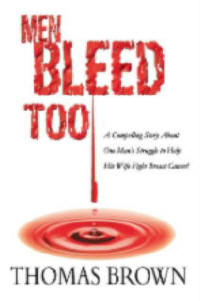
Men Bleed Too is a compelling story about one man's struggle to help his wife fight breast cancer.
PROLOGUE
This is a story about my first wife, Barbara, and her fight with breast cancer. We received the news in December 1992 that the tumor in Barbara’s right breast was cancerous. It was classified as inflammatory breast cancer. This type of cancer is only one of the many forms of breast cancer, but the most dangerous. At the time we were both forty-four years old. I was a colonel in the U.S. Army serving as an instructor at the Command and General Staff College in Fort Leavenworth, Kansas, which is in northeast Kansas. Barbara was a housewife and the mother of our two sons, Thomas Robert and Jason Michael. Both of the boys were students at the University of Kansas, in Lawrence, about fifty miles to the southwest. Leavenworth was also my hometown. As such my parents, two brothers, and two sisters all lived in or around the Kansas City metro area.
When we received the confirmation that the extraction from a recent biopsy was indeed cancerous, I had a poor understanding of cancer, let alone this particular form that seemed to strike only females. I had no idea how prevalent the disease was among American women. However, with a little research I was quick to learn that in the United States, one in every nine women in their lifetime would develop breast cancer. I was shocked at the high statistics and decided that I needed to educate myself about the disease and the kinds of treatment options that were available. I searched the libraries and found several books written by women about their own experiences and the experiences of other women, but I found nothing written by a man. It was then that I thought I should start keeping a daily journal that I might one day turn into a book to help other men facing the same challenge.
The journal became my focal point for each day. I chronicled all the events from December 1992 until Barbara’s death in August 1994. During the almost two years we spent battling her cancer; I found that the journal became very important for a couple reasons. First, it contained all the information about the times, types, and amounts of drugs that Barbara had taken. This was helpful to attending doctors because Barbara had several bouts with infections that landed her in the hospital. With the information at hand, I could easily tell the doctors what they needed to know. Secondly, the journal provided me with a place to write out my thoughts and emotions. At the time, I looked at it as a routine just to keep track of events, but in retrospect, I find that it was a way for me to release pent-up pressure.
The National Breast Cancer Foundation predicts that in 2005, more than 211,000 women in the United States will be diagnosed with breast cancer, and 43,300 of them will die from the disease. Whether or not you or a loved one has been diagnosed with cancer, I believe that the information I provide in this book may help. My experience is only one of millions about fighting cancer. However, it will not be the last. It is my intent and hope that the thoughts and experiences that I share with you in this book will ease your burden.
In the chapters that follow, you will see the role that I played during our fight with cancer. I became the task manager and primary caregiver. I made all decisions concerning the treatment of the disease. It is a sad story, because Barbara ultimately died from cancer. However, it is a story rich in emotion, love, and logic that also details how this disease affected and changed our daily lives. If the information in this book helps someone who has a loved one battling cancer, then I will have accomplished my goal.
Excerpt
Men Bleed Too is a story about my wife’s fight with breast cancer and my role as task manager and caregiver. When I learned that my wife had breast cancer, I sought out as much information about the disease as possible. I searched the libraries and found several books written by women about their own experience and the experience of other women, but I found nothing written by a man. It was at then that I decided to keep a daily journal that one day I might turn into a book to help others facing the same challenge.
The journal became my focal point for each day. I chronicled all the events from December 1992 till Barbara’s death in August 1994. During the time that we fought against the cancer the journal was important for a couple of reasons. First it contained all the information about the time and amounts of drugs that Barbara had taken. This was very helpful to attending doctors because Barbara had several bouts with infections that landed her in the hospital. With the information at hand, I could easily tell the doctors what they needed to know. Secondly, the journal provided me with a place to write out my thoughts and emotions. At the time I looked at it as routine just to keep track of events, but in retrospect I find that it was a way of me releasing a lot of vented up pressure.
Re-Release! No longer back-listed. Return to the Olde Ways. The hustle and bustle of modern day life has brought many of us to a quick fix attitude.This book is for those of you who are fed up; have looked at your life and your loved ones and realize