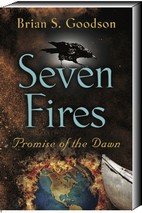
Kindle Edition
Ron's Place
BookLocker
Books-A-Million
Category:
Science Fiction
Publisher: BookLocker.com
ISBN-10: 1634917797
Type: Fiction
Pages: 354
Copyright: November 3, 2016
ISBN-13: 9781634917797
Price: $18.95 (eBook)
When Brian Goodson approached me two years ago with the request to edit his book, Seven Fires, I was reluctant at first because the book had been published twice before. And, upon opening the version he sent me, the book was filled with errors of punctuation and bad descriptions related to conversation. The story was also a bit confusing, at first.
But Brian was persistent, and, although I stopped editing more than once because I had other obligations, I finally finished the editing after nine months. Goodson wanted to publish it again but did not have the funds and fell sick without notifying me. In August, I learned that he died. So, I published this book for him with the proceeds from sales to go to his wife.
Seven Fires opens with a terrible, unfortunate nuclear war between the United States and China caused by missed communication. But Indian prophecy had given the Indian Nations of North America an edge over the people in the cities because they prepared and went underground. Unfortunately, the result of such a destructive nuclear war not only destroyed many population centers, it created a nuclear winter in the northern hemisphere bringing what life that survived the explosions to be buried under tons of snow and ice for months.
Jeff Meserve, an Indian schoolteacher, goes to the grocery store and accidentally lets a crow come into the store with him as a strange snowstorm descends, trapping him and several others of widely different backgrounds in the store. When they finally dig themselves out, everyone is dead except for Jeff and his, now pregnant, librarian friend, Abigail. Both weathered the ordeal that the others didn't. But the crow flew free and guides them to Sipayek, the Indian village of Roman Eaglewalk.
Roman led his village underground into a massive cave system with a fast flowing river providing freshwater and power for electricity. The village emerges from the cave intact, but Roman is troubled. He goes on a spirit walk and discovers a stone tablet of unknown age that seems to foretell the future. In the meantime, a son is born to Jeff and Abigail on their journey and Roman comes to their rescue from a bear. The son is given the name, Promise.
The troubled President of the United States, Franklin Deleanor Lenning, emerging from his shelter and finding the country in ruins, learns of the village's success and goes there to seek advice on how to deal with the invading Chinese. Years before, Lenning and Eaglewalk were in combat together.
Promise turns out to be extraordinarily gifted in Indian ways. He befriends a girl in the village who is older, named Purity. Together, they amaze their parents and seem to be connected to the mysterious stone tablet. Roman prepares the village for war with the Chinese and learns from his wife that Jeff is his son, making Promise his grandson. At this point, Roman's father appears and kills him. The crow, ever present, oversees all. The Chinese assault the village several times but are driven back.
President Lenning arrives with military reinforcement, but they are not needed. The Chinese finally overrun the village and all are forced into the cave and into the underground river. The villagers spend an indeterminate amount of time navigating the treacherous river in birchbark canoes until they finally emerge in the Black Hills where all of the Indian nations of North America have gathered to fight the invaders.
The radiation fallout from all the nuclear bombs has created many mutations, particularly among diseases, that are running rampant among the survivors and the Chinese invaders. The United States Army has also provided just enough fuel and supplies for the Chinese Army to drive deep into the central plains without enough resources to return to their ships in the Gulf of Mexico.
Using unconventional means, the Indians and a few from the United States Army defeat the Chinese and a new era begins. But all of the seven continents, according to Indian legend, must be burned to purify them of the scourge of the mutated diseases. Promise and Abigail set out on a mission to reunite the people of the world. The crow flies with them.
For those that like science fiction based on fact, mixed with Indian legend and folklore, with great adventures and dramas carried out with a bit of mysticism thrown in, Seven Fires is a book you will enjoy. After all my hard work to make it more readable, I highly recommend the story to you, the reader.
Excerpt
Seven Fires
Brian S. Goodson
Edited by: Ronald W. Hull
Copyright © 2016 Brian S. Goodson
ISBN-13: 978-1-63491-779-7
ISBN-10: 1-63491-779-7
All rights reserved. No part of this publication may be reproduced, stored in a retrieval system, or transmitted in any form or by any means, electronic, mechanical, recording or otherwise, without the prior written permission of the author.
Published by BookLocker.com
Printed on acid-free paper.
The characters and events in this book are fictitious. Any similarity to real persons, living or dead is coincidental and not intended by the author.
2016
Third Edition
Preface
“Indians? What Indians? I am the last Indian!”
— Sitting Bull
“We are the stars who sing, we sing with our light.
We are the birds of fire, we fly over the sky.
Our light is a voice.
We make a road for the spirits, for the spirits to pass over.
Among us are three hunters who chase a bear.
There never was a time when they were not hunting.
We look down on the mountains.
This is the song of the stars.”
— Passamaquoddy Song
“Look what they’ve done to my song, ma.
Look what they’ve done to my song!”
— Melanie
At this time the 7th and final Prophet came to the Anishnabe. “He was different from the others and had a strange light in his eyes.” He came with a message, not only for the Anishnabe people, but also directly for the Light Skinned Race. “At the time of the Seventh Fire, a new people will emerge. They will retrace the footsteps of their ancestors and will try to find those things that have been lost along the way. They will approach the elders in search of guidance. It will not be an easy task but if they are of good heart and have pure intention they can prevail. Some elders will be sleeping and have nothing to say, others will say nothing out of fear. The new generation must be fearless in their quest.
“The time has come,” the walrus said. “To talk of many things: Of shoes and ships and sealing wax and cabbages and kings and why the sea is boiling hot and whether pigs have wings.”
— Lewis Carroll
“We live in a culture where power precariously supports itself by relying on a tissue of denial and lies, so closely interwoven that the intellectually lazy never even see it. Just as most people still don’t even notice that the sky above has gone from a heavenly blue to a hell of anemic whitish-gray.”
— Diane Harvey
“Not only did the crew subjugate the natives, they enslaved, raped and plundered their world. The women were forced to become sex slaves. Executions were common for any natives that disobeyed. Eventually the people rebelled, but they were not skilled in warfare and were no match for the muskets, armor and weaponry aboard the Spanish ships. Killings and mass suicides occurred. It was literal genocide. By 1508 there were only 60,000 native Arawaks left on Hispano and 125,000 on Haiti. There had been a death rate of more than 95 percent. But our history books record none of this.
— Excerpt about Christopher Columbus from the Mind of James Donahue.
“We do not inherit the earth from our elders. We borrow it from our children.”
—American Indian philosophy
``Wise statesmen established these great, self-evident truths that when in the distant future some man, some faction, some interest should set up the doctrine that none but rich men, or none but white men, were entitled to life, liberty and the pursuit of happiness, their posterity should look up again at the Declaration of Independence and take courage to renew the battle which their fathers began.''
— Abraham Lincoln
"Seagull, you fly, across the horizon, into the misty morning sun.
Nobody asks you where you are going. Nobody knows where you're from. But you fly, to the sky, never asking why and you fly, all around til somebody, shoots you down."
— Bad Company
Dedication
To Mom and Dad, always.
To the grandfathers and grandmothers of old for their guidance.
To being a grandparent and the gift of living long enough to see such wonders.
To Julie, Mike and Carolyn Munger, enjoy life.
To Robin Hetrick, for putting up with us.
To all those we love who are now departed.
To all readers everywhere, thank you.
Brian S. Goodson died August 8, 2016
Chapter One
Inside a White House being quickly abandoned, the President stood looking at an oil painting with deliberation, his hands interlocked behind the small of his back. The painting hung where it was for as long as he had been a resident, and long before.
“Mister President, we have to leave Sir,” a man in a suit insisted, as small beads of perspiration formed on his face.
The President didn’t turn to look at the man, just continued studying the painting.
“Do you suppose we knew what we were doing then?” President Franklin Deleanor Lenning asked, continuing to stare at the painting of Thomas Jefferson. “Do you suppose we know what we are doing now?” he asked, turning and facing the man in charge of his personal security. The question left unanswered, the President once again turned and continued examining the painting.
“I like to think so Sir,” the man replied, his voice appearing calm, and yet also urgent.
“The thing about oil painting is that it is all in the details, the smallest brush stroke, a precise blending of colors, depictions and placement. Did you know that?” The President asked.
“I wouldn’t know Sir,” the man replied, urgency now unmistakable in his tone.
“Yes, it is true,” the President resumed. “An artist can look into a project with a keen eye, creative whit, and, despite their best effort, still utter the words ‘My god, what have I done?’ Their entire painting destroyed in but a single stroke, just one misplaced impasto.”
“Yes, Sir. We need to go, Sir,” the man cautioned.
The President nodded, sighed and followed him through the open door, walking briskly to the waiting helicopter in the Rose Garden.
Chapter Two
“Welcome to my country. Welcome to my home.”
— Robbie Robertson
Loaded bow and arrow in hand, Roman Eaglewalk stood hunched in the brisk early morning. Ahead and upwind, a magnificent moose stood grazing in the lazy grasses of a bog. Roman moved closer; his footsteps barely audible whispers on the leaf covered earth. Songbirds sing, greeting the day, as a pair of squirrels raced across the fallen trunk of a far pine in spirals, chasing one another in play.
Roman moved ever closer toward the massive creature. He kept his longbow low and was nearly in range for a shot. A few more steps and Roman would have only to wait for the moose to turn to get a clear shot at the bull’s heart. Roman knew the patience required for a good hunt, an efficient stalking often taking an entire day. He continued forward, his moccasins as one with the familiar ground. He blew into the conical birch bark moose call twice before dipping it into the water, and filling it. Roman emptied the call slowly into the water, the sound of a female urinating. The moose jerked its head upward, ears perked by both the call, and the spilling of water, its jaws pausing on a mouthful of sweet grass, fixated.
Within easy range, Roman settled on one knee to wait for the bull to turn. At once alarmed, the moose turned its head to face another direction before darting into the brush.
Behind him, Roman heard the reckless crackle of the breaking of small fallen tree limbs. He turned to see what he believed he already knew. Muwin he thought, a Black bear. Accompanied by a pair of season-old cubs, it approached with the confidence of an apex predator.
The bears were downwind.
Roman knew only a fool would climb a tree to try to escape one of these large cousins to the Espon, the raccoon. He looked right, and left, exploring his options. He could take her life, but was unwilling to make orphans of her young.
Slinging his bow across his back and sliding the arrow soundlessly into the quiver, Roman got into a position similar to a sprinter preparing to run as the bears drew ever nearer.
Running directly at her, and screaming, Roman charged the bear.
Instincts piqued, the bear rose to stand a full six-foot tall.
Roman continued toward her as the bear snarled, focusing on him as her timid cubs scurried behind their mother.
Still screaming, Roman ran to within a few steps of the bear. The bear roared—challenging. The cubs peered nervously around her.
Roman darted left, skirting the animal and continuing past it down the hill, leaving the bear standing undecided.
Roman continued well beyond the encounter, running as fast as his legs would carry him, turning, at last, to discover his plan had worked. The bear chose to remain with its cubs to ensure their safety rather than pursue him. Leaning his hands on his knees and catching his breath, Roman managed an easy smile, grateful that the forest had breathed vibrant life into him yet again. He would go home empty-handed this day, but that was all right…
Roman loved these woods.
Chapter Three
Jeff Meserve could not understand his throbbing big toe. He had come to rely upon it in winter months, knowing it was an accurate source for announcing an approaching snowstorm and, strangely enough, never proceeding rain. It happened with snowfall, and exclusively. But this was October. Hurricane season was not officially over, and snow wasn’t due for many weeks. He tried to ignore the dull pain, convincing himself that it was only the result of aging—a time in life where injuries began to emerge as reminders of deeds of youth. Jeff knew full well where he had received the injury. It was the result of a defiant traveler’s action when he downright refused to pay the Indians any money at their makeshift toll road they had set up on Interstate Route 1 many years before. Jeff remembered what prompted such a radical maneuver.
In an attempt to cut costs, The Federal Government had retracted annuities contracted to the Indians via treaty. Jeff, and many others answered the government’s absurd deliberations by assembling a tollbooth on the US Interstate, charging one dollar per car to continue on the road, which ran squarely through Passamaquoddy land. The action produced the expected results. A collective of travelers filed sufficient complaints to convince the government to reinstate the tribe’s benefits—a prompt resolution. There were, however, those who defied the Indian’s intentions, such as the man who had run over Jeff’s foot. “Fuck you,” the man had shouted, cigar protruding out of his mouth. He steered his tires deliberately left to run over Jeff’s feet, catching but a single toe, effectively rendering Jeff incapable of pursuit. Jeff limped for weeks beyond, and the throb returned as an indication of inclement winter weather ever since.
Meserve made the rounds at the powwow, greeting people and rendering assistance by erecting booths, hanging signs and paintings and helping people identify the allocated location of their particular booth. It was an annual ritual for Jeff, and one he enjoyed. Many of his people relied upon this event as a major source of their annual income, and all were grateful to share Indian customs with non-Indian people for sake of introducing their proud traditions. Jeff saw a man he recognized but seldom saw. It was Roman Eaglewalk, a traditionalist in every sense of the word. Roman isolated himself and his clan with few exceptions—this particular event among their brief exceptions. Roman rarely emerged from the woods. Many perceived Eaglewalk as a caveman in a changing world, never evolving beyond where the Indian people had been prior to any settlers. Even his own people, the Passamaquoddy Tribal Council, though respectful of his traditional intentions, occasionally discussed him with ridicule, speaking behind closed doors and sometimes in whispers, wondering if the madman of the forest would ever evolve into modern times. Jeff and Roman were somewhat acquainted, and had a few friendly exchanges over the years, including an open ended invitation for Jeff to join Roman and his clan in the woods. After enduring many attempts to convince him, Jeff had politely declined. Roman had warned Jeff to return to the ways of his ancestral heritage, and to forget the new, compromised ways the Indian people had adopted, advising him to return to the forest.
Roman had pointed out the seven fires prophecies, foreboding predictions of the end of the world, declared five hundred years earlier. Jeff agreed that a number of foretold events associated with such forebodings had already come to pass. Despite this, Meserve respectfully declined Eaglewalk’s entreaties. Thereafter, Jeff had always smiled when Roman offered this well-intended advice, but had more than once stated that Roman Eaglewalk might consider changing his name to Roman Chicken Little if he continued announcing, “the sky is falling, the sky is falling,” and get it over with. Jeff shot Roman a friendly nod and kept going, not in the mood for discussion about such predications. Later, Jeff would make a collective trip into town on behalf of the vendors, and pick up whatever supplies they may need to replenish at the local grocery store. There, he might also get aspirin for his throbbing toe.
Chapter Four
In spite of his age, Roman Eaglewalk was blessed with the health of a man thirty years his junior. Perhaps it was the fact that he kept with the traditional ways since his separation from the military. His days as a ranger had long ago showed him, firsthand, the horrors of war. His units were ordered to exterminate many in Afghanistan and Iraq. Collateral damage, and plausible deniability became terms Roman learned quickly to despise. Of such activities, he missed none. Eaglewalk had since resumed his Indian diet of organic exclusivity, following the culinary directives of Doctor Thomas Kitchen, the revered village holy man.
During his military career, Roman accomplished many things, conducting missions both covert and high profile, and often in the most hostile of theaters, succeeding where others had fallen. Each night, even within the busy theaters of military operation, Roman had a recurring dream that had plagued him throughout his life. The dream spoke of devastation with alarming clarity—to the point of directing his conscious convictions.
Throughout his life, Roman remained a traditional Indian in every sense of the word, living off the land, hunting, trapping and fishing as his forefathers did, often from a canoe. He would spear fish with a traditional split head spear, a design hundreds of years old still revered as modern technical engineering by the most sophisticated of modern divers. Roman knew all the tricks; such as the fact that salmon arrived on their annual run when one began to see fireflies.
While serving in the US Armed Forces, Roman managed to take advantage of the economic benefits of being fed, clothed and housed. He was able to retain the bulk of his wages, sending them to his beloved spouse, Mary, who allocated the funds toward the construction of their dream of developing a safe haven village, believing all the while that they were racing against time. Meanwhile, Roman also repeatedly tried to obtain documents to prove the sinister and active programs against native people. Many chose to overlook the issues bottle- necked in a quagmire of conflicting philosophies between his people and The Government. Many of the few remaining opposing activists were forced into exile, never to see their native land again. The American Indian activist was considered a terrorist, and fast becoming an endangered species. Roman knew the conditions on most reservations had become little more than American concentration camps. Often contrary to treaties signed, the wheels in Washington repeatedly either ignored agreements or would, at their discretion, endorse modifications, including renewed encroachment and exploitation of Native lands in exchange for contentious funding. The Western Shoshone had been forced into a land deal that paid them an insulting fifteen cents per acre based upon a treaty brokered in the 1800s. The debt remained unpaid until July 5th, 2004, honored only because of recent discovery of vast resources including gold, silver and petroleum. By decree of numerous scientists and geologists, Western Shoshone land was valued second only to the wealth found beneath the Saudi desert. Eager to leave the debt to rest to retain the moon of peace, the Shoshone never pursued payment. Over a century later, the dollar value of the land became greatly varied from its compensatory potential at the time of the original treaty signing. Beyond payment, sacred lands soon endure massive exploitation.
Such invasions would continue.
The modern Indian waged a war much like their ancestors had. Modern battles, however, were fought in an arena of self-preserving courtrooms riddled with strangling rolls of red tape. A common Indian joke was that the only thing stronger than duct tape is red tape. Roman and his clan preferred to live in the relative calm of the deep woods, secluded from the insanity. His family, friends and an ever growing extended clan lived on the same plot of land, each building their homes, sharing the workload of maintaining a community for the common good. For years, Roman, and any who would join him, continued to construct a special village, preparing for the five hundred year prophecy of apocalypse believed fast approaching.
Financed by collective savings and ongoing sale of traditional birch bark canoes, the ever-growing village labored toward building a refuge from a nuclear attack capable of sheltering them for an extensive duration. It was an ambitious endeavor and came to be possible only because of a specific cavern containing a natural spring that roiled vigorously, producing fresh, life-giving oxygen. Testing revealed this particular spring remained isolated from other waterways that potentially carried residual nuclear fallout in their current. Dynamite was used to restructure the cavern to accommodate the many villagers. Sturdy reinforcements were installed, particularly at the entrance, to shield against radiation. Roman’s father, Winter Hoof, had shown him this cavern as a boy and told him over the course of many years what he must do, what to expect, and how best to prepare for it.
Such was the substance of Roman’s ongoing dreams.
His father's advice, reinforced by the recurring dream, convinced Roman that an envisioned apocalypse was inevitable. He and many others had spent years preparing this sanctuary unknown to most, and hidden deep within the dense Maine forest. In spite of many stereotypes created by Hollywood celluloid, Indians did have electricity, computers and telephones, and took full advantage of modern technology wherever it seemed appropriate, adhering primarily to power sources known to be environmentally friendly. Windmills and solar panels were abundant throughout the village. Turbines were installed in select river areas nearby to assist in their electrical needs. Their children received the highest levels of academia collectively, even as each child received personal cultivation based upon their unique, blossoming talents. Every youth received much attention from the elders, resulting in a unique and practical balance of traditional teachings and values, as well as a modern higher education. Strong emphasis on life skills was retained, knowledge of significant first hand values and practices that seemed so overlooked amidst western culture, all the while emphasizing mathematics, language and a specific perspective of their own ill-recorded history. Any one of the new young braves could effectively hunt in the deepest of woods, and many began learning how to one day use the laws to their advantage in the marbled halls of Washington, DC. Theirs was a battlefront of intellect, entangled within the guidelines of The Constitution, and fueled by the voracious tenacity of the human spirit.
Roman’s office was at the front entrance of the compound and most visitors were shocked or amused by it—a forty-foot tall, and permanent wigwam. Roman wanted no misunderstanding by any visiting parties: They were standing on Indian land.
His dreams presented visions of scorched heavens, and Roman would see his father speaking. Roman remembered it well. He documented the dream-vision in his journal, and each night the occurrences would be the same, his written words in observation of the actions of his father, celebrated Chief Winter Hoof. In extensive detail, Roman wrote of the dream visions given him by his father.
Winter Hoof sat in his meager lodging. Feeling an overwhelming compulsion, he had taken the healing peyote, mixing it into fluidic potion and drinking it in repeated steps of four swallows in succession, each an offering to the corners of the earth. Soon, Winter Hoof would feel the stirring power of the spirits, their whispers understood only in visions born beyond dreams. Again, he sprinkled water on the hot stones, those called The Grandfathers, watching the steam rise, vapors carrying voice, and divulging insights. These rigid beings he had gathered over many seasons, during the course of his lifetime, and from various regions throughout which he had traveled. Fasting and going on secluded excursions that lasted for many days, Winter Hoof would listen for their beckoning, seeking them with as much obsession as he knew they sought him, a destined merging of significant spirits. Many had he gathered over time prolonged, taken from elusive mountain peaks, remote desert caverns and drawn from the bowels of swamplands, each enduring geological artifact bearing its own volition. Countless others had been left behind with vigorous deliberation, in their place as he had come upon them. The spirits of the ages, voices echoing rudiments of precedent, could be heard from these stones, many bearing witness to forthcomings meant never to be whispered. These stones Winter Hoof left to the fate of another, wisely unwilling to conjure mysteries of an age long forgotten. Such revelations were to be forever given only to those elite who might emerge from the quagmire of swamp with soles devoid of soil.
On this night, The Grandfathers sang of woes, conveyed through these vested mineral entities, those ever burdened with the pain-laden cries of the mother.
In the seclusion of his abode Winter Hoof began to chant, the drumming of ten thousand years blossoming to merge into a harmonious repertoire. In the distance, the distinct howl of malsom could be heard, the ever-empathic brother wolf. The old shaman would then utter the same words, echoing as if spoken in the dark confines of a cavern. “Listen to the crow.” The sky would then burn red, and flash to white, the atmosphere seared, laden with deadly chemicals cultivated to destroy fellow man, the end of a world once known.
Roman would awaken in a cold sweat and, hearing with clarity the resounding voice of the crow, he would feel as though a steel trap enshrouded his heart.
"Tell them to prepare. The day is coming. Take them to safety and prepare to remain through Ponatom, the spring moon. Mother Earth will suffer great injuries, and will purge itself of atrocities. Mankind will drown in a river of tears. Tell all that the reckoning is at hand. Heed your only warning."
Upon each revisit to the dream-vision, Roman’s fear and anxiety mounted. He would inquire of the crow repeatedly: "How much time?"
His answer came as a cold silence from a night filled room.
The crow offered no reply.
Roman continued walking around the fairgrounds, shaking hands, rejoicing in greeting. He nodded to Jeff Meserve, pausing for a moment and debating speaking with him. Roman wished that the man would listen. Several times he had asked Jeff to join him, and return to traditional ways. Years earlier, Jeff had earned his respect both as an activist, and as an athlete. Jeff was a grand example of his people, and Roman could only wonder why he had abandoned tradition. Perhaps it was too many years of dwelling in the non-Indian world. Only Jeff knew the reasons why he couldn't see what was coming, and refused to see the signs and heed the warnings of Mother Earth, remaining traditional to an extent, but discarding much, like so many others. Roman had heard of Jeff's comments labeling him “Chief Chicken Little.” What would be the point then in trying to convince him now, on this day? Roman saw Jeff leave the powwow and get into his truck, aware that Jeff was going into town to replenish supplies for the vendors.
Roman took a brief glance at his watch. It was nearly four o’clock. The sounds of music, the happy cries of the dancers, and the smells and sounds of the powwow all made him smile. On such a beautiful early autumn day, it was hard to imagine the warnings of the crow, and Roman remained convinced the spirits were granting a day of celebration. Surely for today, he could brush aside such apprehensions, and bask in pride for his people, and indulge their happiness. Roman's confident optimism was shattered by the ringing of his cell phone. He answered it with his face growing immediately solemn. Roman hurried to rejoin his wife, Mary, who was nearby visiting a vendor. He made certain she heard him utter into the phone the words, "Thank you Bill. We're leaving for the shelter right now. May the Creator keep you safe. I'll call you when we get there if I am able to get through."
Roman Eaglewalk and all members of his clan exited quickly the campground, offering repeated warnings as they departed, extending pleading invitation for any or all to join them.
None accepted.
Chapter Five
Jeff found his way into the parking lot of the IGA Supermarket and got out of his pickup truck, double-checking to be sure he had his list of vendor requests. It was late afternoon, and the sky had become an anemic gray. Before the clouds had disguised it, the already visible moon had a ring around it, a phenomenon commonly referred to as a snow moon. His throbbing toe, along with the moon and the sky confirmed they were about to get an early start to what may indeed prove to be a long winter. He believed it a strange occurrence indeed, and quickly thought about the extreme weather events occurring globally as a result of climate change.
Jeff started walking across the lot, noticing a crow spiraling just overhead and barking out whatever it had to say. “Hello brother,” Jeff called out with a warm smile. A gust appeared unannounced, an arctic blast sending a chill through him, and forming vengeful looking wind devils on the dusty lot. He stepped up his pace, and entered the grocery store in haste, the automatic door opening abruptly before him.
To Jeff’s surprise, the crow soared in behind him, swooping upward and taking a comfortable perch upon the rafters. The crow began to caw repeatedly, searching attentively in every direction, as if addressing all souls. Jeff looked up at it as a woman named Mattie commented about, “Jeff really knows how to make an entrance,” before shaking her head at the thought of bird droppings to be later picked up throughout the store. Jeff only looked at her briefly, his gaze returning to the bird that continued cawing raucously. He turned to look once again at the door through which he had entered, and found the snow was falling maniacally outside. Jeff could not see the limited distance to his truck through the large flakes saturating the sky like a flawless white waterfall.
Jeff wondered how the people at the festival were responding. He saw what appeared to be lightning flashes, indeed an unusual phenomenon during a snowstorm. Chief Chicken Little’s proclamation that the sky was falling at once came to mind.
Jeff dismissed it.
He fast concluded his best option was to retrieve the supplies he had come to gather. After all, the freak snowstorm could pass as quickly as it had arrived. Maine, like much of New England, was notorious for dramatic and sudden changes in the weather.
Jeff grabbed a cart and began filling it up, reviewing the list, and occasionally looking up at the ever-present crow. The lights blinked before going out. The generator kicked on to reveal a far darker store.
The crow began a tirade.
Chapter Six
Roman walked in a hurried manner. Along with many others, his wife Mary followed closely in nervous apprehension. Together, all approached the entrance and looked out at the world. They stared; helpless souls taking in the sights of their village, breathing in what they knew would be the last crisp air they would know for an extensive period of time. Snow began to fall, and Roman carefully surveyed to determine if others were coming at this eleventh hour, willing to wait but for a single soul.
There were none.
“Ready?” he asked, looking at his wife and then turning to the others. Tears began to fill even the eyes of the men. Roman stood another moment, hoping in the depth of his heart that none of this was true. Pressing a single button, the massive steel door folded, closing with a resounding echo, a sound that would later be remembered in dreams.
“Mercy,” Mary said as the last view of daylight disappeared behind the cold, steel door.
Chapter Seven
Dennis Levine made his way around the corner of the deli, and began helping himself to the fried chicken. Mattie scolded him, and began writing down what Dennis was consuming, promising to collect for it when the storm passed, shooting the store security guard, Roger, a resentful glimpse as she did so.
A retired cop, Roger Haskill had but a simple reply. “I don’t think he’s going anywhere, Mattie. I don’t think any of us are going anywhere, not for a while,” he proclaimed while looking out, and directing her attention to the still climbing snowdrift outside the front windows. Roger lit a cigarette, and then apologized for it, stepping deliberately away from Mattie, anticipating her insistence that he keep away from her with the deadly smoke. Roger pointed out he could not step outside, no way.
Mattie only scowled, and made her way into the backroom, slamming the swinging double doors as she passed through.
Dennis watched without comment and continued eating, pulling the meat off a wing in a single motion.
The crow cawed overhead, looking down at Dennis as he devoured the chicken. This could be you, bird, if you don’t shut the fuck up, Dennis thought, staring at the crow.
“Roger is right,” Jeff proclaimed. “We should all just settle in, and make ourselves comfortable. We may be here for a while.” Jeff wondered whether he should return the perishable items in his cart to the refrigerated areas, staring at the cart in contemplation.
Roger exhaled and nodded in agreement.
Spurred, Dennis made his way to the beer and slid one Icehouse out of the cardboard container, twisting the cap and washing down a mouthful of half chewed chicken. He downed the beer in a single tip and, finished, proudly belched.
Abigail Hatfield heard Dennis, and looked up at him thinking, he acts like the pigs he raises, from behind a book she had already settled in to read. She shook her head briefly, her eyes then returning to the pages of her book. Abigail, a thirty-eight year old woman who never married, had been frequently called an old maid by many in town, and a spinster, names she had heard whispered behind her back at the library a number of times in recent years, typically followed by giggling. She was secretly relishing her situation. Abigail had been wishing for more time to read her favorite books, serial romance novels. They took her there.
Jeff soon found he was unable to open the back entrance door. He recruited Dennis. The two pushed to exhaustion. Roger joined the detail, alas to no avail. Conceding, each concluded a seat on the floor.
“Ever seen anything like this?” Jeff asked, looking first at Roger and then Dennis. Each shook their head without comment.
Father Matthew Peabody approached. “Quite a storm, isn’t it, gentlemen,” he offered. “A fine demonstration of the power of the almighty.”
“More like climate change,” Dennis replied. He was a devout atheist. “A fine demonstration of mankind’s decimation of the planet,” Dennis continued, speaking in a tone Father Peabody understood to be impatience about bringing up God at a time like this.
Father Peabody shook his head, but smiled. “The Lord works in mysterious ways, son.”
None made comment. Trapped in a snowstorm, no one wanted to think about God. Thinking about God was something people did in church. It was also something people thought about only when death was knocking. Nobody wanted to think about God.
All had been mystified by the unusually brilliant, and brief white light that had preceded the falling snow. More peculiar was the extended red hue that followed directly afterward, an unusual mingling of phenomenon of what appeared to be a spontaneous Nor-Easter. The electrical charge in the air and the loss of power convinced them something was wrong, however none could be certain about what had occurred.
“Should we break down the door with an axe?” Dennis asked, growing increasingly uncomfortable about being trapped.
“For what?” Peabody asked. “There is nothing out there but snow.”
“We have to do something.” Dennis returned.
“That’s right, we do,” Roger asserted. “We have to wait. It’s all we can do. If this snow continues falling at its current rate, we could be here for a while. The towns’ snowplows couldn’t even keep pace with this,” Roger added, the words triggering his imagination as he tried to envision ten feet of snow with fifteen to twenty-foot drifts possible across the region. He shook his head at the consideration.
“We’re in a grocery store. We are blessed,” Father Peabody said.
“Jesus!” Dennis said absently as he thought about people who weren’t in the store, what might happen to those whose food supply would soon be depleted. His thoughts turned to the Donner party. “It’s another ice age!” Dennis announced, looking about, and opening yet another beer and chugging it.
“It’s a whopper snowstorm is all,” Roger asserted. “Nothing more.”
“How about a game of cards?” Jeff suggested. “That’ll kill some time.” Jeff rarely gambled, convinced of the potential destructiveness of what was clearly an addictive activity. He had, in fact, denounced the pending opening of the casino on the reservation, voting and speaking openly, offering a barrage of statistics about gambling as an addiction to any who may need further convincing. Here, however, it seemed a helpful occasion to do something to pass the time—a diversion of evils.
“Good idea,” Roger said, finding relief from the distraction, hoping it would be influential enough to quell Dennis’s apparently escalating panic. “You guys go ahead. I am going to go on the radio, and try to find out what is going on outside,” then making his way into the back of the store. He disappeared behind the same swinging doors that Mattie had disappeared into earlier. Roger found her loading batteries into a half dozen flashlights.
“Another good idea,” Roger said.
Mattie offered a strained smile. She didn’t like any of this. With her, the novelty of being stranded wore off before it even had a chance to take hold. She already wanted out.
Roger sensed her impatient nervousness and smiled, chiming in. “One good thing Mattie,” he offered with an easy and calming grin. “We’re on the clock!”
Mattie found a faint smile before she made her way out to distribute the flashlights. “Overtime,” she said, managing a grin.
|