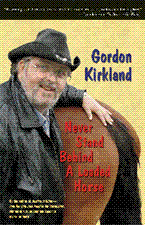
More stories from Syndicated columnist and award-winning author Gordon Kirkland.
WInner of the 2005 Stephen Leacock Award of Merit For Humour.
“Spoof is stronger than fiction” says For Better of For Worse humorist Lynn Johnston, and in Never Stand Behind A Loaded Horse, Leacock merit medallist Gordon Kirkland drives the point home with funny-bone accuracy.
Kirkland’s syndicated newspaper column is no stranger to Canadian and US audiences, and in this premium collection, Kirkland fans will find it all.
Drawing humour out of everyday situations such as trying to stay awake while on an all-night drive through the mountains, or the skewed memory of a long-lost office affair, Kirkland keeps the lines rolling and the laughs churning.
“ . . . If life is a load then laugh at it. This is Gordon Kirkland’s take on the stress of survival. His writing is an affirmation that we’re all in the same boat — it just leaks in different places Nothing is safe from his crack-the-wit columns, which is why I love to read his stuff . . . I just wouldn't want to be married to him!”
Lynn Johnston
(For Better or For Worse)
Excerpt
I Scream You Scream
It sounded like a good idea at the time. But you should always be wary of good sounding ideas that occur to you in the middle of the night, especially when you’re 250 miles from home.
My wife and I watched our son play hockey one July night. Yes, I said July. It didn’t matter. Brad played hockey twelve months of the year. As a result Diane and I developed a chemical imbalance in our brains, caused by an overexposure to sweaty hockey equipment that makes us willing to sit in an arena in Ju¬ly to watch him play.
Our original plan was to watch his game, which didn't finish until 1:30 am, thanks to a late start and an overtime period, go back to our campsite for a cou¬ple of hours sleep, and then drive home so that Diane could get to her office in the morning.
This was a good plan.
This was a workable plan.
This was a smart plan, which ex¬plains why I decided to come up with another plan.
I reasoned that if we drove into the campground at 2:00 AM and then left again at 4:00 AM, we probably wouldn’t be very popular with the other campers. I also figured that a twenty-ounce cup of coffee would have enough caf¬feine to see me through the mountains.
I may have been right on my first assumption, but it didn't take too long to prove that twenty ounces of coffee was com¬pletely insufficient. By then we were in the middle of nowhere, far away from the nearest working coffeepot.
Amazing things start to happen when you’re driving at a time that you’d really rather be sleeping. I always find that the road gets considerably better. What was once a two-lane highway appears to be a multilane freeway. Now that I wear trifocal glasses, I can see as many as twelve additional lanes. This is especially handy when driving through the mountains. With so many lanes to choose from, the odds are pretty good that at least one of them will take you where you want to go without sending you over a cliff.
For some strange reason, Diane was concerned that I might fall asleep at the wheel. This, of course, was just needless worrying on her part. Every time she felt me jerk the car back into the right lane, or heard the tires crossing the lane markers, she’d jump and ask me if I was awake. How could I possibly sleep with her doing that every couple of minutes?
When I really started to feel drowsy, I knew it was time to bring out my old tried-and-true method of staying awake at the wheel. I’ve used this technique for years and it has never failed to produce startling results. It doesn’t involve ingesting any artificial stimulants, and you can repeat it as often as necessary with¬out having to refer to your physician. You might want to try it the next time you find yourself nodding off at 70 miles per hour.
The first step is to open your car window and take in several deep breaths of fresh, cool night air. This, of course, as¬sumes that you are driving somewhere where the air is fresh. It may not be wise to try filling your lungs with the air in some metropolitan areas, near slaughterhouses, or if you are following a truck¬load of cattle.
The second stage of the process is the most important, and you must be care¬fully prepared for it, both mentally and physically. With your lungs filled to their maximum capacity with fresh, oxygen=rich air, look straight ahead at the road, open your mouth wide, and scream.
Loudly.
Scream at the top of your lungs for as long as you can with¬out doing irreparable harm to your vo¬cal cords, ears, and/or windshield. The resulting adrenaline rush is incredibly stimulating. You are immediately wide awake and able to focus on the road with renewed concentration. If you do a real¬ly good job, every dog within a five-mile radius will also be wide awake.
Of course, it's best if you are alone in your car when you do this.
If you are not alone, you should prob¬ably warn your companion about what you are about to do. This is especially true if they are al¬ready asleep. Having the person in the passenger seat suddenly regain consciousness while you’re screaming like a banshee can be dangerous for all concerned. The person is likely to sit bolt upright, flail her arms about wildly, and start speaking in tongues.
Thirteen Sick Tasteless Classics, Part II is adult literature featuring adult language and situations that satirizes thirteen famous novellas and short stories. It is Jay Dubya's sixteenth ebook.