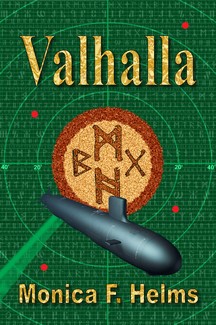
A modern nuclear submarine gets caught in an oceanic wormhole and ends up in the ocean of another planet.
The US Navy sends the USS Kansas, a modern nuclear submarine, to help the Russians investigate missing submarine hulls and reactor cores at their dumping site in the Arctic. While there, the ship gets caught in an oceanic wormhole and ends up in the ocean of another planet. These wormholes have been opening up for centuries on a regular basis, scattering ships, airplanes and other items on the shores of this planet. Vikings survived a journey through the wormhole and mated with the indigenous people at the time. They thought they had gone to Valhalla, hence, the name of the planet. In 1962, three Russian submarines also got caught in a wormhole and survived the trip to Valhalla. Some of them enslaved the natives on one side of the huge ocean and formed a country called New Motherland. They have built up a strong navy and plan of going back to Earth to take over. The crew of the Kansas has to fight the New Motherlanders to keep them from going back to Earth to release their nuclear weapons on our world. They have help from the rebels called the Black Glove and a Chinese sub who also came through a wormhole.
Excerpt
After restocking in Murmansk, the Kansas again headed for the open sea, bound for the island Ostrov Kolgujev. This frozen parcel of Russian real estate lay about four hundred miles east of Murmansk. Admiral Sormova gave Greer three days to gather as much information as he could, without interference from any Russian ship or submarine. Captain Greer ordered the ship to full speed, covering the distance in about fifteen hours. Storm clouds began to form. In spite of the unusual mission, the crew spent its time doing the routine jobs they normally did at sea.
After arriving at the dump site north of Ostrov Kolgujev Island Pillsman began her regular watch on a Sonar Station, next to three others. Ten minutes into the watch she noticed the ocean floor suddenly dropped below the scale of the instruments. The other Sonar Techs saw it on their arrays as well.
“That’s odd.” Pillsman made adjustments, but no matter what she did, she was imab;e tp find the bottom. “Chief, would you look at this?”
Chief Hart stared at her screen and the screens of the other, then turned the same knobs, with identical results. “This can’t be right. The ocean bottom in this area is less than three thousand feet. The charts don’t show any depression.” He turned to LT Rucker, who stood watch as the OOD. She stepped over to the Sonar Station. “What are you seeing?”
“We found a depression of unknown depth that. It’s not on the charts.”
“Keep trying to locate the bottom.”
Chief Hart turned to Pillsman. “This very odd. The Russian sonar techs I talked with mentioned nothing about finding a depression. This has to be new.”
“Couldn’t this be a fresh water pocket?” asked Pillsman.
“A different salinity would cause the signals to bounce back quicker, making the bottom seem closer. You should know that by now.”
“You’re right.”
The ship shook a little. Chief noticed from the instruments that the ship had begun to descent into the depression. “No one told us we were going down.”
LT Rucker also couldn’t understand the sudden sinking. “Pilot, three degrees up-bubble. Co-Pilot, keep the trim. All Ahead Two-Thirds. Maintain depth at two hundred feet.”
The Pilot repeated the orders, then turned to the Co-Pilot, “Help me maintain depth.”
“I’m trying, but she won’t come up!”
The vibrations were growing stronger. Captain Greer and LCDR Bossi entered Control to see what was causing the ship to shake. The Captain decided to take over.
“Captain has the Con,” announced Rucker.
“Ahead full!” ordered Captain Greer. “Five degrees up bubble!”
“We’re still dropping, sir!” the Pilot exclaimed.
Captain Greer stood in front of the periscope screen. “Sonar, what’s the thickness of the ice above us?”
“One foot or less,” Chief Hart reported.
“Prepare to break through ice! Emergency blow! Blow all ballast!”
The Pilot jumped up and pulled the two levers that controlled emergency high pressure air to the ballast. The air rapidly replaced the water in the ballast tanks, shaking the Kansas even more. For a few seconds the ship seemed suspended at four hundred twenty-five feet, caught between two opposing forces, but even after the high-pressure air had replaced the heavier water, the ship continued to sink.
Perplexed by their situation, the Captain and LCDR Bossi looked at each other. Captain Greer picked up the 1MC mic. “Rig ship for test depth!”
The men throughout the Kansas, confused by the conflicting orders, went ahead and carried out the last one given. As the depth gauge moved past eleven hundred feet, the crew shut and “dogged” all watertight hatches. They secured certain systems, while watching others more carefully.
“What’s our depth?” asked the Captain.
“One, three, five, zero feet, sir,” the Pilot responded. His voice cracked. Even his fifteen years of experience could not hide his fear. The massive vibrations didn’t help.
Chief Hart looked at the screen. “Captain, we have indication the ship is spinning in a clockwise direction. I think we can cut down on the vibration if we answer ‘all stop’.”
“I’m willing to try anything. Pilot, all stop!”
“All stop, aye!” He paused, waiting for Engineering to respond.
Back aft, in Maneuvering—the control center for the Engineering spaces—the Engineering Officer of the Watch had his hands full trying to keep the systems online. In all the chaos, the Engine Room Supervisor stepped in front of the Maneuvering Room doorway. “Sir, the seawater pumps are cavitating! If we don’t slow down, wet steam will destroy the turbine blades!”
At that instant, a signal came from Control, asking for “all stop.”
“That should help,” remarked the ERS. He rushed back to the Main Engine Turbines.
Smithers—now qualified RO—stood her first watch on the Reactor Plant Control Panel. Frightened by all the shaking and chaos around him, the Throttleman secured steam to the Main Engine turbines at a rapid rate in order to answer the “all stop” bell. Smithers couldn’t compensate for the quick change in power-demand fast enough. The safety circuits activated, dropping the control rods and initiating a reactor scram.
The officer in Maneuvering grabbed the Engineering intercom. “Reactor scram! Reactor scram! Secure Main Steam valves!”
Control heard the announcement as well. “This can’t be happening to me,” whispered the Captain.
“Depth, two thousand feet.”
The ship shook so violently crewmembers were unable to stand. Loose items turned into projectiles, crashing into people and causing serious injuries. Equipment rattled and young men cried. The fear of dying gripped their hearts.
At twenty-five-hundred feet, every light and every piece of equipment lost power. Even the emergency lights and flashlights failed. Total and pure darkness filled the ship. The wails of frightened sailors drowned out the sounds of flexing metal as the pressure of the sea relentlessly compressed the hull. Then, nothing.
“The year is 2011 and Samuel Elmsmore is adrift in the universe. After a series of breakdowns he awakens as a virtual prisoner in a hostel for the mentally ill. He’s estranged from his family and friends, and is jobless after an unfortunate incident