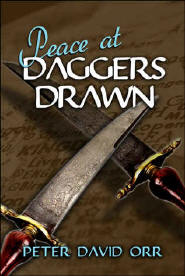
Category: History Publisher: Publish America
ISBN-10: 1413748295
Type: Non-Fiction
Pages: 182
Copyright: May, 2005
ISBN-13: 9781413748291
This work is details the diplomatic initiatives (both official and unofficial, public and secret) that were intended to end or stop the spread of the Second World War in Europe. Special attention is given to specific peace proposals, initiatives, and back-channel diplomatic maneuverings, all within the general context of the intra-war foreign policies of all concerned parties. Diplomatic efforts designed to bring about an end to hostilities by belligerent and non-belligerent nations are included. Geographically, this work is confined to the European theater of operations. The chronological focus of this volume shall be on the earliest stages of the conflict, specifically from September 1, 1939 to September 17, 1940.
On October 4, 1939, Davis cabled President Roosevelt from Berlin with the following message:
“YOUR VIEWS ACCEPTED HERE IN THEIR ENTIRETY, CONGRATULATIONS.”
The next day Davis met with Hitler and Alfred Rosenberg. At this meeting, the same points were agreed upon as in Davis’ prior meetings with Göring.
According to Davis, the Ciano-Ribbentrop meeting in Berlin had taken a similar course, with the Italians agreeing to “take no steps which would prejudice an amicable settlement of the present conflict at a peace conference, should such a conference take place.”
On Monday, October 9, Davis arrived in New York and proceeded directly to Washington, DC, expecting to see the President with all the details and good news. He was denied a meeting with the President, but was received by US Secretary of State, Adolf Berle and Jay Pierrepont Moffat. However, a lengthy letter survives that was written by Davis to Roosevelt. This letter, dated October 12, 1939, summarizes much of what he discovered during his mission. Of considerable interest are Davis’ words on the possible creation of a residual Polish state. Under the topic of “Poland” are three snippets that stand out:
1. “It is the consensus of those with whom I conferred that Germany would now be not only willing but anxious to bring about an equitable settlement with England and France, whereby a new state [of Poland] would be established. Germany desires to retain Danzig, the Corridor and Upper Silesia.
2. “It is the general opinion of all with whom I spoke that Ribbentrop has made a tremendous mistake in the arrangement concluded with Russia.”
3. Extended Russian penetration beyond the agreed-upon frontiers [in Poland] had complicated the prospects of a rump Polish state.
To fully understand the significance of the last two of these three points, it should be remembered that Stalin was doing all that he could to avoid the creation of a new Polish state. This situation was in the process of changing while Davis was in Berlin. He did not know what else was going on behind the scenes diplomatically between German and the Soviet Union.
Excerpt
The publicly stated reason for the Welles mission was to find out what the views of the “four governments” were and to ascertain whether there were any “possibilities of concluding any just and permanent peace.” Roosevelt felt that no solution of this sort was likely and was aware that “Mr. Chamberlain himself had long ago decided that there was no hope for British security.” Still, something about the idea of using Italy as a diplomatic lever seemed to have the faint hint of possibilities. The Italian question, without a doubt was at the center of Welles mission. Welles quotes the President as saying:
“Only in Italy was it remotely conceivable that the policy of this government might have some concrete effect. If by some means the United States could prevent Italy from actually taking part in the war against France and Great Britain, if Hitler could not obtain the active participation of his southern partner in the attack on France, the outcome of the war might be less certain than it then seemed.”
Professional Reviews
Peace with Hitler?
Peace at Daggers Drawn is the most unusual history of World War II that I've ever encountered. It's not really about the war. Rather, it's about the official and unofficial diplomatic efforts to end or localize the conflict; a conflict that became a world war.
There's quite a bit in this book that was completely unfamiliar to me. The second world war is so often portrayed as an event that was somehow beyond mere mortals to stop. However, after reading this book, I can no longer agree with the idea that WWII was inevitable or that it was beyond the power of statesmen to stop the "machine" they had set in motion. Orr's book is refreshingly non-fatalistic and emphasizes personal responsibility. It turns out that there is a lot of blame to go around. Many statesmen and diplomats hold their share of the responsibility for allowing a localized war to become the most horrific war in the history of the world.
I think the book gives a clearer vision of the issues that started and spread the conflict because the author looks at things from a different angle. He doesn't ask "what factors started the war?" Instead, the reader finds out what caused and spread the war by exploring the reasons given by statesmen and diplomats from all over the world who refused to find a solution, or were simply boggled by the complexity of the incompatible and competing "visions of the future."
Neil Armstrong played the Dissolution of America Card After His Return From Space-- the Military Dishonor Card. He had a very messy DIVORCE after a military Platoon Experience for his wife and family.
The heroic story of how a small group of people, few of them TB experts, found the cure for the greatest killer in human history. But the battle needed to be extended to all sufferers. Why have we failed to take the miracle to the developing world?