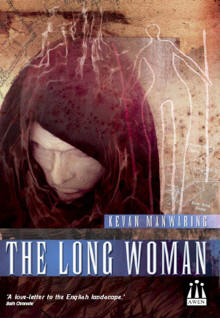
The Long Woman is a love letter to the English landscape, to the Lost Generation of the Long Weekend of the Twenties.
January 1st 1923 Glastonbury
The frost-covered hill rose to the gunmetal sky. Between the spikes of frozen grass the gritted footpath snaked upwards to the tower. Maud’s ankle boots crunched on the salt crystals. She gulped down the icy air, letting it burn away the worries in her breast.
The face of the man in Paddington had haunted her all night. She had been in no mood for joining in the town’s New Year celebrations, but fortunately the guest-house she always stayed in was a peaceful place. Mrs Middlewich respected her desire for privacy – the lilac-draped spinster had seen the state Maud had been in when she’d arrived from London and simply brought some hot sweet tea to her room as she unpacked. The landlady was used to seeing her guest forlorn, for she knew the nature of her visit, but she was surprised at Maud’s distressed demeanour this time. Yet she let the magic of the place do its work, and by the morning Maud had regained her composure and appetite, if not her social skills.
After a quiet breakfast, she wrapped up and set off, filled with the energy of that special day – the importance of the New Year to her overshadowed by the significance of one nearly a quarter of a century ago – the day of their engagement.
Isambard had kept his plans secret, persuading Maud to accompany him to Glastonbury ‘to celebrate the new century’. She knew he looked forward to visiting the Tor, Chalice Well, Wearyall Hill, and the ruins of the Abbey – he’d be making notes and measurements all the time for his damnable journal, she thought – the one he never let her read. Yet he had an ulterior motive that surprised and delighted her once romantic nature. She had always been a fan of Tennyson and the Pre-Raphaelites and so the Arthurian associations of the town thrilled her. She loved seeing the grave of Arthur and Guinevere – the lock of golden hair said to have been found amongst the bones set her imagination alight. Isambard had been sceptical for once, saying it had been a hoax to draw in medieval pilgrims – but she would not let him shatter her daydream. And even he had to admit the place had an unmistakable enchantment.
Seeing the famous Glastonbury Thorn in flower made the mystery seem immanent. The gnarled tree bloomed with white blossom in the middle of winter – a living symbol of rebirth in a barren landscape. Isambard said it was believed to have been grown from the thorn tree that sprouted from the staff of Joseph of Arimathea, plunged into the spot where he first set foot on soil after his long journey from the Holy Land. Her husband was more interested in the idea that this was an early example of geomancy – that Joseph was ‘fixing the spot’, the earth energy of the place, with his rod.
Her Sammy had loved his sticks. Maud had borrowed one from the guest-house, to steady her as she ascended the Tor. The ground was treacherous underfoot in places, and the exertion of the climb made her concentrate upon every step – like a devout pilgrim, with head bowed.
Yet the divine spark had gone out. She was left with the burden of existence, with a mundane world devoid of divinity. When her husband had been taken from her God, had died in her heart, and all hope of an afterlife. She carried the whole weight of her mortality up the slippery steps. This cursed body, she thought. I’ll be glad when its journey is over.
The bitter morning air found every gap in her clothing, despite thick stockings, gloves, and fur-trimmed coat buttoned up to the neck, with a russet scarf looped around and over her felt hat to stop it being whipped off by the strong gusts that spiralled around the Tor.
The ascent began to warm her bones a little as she applied herself to climbing the curiously shaped hill, which stood out like a ship on the green sea of the Somerset Levels.
Excerpt
‘There is much here to tug at the heart. In fact I shed a tear or two.’
Moyra Caldecott, author of 'Guardians of the Tall Stones'
Two brothers compete for the same woman, but only one is alive. Maud Kerne is faced with the ultimate choice. Yet she herself is the key that will unlock the greatest of mysteries: is there life after death? And is there love?
An antiquarian's widow discovers her husband's lost journals and sets out on a journey of remembrance across 1920s England and France, retracing his steps in search of healing and independence. Along alignments of place and memory, she meets mystic Dion Fortune, leyline-finder Alfred Watkins and a Sir Arthur Conan Doyle obsessed with the Cottingley Fairies. From Glastonbury to Carnac, she visits the ancient sites that obsessed her husband and, tested by both earthly and unearthly forces, she discovers a power within herself.
The Long Woman is an exploration of the sacred landscapes of the past and the secret landscapes of the soul.
Dare you walk between the worlds?
Professional Reviews
The Druid Network
The Long Woman is a tender yet intimate journey of personal discovery, which the writer walks with his heroine, and any reader who would travel with them. Guided by the spirits of the land and the gods of nature, it takes us on the first steps towards understanding the ancient wisdom of sacred relationship with the land. Guided too by the spirits of the dead, it teaches of human courage and frailty. A beautiful book, filled with the quiet of dawn, and the first cool breaths of new life, it reveals how the poignance of real humanity is ever sprinkled with magic.
Emma Restall Orr
Author of ‘Druid Priestess’ and ‘Living Druidry’
Waterstones Recommends
A compulsively readable, & beautifully written tale of love and loss. The interweaving of past and present, the earthly and the supernatural creates a poetic and haunting novel - one that is as uplifting as it is heartbreaking. Maud's determination and endurance is a great testiment to the possibilities of the spirit. Her search for something permanent in a transient world is a journey we can all relate to. A great achievement...a beautiful book.
Northern Earth
The theme is poignant and the stitching-together of esoteric threads from the time is skilfully done. I thought there were rather too many eminent figures, though, and that sometimes the author was apt to list his heroine’s feelings rather than letting us infer them. All the same, this is a tender romance that will have knowledgeable earth mysteries enthusiasts nodding with recognition, both for its well-researched background and the sensitivities to place it evokes.
Mark Valentine, review (Northern Earth)
A way to use your mind for silent communication. Speaking about the methods in the book I have used since a young age.
21st Century learning. I also have a GoFundMe page to ask for funds so I can research with other people and add their experiences
The second book in the telepathy series. It contains more ways for the up and coming telepathist to experiment with the sending and receiving of thoughts and is at the end of the story about future telepathy people found unexpectedly chosen by the go