|
RJ Stewart Books
Category:
Arts/Entertainment
Publisher: RJ Stewart
Type: Non-Fiction
Pages: 237
Copyright: Nov 1 2008
ISBN-13: 9780981924618
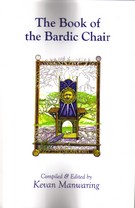
The Bardic Chair is awarded as a prize in competitions of artistic merit, held in a festival of the arts known as an eisteddfod. Born of the Celtic Tradition, initially in Wales, Bardic Chairs are a growing phenomenon – transcending cultural barriers –
not just around the British Isles, but around the world. This book explains the background of Bardic Chairs, lists all the current ones on record, and explains how to set one up. If you ever wondered what a bard is and why they are as relevant as ever this book will enlighten and inspire.
Featuring the Bardic Chairs of…
Wales*Cornwall*Brittany*Isle of Man*Channel Islands*England
Australia*North America*Canada*Argentina
From the global to the local, it focuses on the Bardic Chair of Caer Badon (Bath, Somerset) as an example of the most successfully revived English Chair to date.
The Bardic Chair is awarded as a prize in competitions of artistic merit, held in a festival of the arts known as an eisteddfod. Born of the Celtic Tradition, initially in Wales, Bardic Chairs are a growing phenomenon – transcending cultural barriers – not just around the British Isles, but around the world. This book explains the background of Bardic Chairs, lists all the current ones on record, and explains how to set one up. If you ever wondered what a bard is and why they are as relevant as ever this book will enlighten and inspire.
Featuring the Bardic Chairs of…
*Wales*Cornwall*Brittany*Isle of Man*Channel Islands
*England*Australia*North America*Canada*Argentina
From the global to the local, the 2008 edition focuses on the Bardic Chair of CaerBadon (Bath, Somerset) as an example of the most successfully revived English Chair to date – featuring the 12th Bard.
· Profile of each of the Chaired Bards, Ovates and Druids.
· Winning Poems
· List of Modern Bardic Chairs in Britain and beyond.
· The Modern Bardic Chair Movement
· How to set up and run a Bardic Chair
· How to run a Bardic Circle
· Contacts and Resources
· Essays on Bath, the City of Sulis
· Young Bard competitions
Contributions by Ronald Hutton, Caitlín Matthews, RJ Stewart, Moyra Caldecott, Graham Harvey, Tim Sebastion Woodman, Philip Shallcrass (Greywolf) & many more
Excerpt
The Bardic Chair movement, revived in Wales in the Nineteenth Century, has gained momentum and has moved beyond nationalism to become international in the latter part of the Twentieth Century. Beyond the huge achievement and influence of the National Eisteddfod of Wales, in England this is largely due to the efforts of modern druids – chiefly the Council of British Druid Orders, who in 1992 (the bicentenary year of Iolo Morgannwg’s creation of the Bards of the Isles of Britain on Primrose Hill) sent a petition to the Queen, calling for an English National Eisteddfod at Stonehenge. This has yet failed to manifest, but the fact that Bardic Chairs have been successfully revived in Avebury, Bath, Glastonbury, Exeter, and Winchester; and that new ones are springing up with increasing frequency (Small World, Northampton, Flag Fen and abroad) is in no small measure due to the efforts and inspiration of one man: Tim Sebastion Woodman. The story of the modern Bardic Chairs of England is very much entwined with Tim, a Twentieth Century Iolo if ever there was one – with all that implies. I pick up the tale where I stumbled upon it.
The Bardic Chair of Caer Badon officially began the very first day I arrived in my adopted city of Bath: 21st June 1996. Tim Sebastion Woodman, Arch-druid of Wiltshire, stood on Solsbury Hill at midday and declared the Bardic Chair, witnessed by King Arthur Pendragon and others [see press clipping above]. I was unaware of this, but I had felt a call to Bath – sufficiently strong to make me travel all the way down from Loch Tay, where that morning I had seen the solstice sun rise from the flanks of Ben Lawers, on a hot all-day train journey to arrive at Bath Spa station about 11.45pm and get a taxi to the side of Solsbury Hill (uncertain of its location) which I stumbled up in the dark around midnight. There was meant to be a gathering there, in preparation for the Reclaim the Streets demo the next day in the centre of Bath. I had read about the famous Batheaston Bypass Protest and was expecting a merry eco-camp. Instead I could only find three guys sitting around a spluttering fire, nursing a bottle of cider: this inauspicious tableaux perhaps symbolised the very birth of the English Bardic Chair movement – probably hatched in a similar way by ‘three wise men’ in a pub somewhere in the deepest West Country, drunk on ‘druid fluid’. I was meant to meet my partner there and failed, stumbling about in the darkness of the Iron Age hillfort, calling out her name. Benighted and weary, I bivvied underneath a hawthorn bush – to be awoken at dawn by curious cows. Thus it began, in a humble and slightly dishevelled way. A hill, a druid, a king and a fledgling bard. The pieces were in place for the game to commence.
|