In The Mood is a psychological murder mystery involving New Scotland Yard detective Philip Graves. The main plot is set in present day 1985. Suffering from mental exhaustion, Graves is called back from London to the family village after hearing that his father has been viciously attacked. His father, a retired police sergeant, is part of a team workng on an unusual traffic accident involving a 25 year old mummified body of a man found encased inside a bridge column. In an attempt to find the perpetrators of his father's attack and believing that there may be a connection with this case, Graves stumbles on a chain of events that would change his life forever. His own investigation unearths the dead man's chequered past and that of 3 other ex-sailors and there employment at an orphanage outside of London between 1943 and 1953.
Archive records show that all 4 died in a fire at the orphanage in 1953 so how could one of the bodies die again in 1960?
The origins of the mystery go back to 1943 when twin baby boys are orphaned when their parents are killed during the 2nd World War and placed in Harrington Orphanage.
Chapter 1
Another Time, Another Place
They said that it would only last a year at the most, those faceless
civil servants I had learned to despise. A propaganda ploy to enlist the young and vulnerable I thought? The war was portrayed as a big adventure for those who had never strayed beyond England’s coastline. A ‘jolly’ I remember someone saying at the time, paid for by Winston Churchill. A quick visit to France, miss out winter in England, which wasn’t a bad thing for most people given the employment crisis and poverty, and back home before anyone knew that they had been away. When a year came and went, quickly followed by another, the mood of the great British people changed to a more sombre one. Realisation about the war wasn’t far away and any notion of it being a great adventure quickly disappeared. The grieving for some had started within months of the declaration of war as once young smiling faces returned home in body bags, the lucky ones, as far as their families were concerned, still intact bodily.
For others it was arguably much worse. ’Missing-in-action’ had become a well-used phrase in those early months and would continue to be so for at least another three or four years. Neither lost or found, relatives were left in a state of limbo not knowing whether to grieve or keep their spirits up in the hope that their loved ones would return home some day. How many families were suffering or had suffered to date, I could only guess. Couples like John and I, married only a year. There was always a mixed opinion on the wisdom behind marriage during wartime. For us it was a conscious decision we decided on as the war took hold. We simply couldn’t wait until it was all over. After all, when would that be? Nobody knew, not even Mr Churchill. We had to marry right away. There was no in-depth discussion about the perceived urgency; it was something we both understood and agreed on. Certainly, there wasn’t an indication of what the war may have had in store for either of us. That would have meant acknowledging horrors that had been placed at the back and deepest parts of our minds. It was enough to accept, without the spoken word, that our time together could be short and that we should be happy, if it was only for a moment.
All these thoughts raced around inside my head as I walked arm-in-arm with John along the cobbled platform. It was a cold bitter night for May, but for the last five minutes, I’d become quite oblivious to the biting effects of the northerly wind as it raced out of the tunnel entrance, just beyond the end of the railway platform. Far away in the distance, sirens announced the arrival of enemy aircraft, their monotone drone a familiar sound 4 years into the war.
“A penny for your thoughts darling?” John asked, squeezing my arm gently as he did. His breath bellowed out into the cold night air. With my petite 5’3” frame beside John’s 6’ 2”, heavy set build, I had to crane my head back to see him clearly. We had been childhood sweethearts living in the same country village until John’s father was forced to relocate further north, having been promoted by his employer. We were both just 11 years old when John and his family left the village and I cried none stop for a month.
My mum tried her best to console me bless her, but nothing worked. Then, 6 months later I received a letter. It was from John. Over the years we wrote regularly and even met a couple of times as our respective families found excuses to get together or mysteriously bump into each other on day trips to the seaside. One year when I was 15, I had planned – no orchestrated – a cunning ruse to stay at a friend’s house for a week during the school summer holidays. She lived a short distance from the Laine’s family home. The only problem was my friend caught chicken pocks the week before my visit and all arrangements had to be cancelled. Once again, I bawled my eyes out for a full week. Little did I know that alternative plans were already in place? I stayed at Calverly Sands a few weeks later visiting my grandparents and guess who was also staying there that week on business, John Laine senior, along with his family. I sometimes wonder whether the whole business was contrived for our benefit? Perhaps John was as inconsolable as I was when we were apart? The thought made me feel warm inside.
“Betty darling,” he persisted, patting my hand, “you’re cold.”
We stopped and he pulled his arm clear from between us, unbuttoning his RAF overcoat as he did. Bringing his arm and open jacket around at the same time, he wrapped both around my shoulders so that we were as close bodily as we could be. For a brief instant I felt safe. Safer than I had been since the war began with all the physical and mental torture that it had brought. But how could I ever be safe again? John was returning to duty after an all-too brief spell of leave. Strangely, he had been unwell during his stay at home taking to his bed for a day at one point. Oh how I prayed that it would be something that would keep him with me longer. That was the selfish side of me. Seldom seen, but very much at the fore about 2 days ago. Why shouldn’t I want my husband by my side as we had always planned when we took our marriage vows? Then I would see the propaganda messages about the war effort, radio bulletins from the BBC, individual acts of heroism, food rationing and it wasn’t long before those selfish thoughts were cast aside. I hated that maniac, Hitler. I hated him with a passion, like thousands of other women, wives and mothers, frustrated by the futility of war and sheer loss of life.
The teardrop was involuntary, yet hardly unexpected. From his limited line of sight, John couldn’t see the tiny droplet and of course I knew that he must not. He needed all his resolve now. I blinked in a vain attempt to stem the flow.
“Oh Betty darling,” John stopped squaring up to me so that we were facing each other; my head was still bowed to try and hide my blurred vision.
“Gosh,” I managed finally, staring up at him apprehensively. “The wind coming out of that tunnel is freezing. It brings tears to your eyes.”
The fact that my lips were trembling and my voice was warbling did nothing to support my attempt to hide my true feelings. My Clark Gable look alike, more so since the real Gable had himself recently become an air force pilot, pushed back the peek of his hat so that it perched on the crown of his thick black wavy hair. Even in the subdued light afforded by platform gaslights the twinkle in his eyes remained, that same twinkle that had melted my heart from an early age. His chiselled jaw slowly turned into a wide grin. He placed both his hands beneath my arms and gently, effortlessly, he picked me up until he could look directly into my eyes and I could look into his. The boy I had fallen in love with was still there underneath this raw masculinity, although (see the complete chapters 1 and 2 attached)
Excerpt
“How often have I said to you that when
you have eliminated the impossible,
whatever remains, however improbable,
must be the truth?”
Sherlock Holmes addressing Dr.Watson in the ‘Sign of (the) Four’.
Professional Reviews
In The Mood by Paul Hupton, Reviewer JJ Ladd, Copy Editor
A most enjoyable read, a good unpredictable plot and twist at the end.
I enjoyed the original and honest prose, most unassuming and accessible.
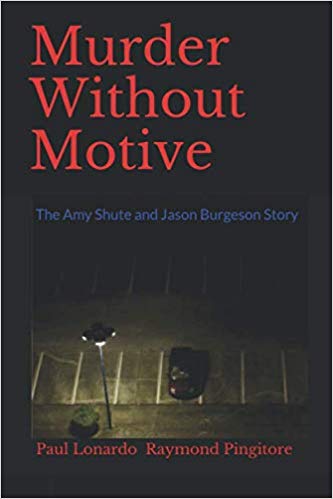
In June, 2000, two college students — Amy Shute and Jason Burgeson — were approached by a group of men. Forced into the backseat and driven to a remote location, they were murdered in cold blood.
Following this brutal double homicide, Johnston, RI D
An eye-opening look into the world of human trafficking. Pilar thought she was destined to die until she met Becky. A fairy tale ending to this story with the help of Tess is called Justice. It was time for someone to hit back because the courts in S