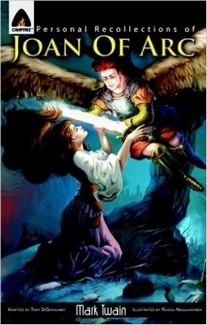
Personal Recollections of Joan of Arc
Mark Twain
Adapted by Tony DiGerolando
c. 2010
ISBN: 978-93-80028-43-9
Campfire Graphic Novels
Kalyani Navyug Media Pvt. Ltd
New Deli, India
68 pages, $9.98
I came across this interesting adaptation of Mark Twain’s Personal Recollections of Joan of Arc surfing The Internet. It is an illustrated and abbreviated, adaptation of Twain’s book, printed in India and meant for young readers. The art is outstanding. The story line follows Mark Twain’s original work far better than the DVD movies available today. It’s only sixty-eight pages, so it is a fast read.
Unlike the popular movies about Joan of Arc, this book mentions almost all of Joan’s military battles, especially the important battles of The Augustine Bastilles of Orleans, Meung, and Patay. A problem with the movies is that the movies condense her many military campaigns into basically two or three battles combining elements of all the battles. Another flaw is that three of the four movies available from Amazon seriously distort Joan’s personal life and show her disrespectful, even arrogant, toward people to whom the real Joan would have felt obliged to show respect. The only movie that showed Joan’s character pretty much as the historical record shows it is Victor Fleming’s Joan of Arc. To its credit, this Campfire Classic book does not exhibit either one of these two departures from Twain’s story.
The only flaw I saw in this book is the way the adaptor handled Twain’s description of the fairies. Twain, I would think, brought up the subject of fairies because his research made him realize that fairies were a major issue in Joan’s trial for witchcraft and heresy. Joan’s enemies wanted her condemned and put to death for these charges. In the trial that led to her execution, her enemies tried to prove that her childhood association with other children, when they played and sang by the fairy tree and hung blossoms on it, showed that Joan attributed powers to the fairies that only God possesses. Twain, I think, tried to show her innocence as a child, but he was very clear in adhering to the court records where Joan said she knew that attributing supernatural powers to the fairies would have offended God. So try as they may, and they tried several times during the trial, her enemies could not prove witchcraft against Joan because of the fairies. The Campfire Graphic adaptation, however, did add some speculation to the fairies, enough speculation to have seriously compromised her trial if the speculations were true. I noticed surfing The Internet that some people object to Twain’s book because of alleged emphasis on fairies. I can see that adaptations of Twain’s work, if they are not done accurately, could serve to amplify this misconception.
Other than that, the story line in this Campfire Classic follows very closely Twain’s original book, and his book, as it turns out, follows very closely the career and court records of Joan’s life, especially records of the much more thorough and unprejudiced rehabilitation trial that was held some twenty years after Joan’s death.
This short illustrated book can serve to introduce readers, especially young readers, to the career of this important Christian soldier and, perhaps, inspire the reader to try to understand why this child was given such an important mission and why, after she accomplished her mission, she was allowed to endure such a cruel death at the hands of her enemies. Mark Twain did introduce some fictional characters and situations into his book, but he remained remarkably true to the facts concerning Joan. This handsome book, containing stunning illustrations makes a good read and could serve as a good starting point to stimulate interest into the life and extraordinary military career of Joan of Arc, heroine of France.