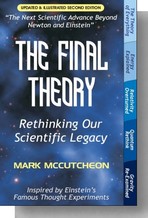
The Final Theory
Rethinking Our Scientific Legacy
Mark McCutcheon
c. 2004
ISBN: 1-58112-601-8
Universal Publishers
Boca Raton
417 pages, $26.96
Mark McCutcheon points out inconsistencies in the standard theories of cosmology, gravity, orbits, magnetism, etc. He argues that scientists still do not fully understand our universe and its workings, especially energy and forces. He describes the four fundamental laws of nature proposed by the Standard Theory: gravity, electromagnetism, strong nuclear force, and weak nuclear force. He argues that Newton’s Gravitational Force is not compatible with the Law of Conservation of energy. Gravity holds planets in orbit for billions of years with no consumption of energy. Magnets cling to elevated surfaces against the pull of gravity also with no consumption of energy even though work was required to lift the magnet against the force of gravity in the first place. Newton’s gravity travels faster than the speed of light and instantaneously reaches to uttermost distances in the universe. McCutcheon made chapter one of “The Final Theory” available as a free download. I read it with interest. His criticism of the standard cosmological theories piqued my curiosity.
McCutcheon claims that Newton’s explanation of how gravity holds planets in orbit was preceded by The Geometric Orbit Calculation, which provides for calculating the distance of orbiting objects if their speed was known.” After accepting Newton’s description of gravity as a force, mass was arbitrarily introduced into the equation so that the mass of any orbiting object could be calculated. McCutcheon argues that the calculation is arbitrary and is not an accurate way to calculate mass. He thinks that this is one of the misconceptions generated from Newton’s law of gravity. He writes: “Though not recognized today, Newton’s gravitational force is a completely superfluous and redundant abstraction, both in theory and in practice.” I surfed The Internet and saw that “The Final Theory” has come under much criticism. Still interested, I got the book so I could read his arguments myself.
McCutcheon asks the reader to imagine the real world as being two-dimensional, and within that two-dimensional world, contemplate how a three-dimensional world might be visualized by people experiencing only two dimensions. We could not comprehend three-dimensional objects, but they would manifest themselves into our two-dimensional world. If all objects were conical, and we only see flat sections, then the flat sections we see would continuously grow bigger as the three-dimensional cones intersects into our two-dimensional world. It is equally difficult for us to imagine that objects we are familiar with in our three-dimensional world might somehow be our perceptions of objects from a four-dimensional world that project themselves into our three-dimensional view of reality.
McCutcheon’s proposes that the universe is four dimensional, the fourth dimension being outside normal experience, mysteriously beyond our normal three-dimensional comprehension. He argues that this fourth dimension is right here within our regular three-dimensional world. It exists even down to every atom. Atoms occupy the fourth dimension, which is completely foreign to us, with physics unlike anything in our atomic models today. It is the nature of this fourth dimension to continuously expand outward into our dimension, literally creating what we call atoms – but atoms that are continually expanding from this fourth dimension into our three-dimensional perception.
The space inside an atom is also different than the space outside an atom, almost like another unknown dimension. The rates of expansions in these two new dimensions are different, being much faster within the subatomic space within the atom. The internal expansion within the atom does not occur in space-as-we-know-it, and, therefore, does not consume space; instead, it merely supports the overall structure of the atom, which then defines space-as-we-know-it outside the atom. He claims that there is a big difference between the enormous subatomic expansion rate within the atom and the comparatively tiny expansion rate outside the atom. McCutcheon’s feels his new Expansion Theory, when used as a single overall theory can explain everything that previously required three theories (a mix of Newton’s gravity, relativity, and Quantum Mechanics) to explain.
My take on McCutcheon’s proposing a fourth dimension outside the atom and a fifth, much different, dimension within the atom is very hard to comprehend. I hope he has worked out his Expansion Theory mathematically and that the mathematics supports his position. What diminishes my acceptance of his arguments is that his new dimensions are not based on empirical observation – nobody has discovered them, measured them or described them. No experiment, I suppose, can prove that they exist. They seem to be purely intellectual theories that could possibly serve to give a single explanation to solve inconsistencies in the standard theories. Since the standard theories are backed up by mathematics, it would be interesting to see McCutcheon’s mathematical equations supporting his theory.
What I got out of McCutcheon’s arguments is “why does there have to be a Grand Unified Theory?” Maybe the human mind is incapable of fully understanding the inner workings of the universe. Some scientists like to argue that there is no God (McCutcheon doesn’t); but if God really exists and really created the universe, then, most likely, the human mind is incapable of fully understanding both God and how and why God created the universe. So I got something positive from McCutcheon’s book. You will find this book thought-provoking though not convincing.