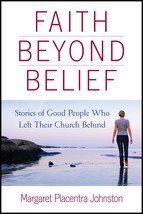
Despite its title, Faith Beyond Belief: Stories of Good People Who Left Their Church Behind is not really a book against religion. It is an invitation to consider a broader perspective.
Are you tired yet of the warring between religious believers and non-believers? (Have you noticed how some, especially in our political arena, fan the fires of this battle?)
Did the “New Atheist” writers, Sam Harris, Richard Dawkins and Christopher Hitchens, speak clearly to your rational mind, yet leave your heart still yearning for some greater spiritual reality?
Does the challenge of a more sophisticated understanding than either the religious believers or the nonbelievers typically put forth excite you?
Faith Beyond Belief: Stories of Good People Who Left Their Church Behind challenges readers to consider a broader perspective than the typical believer versus nonbeliever divide. It offers an overarching explanation for that controversy itself, and points a way forward--toward peace and understanding.
Excerpt
Taken together with the surrounding discussion, the stories offer an overarching explanation for the atheist/believer controversy itself. This explanation disallows dividing people up into good versus bad, right versus wrong, or even right versus left. It shows how any such black-and-white distinctions deny the complexity of which human reason and spirituality are capable and are necessarily inadequate when applied to humanity itself...
Professional Reviews
Publisher's Weekly
In this thought-provoking first book, former optometrist Johnston, who has studied spiritual development, allies herself with the “beyond religion” movement, in which nonbelievers or those who are “post–organized religion” advance toward spiritual maturity through emotional intelligence, psychology, ethics, and critical thinking outside of traditional religious structures and belief systems. Interweaving personal stories from Catholics, a Mormon, a Muslim, Protestants, and others with accumulated core insights from human development experts, including Abraham Maslow, Lawrence Kohlberg, Gordon Allport, and James Fowler, Johnston identifies five stages of “deconversion” and spiritual growth: Lawless, Faithful, Rational, Rational Plus, and Mystic. Understanding this natural movement, indicates Johnston, may shift the expanding “spiritual, but not religious” demographic toward more satisfying spiritual depths. Describing many religious institutions as “exclusionist, ethnocentric, judgmental, and triumphalist,” Johnston maps a future for religion that is “post-critical,” heterodox, mystery-centered, and teaches moral reasoning rather than doctrinal adherence. Building on what psychiatrist M. Scott Peck’s The Road Less Traveled (1978) and People of the Lie (1983) did for a segment of Protestantism in the 1980s, Johnston may provide similar direction for the postmodern meaning-starved spiritual seekers who are becoming adults in what philosopher Curtis Carter has termed a “transreligious” world. Agent: Lisa Hagan. (Oct.)
Reviewed on: 08/13/2012
Retailing Insight
What happens to the spiritual lives of people who leave the traditional Christian churches of their childhood? I’m one of those people, and so is the author of this book. She was curious enough about the question to begin researching it. Writing as neither a scholar nor a member of a religious community, she is free to notate her findings without restraint. The result is an honest look at spirituality without religious affiliation. She shares her own story as well as stories from a diverse group of individuals. There is no one answer to her question, but there are similarities in what she discovered. For ease of understanding, she has organized the answers using four broadly-defined spiritual stages: Lawless, Faithful, Rational, and Mystic. She thought long and hard about the ramifications of putting her thoughts on public display, but having left a thirty-year career as an Optometrist in order to study the topic, she ultimately decided it was time to begin the discussion.
In a world where religion is becoming increasingly divisive, and is often used as a political weapon, many of your customers are asking the same question that Johnston did. Her book will not only provide much-needed insight, it can also serve as a guidebook for empowering individual spiritual growth. It is a different kind of Good News.
Poetry. Various urgent, lively, and sometimes haunting poems appear here alongside stark black and white photos of Jones' homeless subjects. Jones takes on the plight of the homeless in different voices, echoing the thoughts of people on the streets,