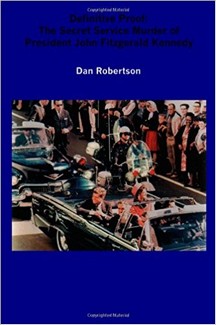
President John F. Kennedy was killed by a handgun fired at close range, not a rifle as concluded by the Warren Commission. The fatal head shot entered the president's right temple and traveled rearward into the right side of his brain. Recently digitally-enhanced photographic evidence confirms this conclusion, and fits with the medical, ballistics and eyewitness evidence, as set forth fully in the book. This book definitively solves the 40-year mystery of who killed JFK, and it was not Lee Harvey Oswald or a gunman from the grassy knoll. The true assassin was a federal agent located close to and in front of President Kennedy.
This book presents the medical and ballistics evidence -- as amassed by experts including Dr. David Mantik, Dr. Charles Wilber, Dr. Howard Donahue, Dale Myers and Tom Wilson -- and testimonial evidence and reports compiled in the Warren Commission Report to support the conclusions that: (1) the bullet fired into JFK's brain was not the same type of bullet that hit JFK in the back and neck, or that also hit Governor Connally; (2) since the Warren Commission concluded that Oswald fired bullets all of the same type, then there must have been a conspiracy since the evidence clearly indicates a different type of bullet (a frangible bullet instead of a full-metal-jacketed bullet) was used for the fatal head shot; (3) Dr. Mantik concluded, based on JFK's head wounds as depicted in his X-rays, that the head shot was fired in front of JFK, not behind him, also clearly indicating a conspiracy because of the existence of a gunman in front of JFK as well as a gunman behind him; (4) Dr. Wilber concluded that the notes of the Parkland Hospital surgeons in Dallas "suggested" that the fatal head shot was caused by a "high velocity hand gun fired at close range; (4) eyewitness Austin Miller testified that he thought that the shots came from "right there in the car," referring to JFK's limousine; (5) numerous motorcade participants reported smelling gunpowder at street level where JFK had been shot seconds afterward; (6) the only people who had hand guns who were also near JFK and in front of him at the time of the assassination were Secret Service agents William Greer and Roy Kellerman; (7) Greer lied to the Warren Commission on several occasions about his actions during the assassination; and (8) a close review of the recently digitally-enhanced Zapruder film depicts Greer aiming a dark object at JFK from frames 305-312, with JFK's right temple exploding from a gunshot wound at frame 313. Accordingly, the true assassin of President Kennedy was not Lee Harvey Oswald, but was instead Secret Service Agent William Greer, who undoubtedly had assistance from other Secret Service agents. In fact, as detailed in the book, the Secret Service failed to take 13 separate measures they ordinarily followed, leaving the president unnecessarily exposed. The U.S. Government then covered up the crime by controlling the evidence, controlling the investigation and controlling the government report, the Warren Report. As detailed in the recent book, "Brothers: The Hidden History of the Kennedy Years," neither Robert Kennedy, Richard Nixon or Lyndon Johnson accepted the conclusion of the Warren Commission that Oswald killed JFK. Why should you?
Excerpt
And so, when the other gunmen had failed to mortally wound the president, Greer slowed the big Lincoln and looked back toward the wounded president in order to take careful aim. Nellie Connally had pulled the wounded Governor Connally back toward her, giving Greer a clear shot at a target a mere few feet away. Roy Kellerman was no longer looking back at the president, but had turned away from him, and was now looking straight ahead, making no effort to go to his aid. Greer did the unthinkable ... he fired. Like the bodyguards of Caligula and the bodyguard of Alexander the Great's father, Greer killed the man he was sworn to protect. President Kennedy's limp body then flung itself violently against the back seat, and then over into the arms of his beautiful wife who screamed ....
This is a Hypertext Book Release of the F. Scott Fitzgerald classic This Side of Paradise on Black April 23, 2016 which is William Shakespeare,s 400th birthday.
The Borderline Anti-Memory PastBook asks questions a diary does not ask and raises the questions to dialectics and answers them in a way a memory work does not answer questions.