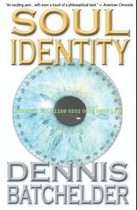
Smart book, with smart-aleck protagonist. Soul Identity bridges your past and future lives--for a price.
You can't take it with you...but what if you could?
Most people believe their souls outlive their bodies. Most people would find an organization that tracks their souls into the future and passes on their banked money and memories compelling.
Scott Waverly isn't like most people. He spends his days finding and fixing computer security holes. And Scott is skeptical of his new client's claim that they have been calculating and tracking soul identities for almost twenty-six hundred years.
Are they running a freaky cult? Or a sophisticated con job?
Scott needs to save Soul Identity from an insider attack. Along the way, he discovers the importance of the bridges connecting people's lives.
Professional Reviews
(BookPleasures) Batchelder succeeds in serving up an exciting yarn!
To understand the nuances of Dennis Batchelder’s debut novel, Soul Identity: a novel, it wouldn’t hurt to be familiar with some of the computer lingo mentioned in the text, however, it is not absolutely essential to enjoy the experience of its reading. Batchelder succeeds in serving up an exciting yarn alluding to the implications of technology, identity theft, as well as mixing in some fantasy and spirituality with even a touch of a philosophical twist.
To accomplish this feat Soul Identity centers on the adventures of a computer security consultant Scott Waverly, who lives on Kent Island in the middle of Chesapeake Bay. One morning Waverly receives a package from a company called Soul Identity that is looking to employ his services. Apparently, the company had previously contacted Waverly’s home office to inquire as to the kind of services he offers his clients.
The package received by Waverly contains two yellow envelopes containing a “soul identity reader” that resembles a pocket flashlight and instructions as to how to use the reader. Waverly is informed that before he begins his business relationship with Soul Identity he must first signify his acceptance by providing the company with his soul identity. Consequently, by following the instructions and using the reader he would be able to photograph the iris of each of his eyes that contains his soul identity.
As a practical joke and believing that he is dealing with some “wacko company”, Waverly and his parents, who are his business associates and are at his home office at the time, decide to provide the soul identity of a bluefish they just caught. Upon completing the task, they call the company and tell them to pick up the package. However, before the same individual who delivered the package returns to pick up the package, Waverly and his parents try to find out what the reader is all about and attempt to decode its contents.
A week later Waverly notices that the same delivery man shows up at his neighbor’s doorstep and for some reason causes the neighbor, a Mr. Berry, to chase after him with a shotgun. Curious to know what happened, Waverly knocks on Berry’s door and he is asked to step in for a cup of coffee. It is here where he learns that Berry, who believes in reincarnation, recently visited a neighborhood palm reading establishment owned by a Madame Flora. Coincidentally, or perhaps it is a twist of fate, a Soul Identity member shows up the very next day and explains to Berry how their company could extend his life forever by building a bridge between his present life and his future lives.
Berry struggles to convince Waverly that the company is legitimate and is not selling false hopes as they really did in fact figure out how to identify and track your soul. Apparently, they know how to read it, and after you die and come back in a new body, they can find it again. Moreover, the company acts as a depositary where people can bank their money, ideas, life experiences and other valuables and give it back to you after they find you in your future life.
Waverly thinks this is quite a novel and compelling idea, particularly if the company could accomplish this feat without cheating their clients in the process. What Waverly discovers and what angered Berry, however, was that he was turned down and would not be let in due to the fact that he had one glass eye.
As our story progresses, Waverly meets up with Archibald Morgan, the “executive overseer” of Soul Identity and who works out of the company’s Massachusetts headquarters. It is here where Waverly learns about the history of the company dating back twenty-six hundred years and that the first overseers were the people whose soul identities matched the eye images of ancient Egyptian paintings.
He is also clued-in as to the consulting services he is to provide to Soul Identity. Morgan explains to Waverly that the company is in the process of offering their services over the Internet. However, he believes that its very existence is at stake as they are being maliciously targeted by a rival company that involves some very wicked people. He has a good idea as to who are the culprits however at the moment he is unable to provide solid evidence. This is why he has engaged Waverly whom he knows is perfect for the job, as he is a non-believer and a skeptic, particularly in light of the fact that he tried to fool him with the submission of a bluefish’s eye images when he was requested to submit his own.
To add a little romantic spice to the narrative, Batchelder throws in a love story when Waverly meets the beautiful, blue-eyed and brilliant Valentina (Val) Nikolskaya, a programmer at Soul Identity who helps him discover who in the company is an impostor that is collaborating with other scoundrels in a devious scheme to wipe out the company.
As the chase comes to a close, Waverly and his girlfriend Val wind up searching for a character by the name of Tinless Tiskey, supposedly an amazing programmer, who lives in a Buddhist temple in the Himalayas next to Tibet, and who eventually provides them with the needed answers to bring closure to Waverly’s assignment.
Even though the novel may seem to be a trifle absurd and far fetched, it does have its many moments of wit, and probably without consciously realizing it, makes one speculate as to what would be the ramifications if it were possible to trace one’s soul as offered by Soul Identity? Batchelder’s take on modern technology coupled with his vivid imagination are quite intriguing. However, I did find his tendency to veer away from the main plot line a bit distracting, particularly when Morgan gives him a history lesson of the origins of soul identity as well as the mumbo jumbo and technical jargon thrown in from time to time. As you can gather, I am not a computer geek. Nonetheless, I have to admit Soul Identity was a fun romp with its adventure and suspense and I look forward to reading more from Batchelder, only next time I hope he stays more focused and remembers that we are not all computer literate.
(BookReview.com) I found Soul Identity to be a compelling novel with an interesting mythology
Everyone is interested in the concept of immortality: the idea that our existence doesn't have to end with our death, and that something of us survives to another level or comes back in a new form. Most of these theories are tied to a spiritual idea but Dennis Batchelder's debut novel "Soul Identity" offers a new God-free idea of reincarnation and does so in a very entertaining read.
Scott Waverly, a wisecracking security expert well-known for poking holes in his client's systems, is contacted by an organization known as Soul Identity. The organization has a radical mindset: it claims to track the souls of its members through successive generations. Selected to help bring Soul Identity into the digital age, Scott must decide if he believes in their claims of soul connections while at the same time dealing with the machinations of ambitious members.
The idea of finding someone's soul through an ocular fingerprint may seem like science fiction, but "Soul Identity" reflects a lot of thought on the author's part to make it believable. Batchelder has written a compelling history for the group that spans ancient Egypt and Alexander the Great, and goes into considerable depth on the faith and interest that draws members into the organization.
This depth is backed up by an interesting group of characters and sites, such as a beautiful Russian computer expert, a group of Tibetan Buddhists and an elderly fortune teller with culinary-challenged nieces. Using extensive dialogue, the book creates distinct characters with such traits as Scott's clear familiarity with computer security and the villains penchant for using Latin phrases.
Unfortunately, the dialogue is also tied to the main problem I had with the novel: with most pages consisting of at least 50 percent conversation, there is a lack of details such as scenery and description. When the book is focused solely on what people say, it also means that the action of the book is slowed down and the tension tends to fall away. (One personal complaint of mine: it gets a little annoying when every time a character says something in another language they immediately provide a translation as if they were speaking to the reader directly.)
Despite this dependence on speech, I found "Soul Identity" to be a compelling novel with an interesting mythology and a sense of humor. Batchelder promises in the endnotes the series will continue, and if the same soul travels from book to book it should be equally engaging.
Foreword CLARION
Self-described computer security entrepreneur, Dennis Batchelder, has taken his considerable knowledge of security systems worldwide and crafted it into a fast-paced action-adventure novel involving a couple of competing cult-like organizations, Soul Identity (SI) and WorldWideSouls (WWS). One is good, one is evil. Thirty-two-year-old computer expert hero, Scott Waverly, his mom and dad, his one-eyed neighbour and the body and soul of Scott’s flaming hot soul mate, “software girl” Valentina Nikolskaya—not to mention flamboyant palm reader, Madame Flora, twin granddaughters Marie and Rose, and various soul seekers, recruiters, overseers and a Tibetan Lama named Tinless Tiksey chase each other around the world in a series of exciting adventures of bits and bytes.
Batchelder has a flair for telling a story and involving his readers. Right from the get-go of a riveting Prologue there are the elements of suspense, sexiness, and humour that abound throughout the book. Scott is an expert self-employed computer security analyst who gets hired by a 2600-year-old SI organization to update its recently installed but flawed computer systems. It isn’t long before he’s is up to his scanner’s eyeballs with problems far beyond the “just for a start” stage. Some of the problems are funny ones such as his encounter with Madame Flora and her weird ideas about the purpose for her fax machine. Rose and Marie do some comical turns too with cooking capers and an ambulance. Even the elevator rides with an eccentric centuriat operator have their soulfully funny moments.
Other problems, however, are less funny, with electronic bugs, deficient computer programs, malfunctioning soul-reading machines, an illegal corporate takeover and attempted assassinations by bombing, shooting and poisoning. The on-the-page sexual descriptions are evocatively and decently done and those off the page are left to the reader’s imagination. Threats of bodily harm are adequately frightening and realistic with the more fantastic elements of the story becoming willingly believable for the sake of the action. Several historical bits are worthy of Da Vinci Code inserts while others get to the heart and soul of Venice, Iceland, India, the Himalayan Kingdom of Ladakha, and the Buddhist gompa, Lamayuru. Character, action and place all complement the soul searching in Soul Identity and help make for an entertaining trip.
Do you believe in reincarnation? Past lives? The concept of a soul? If these subjects yield you no conclusive answers and only leave you scratching your head in wonder, you're not alone. These are just some of the imponderable questions posed to Mr. Scott Waverly, the quirky protagonist of Mr. Batchelder's novel Soul Identity. It's lucky for us that it was Mr. Waverly that got to field these shag flies because let's just say Mr. Waverly lives in his own very special Field of Dreams. It's a land that most of us only occasionally visit and that's a shame! For in Waverly's world we find that we can suddenly start taking things - including ourselves - way less seriously. We can laugh, test, prod, poke fun, take potshots and let the air out of just about any subject! And that's just what Mr. Waverly does, but then what would you expect from a security consultant that is one flea short of a circus?
Scott Waverly finds himself in the unique position of being contacted by an organization that purports to read souls by taking an eyeprint. This organization - Soul Identity - does for eyes what forensics and CSI has done for fingerprints! Seems that the old saying "the eyes are the windows of the soul" was just getting us started in the right direction. That's where this mysterious organization comes in. They've perfected the art of finding out where our soul has been, through centuries of making hand drawings of our orbs. They've even gone high-tech and now use computers to help the process along, but that's where things go downhill. They find a slow leak causing profits to go down and a usurper waiting in the wings to takeover their clientele when they do bottom out. That's where Mr. Waverly comes in. They hire him to find what's going on. I don't know if they would have done so if they'd met him first, but you know what they say about resumes and hiring people - some people sure do look good on paper! Mr. Waverly seems to be in this category. He's brought on board to find the security glitch and he does so in his own ... er ... strange? ... squirrelly? ... unique? ... yes, unique way. He encounters bad guys, assassination attempts and even romance along the way. We're taken on a carnival ride that is slow enough to enjoy and let us view the scenery - and fast enough to keep us interested! More, importantly, we get to reside in Waverly's world at least until the end of this journey!
I don't know if any of life's burning questions are answered through Mr. Waverly's travails, but I do know that even if you can't take everything with you - at least keep a copy of Soul Identity around! You'll find it an easy and a very fun read and the perfect companion to accompany you as you soul hop through the centuries!!!
Dennis Batchelder's "Soul Identity" is a fantastic read that grabs the reader's attention right from the start. The style is very similar to the Da Vinci Code, with the author's incredible attention to detail and knowledge of a vast array of places around the world. We live in an age where computers and technology are evolving at a high rate of speed, and in a world laced with conspiracy theories. Dennis Batchelder has weaved a story incorporating those fascinating elements and much more. I highly enjoyed "Soul Identity" and look forward to the next!
J.R. Reardon, author of "Confidential Communications"
As the old saying goes, "The Eyes are the window to the Soul". In Dennis Batchelder's Soul Identity, this is more than a figure of speech. Rather, it is the premise behind a twenty-six hundred year old organization tasked with finding, recording, and managing their clients' soul lines. Similar to a finger print, a persons eyes, specifically their iris patterns is unique - at least while they are alive. At some future point after their death, their iris pattern may repeat in a new body. It is this unique pattern that identifies that this new body carries the same soul line as the previous body.
But in the present day, the organization - aptly named "Soul Identity" - is finding it harder and harder to match soul lines - especially the company overseer souls - even though technology has made it easier to capture, read, catalogue and compare iris patterns. Could it be this same technology is actually preventing this company from its mission? Is someone using this technology against them?
In comes Scott Waverly, a security and technology expert hired to find the answers and save "Soul Identity" and its millions of soul lines from disappearing forever. Though skeptical of the company's claims, Waverly quickly finds himself in the middle of a philosophical, technological, and life threatening affair which has him jet setting around the world to save the company as well as his life.
In his debut novel, Dennis Batchelder has created a fast paced barnstormer similar to the likes of Lincoln Child in novels such as Death Match and Utopia. Though taking on the questions of immortality through the possible reincarnation of souls, Batchelder, similar to his fictional "Soul Identity" overseer Archibald Morgan, does not delve too deeply into the philosophical and spiritual implications of this "technology". Rather, the novel relies on the wonderfully written dialogue and suspenseful situations the protagonists must overcome to solve the mystery behind who is trying to destroy "Soul Identity" and why.
This novel is a very engaging read and I would encourage anyone who enjoys novels such as those written by Lincoln Child, to consider purchasing Soul Identity - you are sure to enjoy it. The book ends with a few teaser preview chapters from the sequel which looks equally good if not better. I, for one, am anxiously awaiting the release of Batchelder's next book.
The Eyes Have It! No, that's not a typo. Eyes are critical to this story. From the deep blue eyes of Scott Waverly's soul mate, Valentina, to the eyes of the members of Soul Identity, eyes play a big part in this drama. You'll have to read it to find out why.
Soul Identity hires Scott Waverly, an eastern shore of Maryland computer security genius to evaluate their security. He meets Val, a computer geeks' image of Venus. Together they find the clues and unravel the mystery of why another company is trying to eliminate Soul Identity.
Having lived most of my life in the Washington DC area, I traveled many a day on the way to Ocean City across the bridge and Kent Island where portions of this story take place. The story makes one feel they are there again.
Dennis's writing reminds me of Stephen Frey, or a young version of Jerry Labriola.
I hope to see Val and Scott pitted against many more bad guys in the future!
Benjamin Blue - Author of Storm Killer
Kim Jong Eun č morto. L'esercito nordcoreano č ora al comando. Il loro nuovo dittatore militare, il maresciallo Ko, crede che con un'invasione totale possano raggiungere Seul, a sole 35 miglia di distanza.
Part mystery, part fantasy with a twist of science fiction, Clues of Chaos is brimming with suspense and adventure that will have you racing to the end yourself.
Winner 2016 Pacific Rim Book Festival in Science Fiction category. Honored as
Crowley County Series, Novels 4-6
An uplifting series with romance, mystery and suspense.
Join the people of Crowleyville as they face the challenges of small town life while struggling to welcome an influx of newcomers.