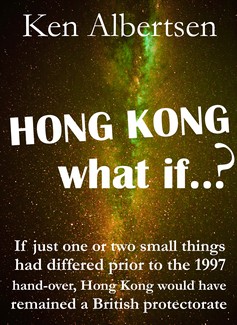
If just one or two small events had differed, prior to the hand-over to the Chinese in 1997, Hong Kong would have remained a British colony.
If just one or two small things had differed, prior to the 1997 hand-over, Hong Kong would likely still be a British colony. Chinese officialdom wasn't cognizant of the hand-over until British officials informed them in 1979, because of the cavalcade of tumultuous events which followed the 19th Century treaties which ceded HK to the British 'in perpetuity.' The first half of the book summarizes the actual true-life history of China, from the Portuguese and British trading ships of the 16th century, up until the 1997 hand-over of Hong Kong. The second half of the Hong Kong book offers a fictional scenario of what might have happened if just one or two lead-up incidents had been slightly altered. Hong Kong island and Kowloon could well have remained British, according to signed treaties.
Excerpt
Herein are two scenarios which tell about the transfer of Hong Kong to China in 1997. The first scenario is the actual true-life scenario and the main historical events in China for the 400 years preceding the hand-over. The second scenario, described later in the text, tells a story of what might have happened if just one or two small things had differed from the true-life scenario, in the lead up to the 1997 handover.
The Actual Scenario Leading up to the Hand-Over of Hong to China
Including historically relevant prior events in China, since the 16th Century, which led to the creation of Hong Kong as a City-State.
The actual hand-over was kicked in to gear when then-governor of Hong Kong, Mr. Murrey Maclehose, met with the Chinese premier Deng. The year was 1979, and was Maclehose's first official meeting in China. At a social function, when Maclehose broached the subject of a somewhat impending transfer of Hong Kong territory to China, Premier Deng appeared surprised, as if being broadsided with news that China would magically gain valuable property, 19 years hence, with just a ceremonial hand-over. The scenario can possibly be explained by the flood of historical events which shook China, from the time of the first British involvement with Hong Kong, on through and in to the 20th century. Though there may have been some within China who were cognizant of the impending handover, yet it may well have been that not one-in-a-billion Chinese were up to snuff on that element of their history. That odd fact becomes more understandable, when seen in the perspective of preceding events.
Let's turn the pages back on China's contemporary history, in order to get a better perspective of the events which saw a small rocky wind-swept island with just a thousand struggling fishing families - becoming a part of the British Commonwealth, and a few decades later, one of the most prosperous cities in the world.
In the decade between 1966 and 1976, a couple years prior to the fateful meeting in Beijing between Governor Maclehose and his Chinese counterpart, China had been tormented by sustained riotous behavior. Within every city, and on in to the provinces, young Chinese men and women calling themselves 'Red Guards' had gone witch hunting for intellectuals. Anyone associated with history, culture or higher learning, was hounded or rounded up. Penalties for being a University professor might be public humiliation at best, or murder. Chairman Mao and his wife were the prime inciters of the mayhem and mass cruelty, though even Mao probably wished he could put the genie back in the bottle when he saw, years later, how much mayhem was going on in his name.
Even far reaches of Tibet were not spared. Centuries old works of art were destroyed in seconds, and monks were permanently run out of monasteries. Some of the destruction was carried out by monks with guns pointed at their heads by 'Red Guards.' One of Chairman Mao's oft repeated quotes from his Little Red Book, was; ”The sign of a true revolutionary is his desire to kill." He also forbade police from interfering in the Red Guards' mayhem. As if things couldn't digress further, Mao's wife, Jiang Quing, incited some Red Guard factions to storm Chinese military barracks and steal weapons. In lieu of that, it would have been an opportune time for a foreign country to have invaded, as China's military defenses were compromised. Yet, what country would have wanted to take over China at a time of such extreme turmoil?
Fifth Book of the Southern Swallow Series. Nan Ya and his crew take a final adventure into a mythical Chinese universe and become entangled in court intrigue.
Fleeing from a scorned past,Catherine Merit struggles with her failing medical practice and a rich man's obsession of her.Book Four in the Indignities Series