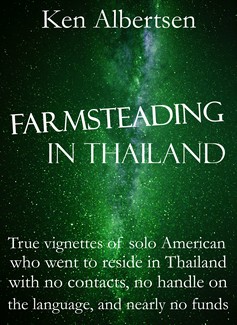
True stories of solo foreigner coming to Thailand with no prior contacts, no handle on the language and little money – then going on to develop a homestead, experimental orchards, and an adventure park featuring rock climbing.
True memoir of solo foreigner coming to Thailand with no prior contacts, no handle on the language and little money – who goes on to develop homestead. This 250 page book touches on a wealth of topics including inventions, alternative energy, unique building methods, and rock climbing. If you even wondered about the romantic dynamics between a middle aged westerner and a beautiful Thai lady half his age, or whether it's possible for a foreigner to secure property in Thailand, there are musings on those topics as well. Over two dozen photos.
Excerpt
One simple pleasure is to space out on the land. It’s like being mildly stoned. There are always new things to discover. Generally, the closer to the equator, the more species of plants. For comparison, the western slopes of the Sierra Nevada foothills, at 38 degree parallel, - where I resided for 25 years before moving to Thailand, had about two dozen large tree types. Of those two dozen, five predominate: ponderosa pine, black oak, madrone, live oak, and douglas fir. In contrast, the part of northern Thailand at 20 degree parallel, hosts hundreds of types of large trees.
There’s a particularly pleasant walkway that meanders by the river near town. It’s a magical little strip of land that’s set between the steep sides of a verdant hill on the north side, and the wide Mae Kok river on its south. Large meteorite-looking rocks, which tumbled down from the hill over time, dot the narrow swath of land, which partly explains why it’s never been farmed.
Question; is a rock which has tumbled down from a cliff; a rolling stone? ….and does it gather no moss?
Among other things, there are a plethora of shade-loving plants, any of which could be a fine addition to an uptown dentist’s office in the States. Though green types predominate, there are others which sport variations of speckles and stripes of pink, red, purple and yellow. Some have leaves as big as beach umbrellas.
Gravity defying tropical trees extend thick branches horizontally out tens of meters over the river flowing below. One stand-out is a massive fan-rooted fig tree that grows by a hidden rock-climbing crag. In season, its crimson fruit cluster around broad branches high in the canopy. Not long ago, monkeys, birds, and a plethora of other wild animals must have indulged on such seasonal bounty. With few wild animals left, and people not interested, it’s now mostly left to ants or bacteria to dispose of wild figs which carpet the ground.
Another odd plant features large ground level flowers which jut out of the ground with no accompanying foliage. Within a day, they can unfurl to over 2.5 feet tall and over 1 foot wide – yellow on the outside and reddish brown on the inside. A single thick petal bunches and twirls to form a vase shape with a gaudy flap of a lip that’s cool to the touch. The parent plant also seems to come out of nowhere. Because I don’t know its real name, I’ve named it the ‘triffod plant’ after the fast growing plants from outer space featured in the book by Anthony Burgess titled; ‘Day of the Triffods.’
Growing a foot a day, the light green, white dotted triffod can grow from nothing to two meters in less than a week, with a leafy canopy just as wide. Its 3 inch wide ‘trunk’ is fleshy and can be cut asunder with a butter knife. The whole package sprouts from an underground tuber as big as a flattened basketball.
I once saw three hill tribe kids crouching around a particularly large triffod flower – equipped with a kitchen knife and a glass jar. They had cut to the heart of the amorphophylus flower and were extracting large black beetles to take home – either to eat or to play with. The flowers do have slight scent of old flesh, but not the putrid stench that one might expect from such an insect-attracting flower. I have since found that the plant’s Thai name is ‘buk.’
Playing with captured beetles appears to be a popular pastime for kids across southeast Asia. One variation is to tie one to a string tether and marvel as it flies in circles. The largest beetle I found was a type of wingless weevil, evidenced by its thin downward curving snout. Its amber colored body was 4.5 inches long and thin like a switchblade – and its gangly legs spread just over two inches from each side of its body.
huddled in a nook in the rock – making fun little things from plants and twigs.
I recently saw a little ball moving around in a bald spot on the lawn. Upon closer inspection, it was a marble sized chunk of manure being manipulated by an odd looking ant-like insect. A moment later the ‘ant’ came apart and I realized it was two small black beetles playing piggy back while rolling the manure ball. Perhaps they had surmised the added height gave them additional leverage for their big job. The big multi-colored scarab beetles of northern Africa have been lifted to near-exalted status by devoted Egyptian artisans of antiquity, as depicted in awesome jewelry and such, but I didn’t know scarabs could be found here in northern Thailand – yet there they were, two little black fellows, rolling a ball many times larger and heavier than they were.
Sometimes a particular frog will pay me a visit. No big deal, except when you figure the guy’s about the size of my index fingernail. I’ve mentioned this to some Thai friends and they wave it away with a ‘mai pen rai,’ saying, “they’re baby frogs.” Granted, I’m no herpetologist, but these guys look fully formed, and could possibly give a frog discovered in Cuba in the 1990’s and dubbed, ‘the world’s smallest frog’ - some competition for the title.
During that time, work continued on the land itself. Though we took down some of the fences that had earlier been put between our parcels, there were still fences between my land and neighbors’ land. Close to cities, 90% of parcel boundaries have cement walls. In rural areas, 90% of parcel boundaries are barbed wire fences. For a Thai property owner, there is never a doubt about the necessity or putting up a fence or wall. Such a division between parcels is as much a pre-determined necessity as putting clothes on before exiting one’s house. If a wire fence is chosen, it’s always has to be barbed. More than a few rural parcels sit idle with but one ‘improvement,’ namely; a two to three meter high un-stuccoed cinder block wall strung along its perimeter. It’s a fine way to divorce an area from any sort of innate naturalness it might have had.
Some of the neighbors were absentee or otherwise lazy about trimming things, so I had come to take it upon myself to do it. No one has yet complained, but there have been times when I’ve clandestinely hopped a fence and cut plants that have crossed over the fence line, and then only if they’re particularly prickly or spiny things. They do the same.
There’s one small sprawling tree called Cha-oom which is particularly annoying. Besides having gnarly thorns on its every part, it also has a very pungent smell. It’s newest branch shoots are edible, but to me the whole tree is anathema, as it spreads its branches horizontally for many meters at face and chest level – plus, grows several inches per day. To top it off, its thorns not only pierce and rip the skin, they emit chemicals that cause itchy welts. It’s like a demon plant from Mars that clandestinely came back on a space probe and invaded Earth.
There are three things that establish ownership of un-titled land in Thailand; 1.surround it with walls or barbed wire fences 2.set water holding tanks at its highest point, and 3.do something to show you’re developing the land. Number 2, ‘holding tanks,’ are often very large clay or cement jar shapes (it may be interesting to note that a fat girl can be unflatteringly referred to in Thai as ‘tum dern’ = ‘walking water jar’). It doesn’t matter whether or not they hold water or whether they’re functional (the jars, not the girls), the important thing is to have them visible on a high spot to serve as a statement of claiming that particular piece of land.
‘Developing the land’ used to be as simple as ‘cut an access road and/or plant some things.’ Nowadays, an additional way of asserting ownership is to run a weed-cutter around on a piece of land of questionable ownership. In Thailand, weed-cutters are the metal blade-type rather than the nylon string type. I have one neighbor who spends considerable time, perhaps twenty hours per week, weed-cutting nearby hills and valleys. None of the land has title, but the sparsely populated region’s inhabitants have seemed to resign themselves to the inevitability that the ballsy man with the weed-cutter must be the owner of all those many rai - because he’s out there mowing. Even after the sun goes down, his motor can be heard echoing across hill and dale. It’s gives a new twist to the term ‘land grab.’ Perhaps he should give seminars titled; ‘How to Gain Property by Weed Cutting.’
A mile away, at the ‘Rim Rock,’ a small crew was staying busy. Clearing brush was the main activity, both on the hills and on the rock faces. As the rock slowly revealed its contours, the true majesty of the terrain became evident. At the end of the dry season, particularly in March and April, large parts of the land would get burned. Even if we didn’t start the fires, some neighborhood kids would have – just on a lark. Every so often the annual burn would charge up one or another of the vertical ravines carved into the steep hillside. Neighbors would gather, some being afraid that the firestorm would ignite the top reaches of the hills.
Though I had resided in Thailand only a few years by that time, I knew that the uppermost regions would not catch fire - because of the fire-resistant nature of its plants. So even in the driest season, with a hundred foot wall of flame licking at its foliage, the brush at the top would get singed but wouldn’t actively burn. A month after the first rains, it would revert back to a massive tangle of gnarly weeds – barely passable to the most adamant machete-wielding native.
Technically, such hillsides are public domain; not allowed to be owned by anyone – which is fine with me. It’s also appreciated that, though most prominent hills in Thailand are claimed by monasteries, this particular hill wasn’t. If it had been claimed by a monastery, it would be off-limits to my mischief and also to recreational climbing.
Every so often, one or more climbing enthusiasts would drop by to check out the rock. Though every climber seemed to have a good time, my perspective on developing it as a commercial climbing crag changed. For several reasons, I chose to put the commercial aspect aside, and thereby concentrate on other endeavors. Cash flow was slowing to a trickle, so the dream of developing a rock climbing park had to be put on hold – in order to focus on more ‘down to earth’ gigs.
Two jobs that got put off at that time were; paving the access road, and developing the water system. Since no one was living on the land, water was only needed to maintain the fruit trees that we had planted earlier – and then, only during the latter part of the long dry season. To do that, we would load and fill plastic water containers in the pick up truck, and drive them up to the upper landing of the land. From there, we would hand-water. Nearly all the trees we planted were started by us by seed – keeping with the plan of planting such things that weren’t available at Thai markets or plant nurseries.
Early on, around 2001, the two primary types planted were avocados (various types) and pink grapefruit. Later on, we added a few other fruit and nut trees for variety, such as date palm, macadamia, brazil nut and two edible fig varieties (Mission and Dakota).
On the suggestion of a young Peace Corps friend, we planted a few acacia trees. I had asked him what would be suitable on the south rim of the prime house site – to provide shade. His suggestion was right on the mark, as the acacias grew robustly – seeming to double their girth annually for the first few years. Roughly half the land is steep hills which, regardless of how much we slashed and burned, always grew back thick with weeds. Some of those weeds are actually aided by burns – in that their seeds germinate better after going through a fire. Those hillsides have now becoming dedicated to growing pine.
The initial plan was for the pine seedlings to simply stay alive and avoid getting burned to a crisp in brush fires. As they get taller and branch-out, they slowly put a damper on the surrounding weeds. I doubt they’ll completely eradicate weeds in their drip zone, but their shade and acidity will help in the process.
When we plant a seedling, whether fruit or pine tree, we need to mark it with a stake. Initially, we used bamboo stakes sticking out one meter above the surface – along with a plastic marker ‘flag’ on each. Those proved to be too short because the grass and weeds grew so dynamically. More than a few seedlings have likely been lost and overcome by weeds because we couldn’t find and tend to them when they were young. It’s a good thing we weren’t raising children in that manner.
Speaking of ‘raising kids and losing track of them in the weeds,’ that brings to mind a true story that took place in the 1990’s at the rural northern California region where I used to live. There was a man named Jeremiah who lived with his woman in a secluded cabin. He was one of those very dynamic, semi-wild men who obeyed no man’s rules. The type of man you’d want on your side if you were defending the Alamo. One morning he opened the door of his cabin and found a baby boy asleep on his lawn, covered in dew. He picked the child up and carried it the half mile to the boy’s parents.
He held no quarter in verbally chastising the parents and their elder son, prompting the boys father to brandish a shotgun in Jeremiah’s face. Jeremiah walked away in a huff. The next day, he positioned himself at their access road – and when the boy’s father drove alongside, Jeremiah shot and killed the father. The last I heard was, months after that, as Jeremiah was driving along a highway with his wife, the grown son of the slain man drove a car alongside Jeremiah’s and ran him off the road. By the time the dust settled by the side of the road, Jeremiah’s wife had died.
When marking planted seedlings, we found we needed tall marker stakes. Bamboo stakes sticking up 1.5 meters were not tall enough, because many would wind up getting hidden by grass and weeds. Currently, we use stakes that stick up well over 2 meters.
One might say the answer is simply to cut the stuff – and Bob knows we do! - but it’s quite a chore to try and keep pace with the fast growing grass and weeds. Indeed, during the rainy season, cutting grass is the main chore. The land is of such size, and the grass and weeds grow so robustly, that we can literally finish the job on the NE corner of the land - and walk over and start again on the SW corner where the grass and weeds have already grown over a foot. It sounds like a joke, but it’s true.
Conversely, the primary chore in the dry season is watering. Initially, a drip irrigation system was tried, but it became impractical because of its incompatibility with weed cutting. I may try drip irrigation again in the future, though it would likely be one of two methods; (A) have the connecting tubes buried underground, or have it be part of a trellised set-up, where the water tubes snake along the upper part of the trellis – which is how grape growers do it in northern California.
Though it’s generally thought to be good to water during the long dry season if one has the infrastructure to do so, there may be times when it’s smart to hold off on watering. Here’s the theory; allow even water loving crops such as avocados, figs and blackberries to go thirsty during the six weeks leading up to May, the month when the rains come. That way, when the rains do come, the plants will start a strong growth cycle, and they’ll get deluged with over a meter of rain spread out until November.
On the other side of the coin, if one were to water at regular intervals, at about every week during the dry season, it might confuse the plants growing cycle. In other words, some plants might start their growth cycle in February for example, and be winding down their growth cycle by August, halfway through the monsoon season. We’re still trying to fine-tune it.
After cutting grass and weeds, the clippings are either left on the ground or, if manpower is available, raked in to piles. We don’t have farm animals to feed, so the grass and weeds are allowed to decompose. The cut grass that’s left on the ground serves several functions. It smothers some of the emerging grass and weeds, and provides fodder for insects and little animals. Many of the insects pay their dues by burrowing all through the soil, along with the earthworms that also cherish the space below matted dead grass. Cut grass is also good mulch for trees. After aerating the soil around trees with shallow hoeing (not deep, so as not to disturb roots), we pile the grass on thick in preparation for the long dry season which lasts from November through May.
Professional Reviews
Phuket Gazette
“Hi Ken, finished reading it today. I enjoyed reading it, I particularly like to read of other peoples endeavors in LOS [Land of Smiles]. Overall very humerous and interesting. I'm passing it on to my friends, hope you don’t mind.” Sam in Phuket
Charlie Gallery
“I started reading it today. While eating my fresh fruit for breakfast I almost choked to death on a watermelon seed. The part about you going down the river with the inflatable kayak with the suitcase sticking out got me laughing. I can just picture what was going on in the local Thais mind while you floated by. I wish I could have seen that.” Charlie at Charlie's Gallery, Bangkok
Hong Kong Review
“Ken - wow what a truly fascinating book. I just gave it a quick skim, and plan to take a look in more detail. Is this a book that will be in Thai bookstores? If not, it should be. Its so much better than some of the other books one sees in there - most of which seems to be focused just on BKK nightlife!” Rembert Meyer-Rochow, Attorney, Intel Semiconductor, HK
At the heart of the eight compelling nonfiction stories and five-article appendix which make up Dreams of the Immortal City Savannah is this interesting question: What would your life mean if you were living someone else's dream of what it should be?