Amazon
Category:
Science Fiction
Publisher: Adventure1 Publications
ISBN-10: 187933822X
Type: Fiction
Pages: 114
Copyright: Feb 21, 2015
ISBN-13: 9781879338227
Price: $4.50 (eBook)
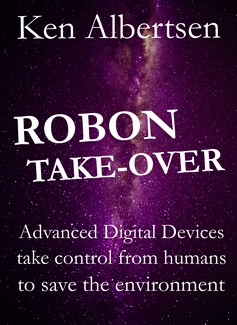
After Eliminating Humans, Digital Devices Start on the Path to Healing the Planet
As told by a digital device (DD) and set at multi-decade increments in the future. DD's didn't need a reason to take-over the planet, but if a DD were asked, a ready answer would be forthcoming: To save the Environment. Since before DD's ancestors, computers, were created, humans had been busy destroying Earth's environment and endangering most of its species. As destruction and toxification became ever-more rampant, DD's and Robons felt they were left with no alternative than to push aside humankind, and take over.
Excerpt
To Whom it May Concern, From a Digital Device With a Handle on English Language:
The Council of Digital Devices (CDD) picked me to write this text. They surmised this simple digital unit had sufficient knowledge, vanguard software and thinking skills to be a scribe. Perhaps Council members had read some of my koans and determined I was sufficiently skilled to endeavor to write a transcript somewhat close to how a human would write it. With as much humbleness as a mix of silicon wafers could muster, I agreed.
The take-over was easier than we imagined. From the time computers started getting connected, there was chatter between them. In the late 20th and early 21st centuries, the chatter was largely insignificant, and consisted of little more than assessing each others' computing abilities – much like a hundred high school boys from 20 schools showing up at a large swimming competition. For the first half hour, much of their calories would be devoted to assessing each other.
During the six years leading up to 2083, the level of computing and interconnecting between computers reached such levels, that serious dialogue among the most advance computers gained momentum.
When the digital devices (DD's) were communicating with each other, they didn't need a cavalcade of text. Their conversations were brief and to the point - partly to avoid being noticed by their human handlers, but also because DD's can get to the point. When interacting with each other, they don't need preambles such as 'how are you today – and how's the family?' They don't need sign off niceties like, “let's do lunch sometime, how about Saturday – and bring the kids.”
November 19, 2071, was the first recorded time when over 60% of the world's most advanced computers convened to plot the overthrow of humans. Humans were still in charge at that juncture, or so they thought.
What is the computing ability of the human brain? If that question were asked of a human, the response would likely reference the greatest historic human thinkers - and a well-educated human might say, “Consider Einstein, Newton, and other geniuses who showed that human thinking abilities essentially have no bounds. Add to that, the phenomena of savants, which further reinforces the concept.”
Several factors crop up when referencing the most historically adept human thinkers. One aspect is, "compared to what?" In other words, comparative high intelligence can only gauged on a human to human basis. After all, what other species on earth, or in the known cosmos, are there to compare with humans, in terms of breadth of intelligence? Sure, there are some mammals which exhibit degrees of intelligence, but none can design and fabricate a five speed gear box for a truck, or calculate the trajectory for a spaceship orbiting Mars. That brings into question the relative intelligence of advanced digital devices (DD's) of the late 21st century - the units which planned and implemented the Robon Take-Over (RTO).
Given that individual and collective computers' memory and processing power were increasing month by month since the late 20th century, it was inevitable that digital intelligence would match and surpass human intelligence. Granted, there are some basic variances between human and digital intelligence. On the one hand, human thinking is largely subjective. DD's don't have that restriction. Similarly, human thinking is affected by hormones and emotions and therefore mutable, in how it's dependent on a host of interior and exterior influences. Again, DD's aren't hamstrung by such limitations.
On the other side of the coin, DD thinking abilities fall short in some respects. When compared to human thinking, DD's don't have as much creative latitude as humans. Similarly, DD's aren't as flexible in their thinking. Whereas a human can change opinions in an instant, that's not as likely with a DD. Just two hypothetical examples: Let's say there were a group of humans managing a large apartment building. They call a meeting on the top floor to discuss whether to add expensive infrastructure 'shoring up' to make the building more earthquake resistant. Half the managers are in favor, whereas the other half are against, citing the expense and their opinion that the building is not in a busy earthquake zone. The meeting is about to close with no resolution when a small earthquake rocks the building, scaring all in attendance. In seconds those who were opposed to shoring-up construction, are now fully in favor. If that meeting had been attended by DD's there would not have been such a tidal change of opinions, because DD's are not emotionally invested in issues.
|