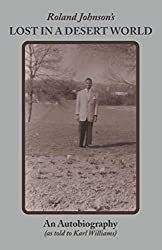
After spending half his childhood in Pennhurst State School and Hospital for the Mentally Retarded, Roland Johnson emerged to become a captivating speaker and a respected leader of the self-advocacy movement. The story of the path he traveled and of the people who helped him along the way is a testament to the triumph of the human spirit and the power of good will as a strategy for effecting social change.
Roland Johnson spent half his childhood at Pennhurst State School and Hospital for the Mentally Retarded, where he was sexually abused and, essentially, enslaved. When he'd won his freedom as a young adult, he spent several years putting his life back together and learning to control the anger his experience at Pennhurst had kindled in him. And then he happened upon the Philadelphia-based group Speaking For Ourselves. He quickly rose to the presidency and, in the spirit of Martin Luther King, Jr., whose career he'd followed and whose death he learned of at Pennhurst, was soon traveling across the US and to Canada and England to speak to other fledgling self-advocacy groups and at conferences of professionals, and to work toward establishing a US national self-advocacy organization.
Originally published after Johnson's death by Speaking For Ourselves, the group Johnson headed up for much of the 1990s, the book sold out its first small printing. One reviewer called it ". . .a work of pioneering authenticity." Karl Williams has also written a play of the same title, based on the book.
~~~~~~~~~~~~~~~~~
Roland Johnson’s autobiography is the triumphant story of a man who rose above an intellectual disability and devastating abuse to become a prominent leader in the self-advocacy movement.
As a child, Roland was sent away to live at the infamous Pennhurst State School in Pennsylvania, where he was sexually assaulted and forced to do unpaid manual labor. When he finally got out, he discovered the “real world” had no place for people like him — people who weren’t considered normal or valuable by societal standards.
Through a hospital counseling program, Roland ultimately began to find his voice. He discovered an ability to speak his truth and to fight for other people with disabilities. He would become president of Speaking for Ourselves and bring wide-scale awareness to the struggles faced by people with disabilities, as well as the unique gifts those same people have to offer.
"Lost in a Desert World" brings you into Roland’s life through his own voice and both encourages and challenges you to connect to your own humanity as a means of connecting with the humanity present in all people. Roland Johnson was a man of great courage, vision, and determination. He had an alternate kind of intelligence — one not based on what we call intellect. In Roland Johnson’s world, understanding — one person for another — is the way of the future, the only route to true freedom.
Excerpt
PENNHURST
After that long ride up there, it was just horrible. That was very scary. Very, very frightening. I was crying that I would never see them again, my family or sister. We went out into this great big institution that I didn't know anything about.
I saw Pennhurst for the first time. Where you come down on the main road you see this big thing up at Pennhurst, the water tower, coming in to Pennhurst. Things looked different to me - because it wasn't like a house that I lived in. I'm out here in this gray institution with three thousand people that live in it. It was just something that I didn't like. They had a playground there as you come to a dead end. And the office.
They admit me on the hospital ward. It looked to me it was all right. I was on the hospital ward before they discharge you from the hospital and put you on the ward. It looked pretty good to me. They fed me very good, filled my plate up with a lot of food. It smelled like a hospital, like a regular hospital; it didn't smell like it had a strong odor. It had beds, lots of beds and lots of nurses and different wards for the little kids and for older people. And cribs that had babies that was sent there at Pennhurst. I didn't know first thing about the place; didn't know where I was going or what I was doing there. But I knew what I was sent there for - to be out of my mother's head.
Well, I was on the hospital ward. They interview your mother - my mother - and they axed my mother some questions. I wasn't there; I was getting undressed to be on the ward. I didn't know what she was saying; I don't know what took place. All I knew - they took me back in the hospital ward and my mother was talking to Mrs. Clark.
But once I was there things got very overwhelmed to me. I stayed there for a week and ten days. They did some tests, psychological evaleration and stuff like that. The doctor keep axing questions. It was so much overwhelming that there's this great big ward with all these people; I'm used to my mother and father, my sisters. Never was used to all these other people around. It was just something. I was just crying, with tears. I cried that, "My mommy's gone; my daddy's gone. I will never see my sisters again or my brother or anybody. I'm here for life."
I thought that, "Here I am. I'm here and there's nothing that nobody can do. Nobody can do anything about it. I put myself there; I got myself into all this mischief and trouble and that's why I was here, to try to better myself." Maybe I had a lot of guilt in me. And that's why I was sent there. I had a lot of bad memories - things that I used to do, things I used to take. And if I didn't take them, I would be still living with my mother instead of at Pennhurst. If I wish back, if I wished that I could do it over again, maybe that possibility that I wouldn't have control over myself, that I might have to do it all over again, stealing and taking things and eating my mother out of the house... I guess it was just a thing that I could not think of... I put a thing down back in my memories: I would not do that any more; if I came out of Pennhurst, I would not do it, not eat my mother out of the house any more; I'd change.
I cried when my mother left; I cried before she left and after she left. And I cried when I left out - when they transferred me to the ward, to D-4.
Jamie was a healthy, active 12-year old who loved to skate and played hockey as well as any boy. Then one afternoon during a game, she suffered a stroke that changed her world. Her memoir takes the reader through her ordeal and her journey out of the
Rosetta was born in 1909 as the youngest of ten children. The family had more laughter than money and neighbors would knock on their door to ask, "Can we come in and laugh, too?"