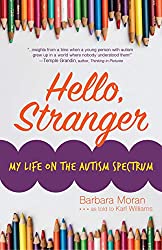
"Hello, Stranger" (KiCam Projects, 2019) was done with a graphic artist who has autism.
In the early 1960’s, at age eight, Barb finds herself living in Menninger’s Clinic in Topeka, KS, diagnosed as schizophrenic and treated with drugs and punishment for her inexplicable behavior. From the start she’s been very bright but human connection simply eludes her. She imagines objects (buildings, traffic signals, etc.) with faces and arms and legs; draws this world of her imagination; and speaks to objects as if to human beings. She’s in her forties before her sister Ruth, back in school to become a doctor, helps Barb receive a proper – and “forgiving” (as Barb terms it) – diagnosis of autism. Barb’s journey at the clinic is interwoven with the stories of other patients, children like herself struggling to be different in a difficult world.
Excerpt
CHILDHOOD
1
I didn't want to please anybody but myself. I knew who Mom was; it was just that I did a lot of pretending and I wanted to be someone else's kid. Other people's feelings, other people's happiness - that wasn't important to me; it wasn't even real to me. All I cared about was whether I was getting what I wanted. I think I remember once, when I was two or three, just repeating what someone said to me. But most of the time if somebody talked to me about something that didn't interest me, I just didn't bother to listen.
We moved to Omaha when I was three. It was a single, fairly large house with a big yard on a corner lot. I don't remember this, but Mom says before then I didn't talk much and my parents wondered then whether I was aware of anything at all, because I didn't respond to people the way they thought I should - I never looked at people.
This house we moved to had front and back stairs. I counted the steps and then I said, “The front stairs have twenty-one steps. The back stairs have seventeen steps. I like the twenty-one better: they have carpet and they’re not slippery.”
Later that same year somebody told me the meaning of a word and I forgot it. I couldn't understand how you could learn something and then not know it later. I thought when you learned something, you'd always know it. I had no comprehension of forgetting before that day.
When I was little I could have pointed to colors on a color chart that to me matched songs. I didn't see the colors when I heard the song; it was just that the song sounded like the color green, or blue, or red. But I soon realized that no one knew what I was talking about.
I thought that people were wet blankets. I spent time with my brothers and sisters, but mostly I was doing my own thing. It seemed to me that other people were getting what they wanted, but because my wants were different, somehow they were inferior. When I was by myself, though, if I was in a good mood I could at least entertain myself, and I didn't realize that there was anything wrong.
I thought animals were prettier than people - because they had fur. They were better to touch too; I didn't like to touch other people's skin: it felt like rubber to me. Different types of clothing just did not feel right. I didn't like that wet, sticky feeling that you get when you wear certain kinds of clothes; I didn’t like tight clothes that had no “give,” such as tapered slacks or a dress with a narrow waist. I liked to have a loose top on and nothing underneath, because then I didn't feel that stickiness as much. In the summertime we went barefoot a lot and if I wasn't wearing shoes very much and then I put them on, I felt like my toes were squished together.
I also remember when I was little that sometimes some household objects would look to me like they had private parts - like they had vaginas. And I would have dreams about somebody molesting them - the objects. These bad thoughts were intense and I was preoccupied with them. Usually I didn’t have them, but when I did, it could last for days and, not knowing any other word for what I was feeling, I would say that I was “sad.” But I felt that I couldn't tell anybody about these thoughts and dreams either - I just couldn't . . .
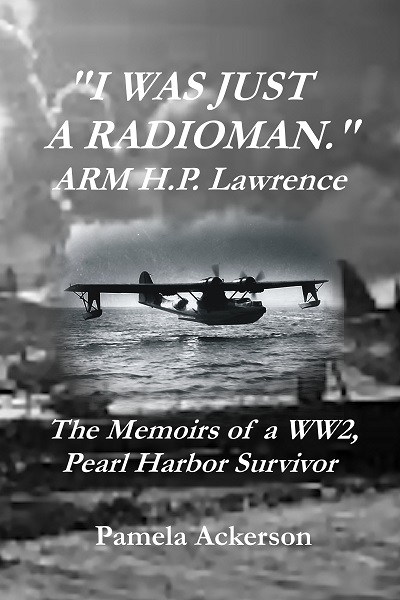
This is not a drill. The attack on Pearl. They were the ghost planes of the night, deadly, illusive, sharp-clawed Black Cats. The Memoirs of ARM H.P. Lawrence, a Pearl Harbor survivor, Black Cat, and decorated war veteran.
Jamie was a healthy, active 12-year old who loved to skate and played hockey as well as any boy. Then one afternoon during a game, she suffered a stroke that changed her world. Her memoir takes the reader through her ordeal and her journey out of the