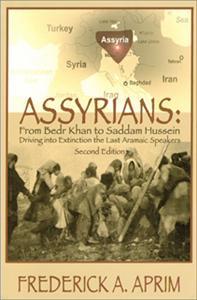
Category: History Publisher: Pearlida Publishing
ISBN-10: 0977187314
Type: Non-Fiction
Pages: 408
Copyright: January 2007
ISBN-13: 9780977187317
This book is about the genocide committed against the Assyrian Christians in the Middle East by Kurds and Turks for the last 150 years.
Throughout the Christian Era, the Assyrians have faced an immense tragedy through persecution, oppression, and massacres. The Assyrian tragedy in Mesopotamia continued intermittently during the Sassanid Persians (A.D. 226 - 637), Seljuk Turks invasion of the eleventh century, Mongols invasion in 1258, Tamerlane's destruction that began in 1394, the Saffavid Persians in early sixteenth century and during the rule of the Ottoman Turks since the middle of the sixteenth century. Throughout the nineteenth and early twentieth centuries, Turks and Kurds committed numerous massacres against the Assyrian Christians in their secluded mountains of northern Mesopotamia and in Tur Abdin region in modern southeastern Turkey. As the Ottoman Empire entered WWI, it declared jihad (holy war) against its Christian subjects.
Backed by Kurds, the Turkish army invaded northwestern Persia (Iran) and committed further atrocities against the Assyrian refugees who fled the Ottoman territories and against Assyrians of Persia as well. The jihad transformed into an ethnic genocide against the Assyrians that was perpetrated by the Turkish state and Kurdish warlords. This genocide continues to this very day due to the policies of the Kurds in northern Iraq, southeastern Turkey, and northeastern Syria. The Assyrians lost two-thirds of their population and most of their homelands in northern Mesopotamia during WWI alone. Since the creation of the modern Middle Eastern states after the partition of the Ottoman Empire post WWI, the Assyrians have faced and continue to face a systematic Arabization, Turkification, and Kurdification policies by Pan-Arab governments, Pan-Turkish governments, and by Kurdish political parties. Hundreds of thousands of Assyrians have fled their homelands seeking shelter in Europe, United States, and Australia. Furthermore, the rise of fundamentalism in the Middle East is posing another serious threat to the survival of the remaining Assyrians and to other Christian communities in the Middle East..
Excerpt
To understand the magnitude of the demographic change in Assyria (northern Mesopotamia) or what is today wrongly referred to as Kurdistan, we could reflect on the situation in Amid (Diyar Bakir). The wall that surrounds the prominent castle in Amid was built at an altitude of one hundred meters (328 feet); it opens on all four directions through gates that present a visual feast. Inscriptions and symbols on these walls and gates are a history that gains depth through every reading. There are eighty-two bastions on the wall. Diyar Bakir's prominent Ulu Cami, located conveniently at a short distance from other historical sites, is a former church converted to mosque in A.D. 639. The Nestorian Assyrian Church and the St. George Church inside the castle area are significant not only as religious buildings but as signs of the belief in immortality of the contemporary architects. The stone walls tell stories from a distant past. Amid was a Christian center in which Armenians, Jacobites, and Nestorians (becoming Catholics in nineteenth century and hence called Chaldeans) have been mentioned extensively from early Christianity. Furthermore, eleventh century records indicate a large community of Christians with bishops and monasteries. Soane relates in his travels that it was only in A.D. 1056 that Tughril Bey and the early Seljuq Turks captured Amid. He explains how the Turks later destroyed remains that resembled a pagan past, such as its north gate and build a new gate (Soane 1912, 63).
Additionally, Soane explains that there were Chaldeans in Amid, who glorified the assertion of being the descendents of Nebuchadnezzar and Assyrians (Soane 1912, 64). Nineteenth century travelers estimated the population of Diyar Bakir at 30,000 to 40,000, with one-third Christians. In 1892, and according to V. Cuinet and his la Turquie d' Asie, Paris 1890-95, the Christian population of the city stood at 20,000 (Wilmshurst 2000, 54-55). Meaning, the Christians were one-half or two-thirds of the population, depending on the total figure assumed. Last but not least, according to the Islamic Encyclopedia, the population of Diyar Bakir at the end of nineteenth century and early twentieth century was 35,000. The Kurdish population totaled only 4,130, and the Suryani Assyrians numbered 13,000. Today, Diyar Bakir is a Kurdish city.
Another example is Mardin, the city of stone, which continued to be the main building material even after the discovery of concrete. The most prominent aspect of the city’s architecture are the Assyrian monasteries and churches, for Mardin used to be the center of the Christian Assyrians until World War I. Nineteenth century travelers estimated the population of Mardin at 20,000 in the early 1800s and between 30,000 and 50,000 by the end of the 1800s. Christians represented between one-third and one half of the population (Wilmshurst 2000, 76). Rev. Thomas Laurie, who served the Christians during his missionary work, puts the population of Mardin in the second half of the nineteenth century at 20,000, with half of the population being Christian and mostly Jacobite. The Washington Post (Washington Post. April 5, 2005. Article titled "Turkish Nationalism Reflected in Southern Town’s Growing Homogeneity" by Karl Vick) repoted that the Assyrian Christians who constituted a majority in Midyat in the early twentieth century had dwindled to only one hundred families. One wonders, what happened to these large Christian communities and how did the Kurds become an overwhelming majority today?
Professional Reviews
Eden Naby, Ph.D.
"After the establishment of Islam as a state religion in the Fertile Crescent by the 8th century, the ferocious attacks by the Timurids, plundering the region as they descended from Central Asia in the 14th century, drove many Christian Aramaic speakers who did not convert to Islam into the mountains of the Taurus, Hakkari, and the Zagros for shelter. Others remained in their ancestral villages on the Mosul (Nineveh) Plain only to face heavy pressure to assimilate into Arab culture. The greatest catastrophe to visit the Assyrians in the modern period was the genocide committed against them, as Christians, during the Great War.
From the Assyrian renaissance experienced when, miraculously, they became the objects of Western Christian missionary educational and medical efforts, the Assyrians fell into near oblivion. Shunned by the Allies at the treaties that ended WWI, Assyrians drifted into Diaspora, destructive denominationalism, and fierce assimilation tendencies as exercised by chauvinistic Arab, Persian and Turkish state entities. Today they face the growing clout of their old enemies and neighbors, the Kurds, another Muslim ethnic group that threatens to control power, demand assimilation, and offer to engulf Assyrians as the price for continuing to live in the ancient Assyrian homeland. As half of the world's last Aramaic-speaking population has arrived in unwanted Diaspora, some voices are making an impact, including that of Frederick Aprim."
Want to review or comment on this book?
Need a FREE Reader Membership?
Reviews for "Assyrians: From Bedr Khan to Saddam Hussein"
This is the first I have heard of such genocide committed against the Assyrian Christians. I hope that you will become more vocal. Perhaps by writing more short stories here at authorsden? Your book really sounds like an important read.
If you think you know Delaware, think again. Pirates? Quakers fighting with Pennsylvania? Towns so ugly no one would settle there? With stunning pictures and straightforward storytelling, Dave Tabler opens hidden passages and describes defining momen