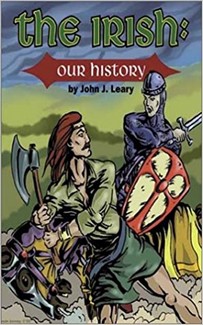
Category: History Publisher: Author House
ISBN-10: 1587210789
Type: Non-Fiction
Pages: 540
Copyright: 2000
A history of the Irish people from earliest times to the mid-nineteenth century Great Famine, when hundreds of thousands left their distressed homeland and emigrated to America and other havens around the world.
This book about the Irish begins on the European Continent because it was there that the Celtic people who later entered Ireland, giving the island its culture and character, made their mark in history. The Celts first emerged as a people hundreds of years before the birth of Christ. Led by an aristocratic warrior class, they dominated most of temperate Europe for nearly seven centuries.
Before the arrival of the Celts in Ireland, the island had been settled by an earlier people who probably migrated over a land bridge that connected Ireland and Scotland. These settlers became the island's first farmers and left a legacy of megalithic monuments still visible today. Ireland's next cultural stage saw the introduction of metallurgy, including iron weapons that were associated with Celtic warriors on the continent.
Celtic culture dominated Ireland until an invasion of Anglo-Normans in 1149 heralded the eventual conquest of the entire island.
Excerpt
While the urban Irish still constitute a political factor in some American cities, their machines have long since been passed by time, the movement to the suburbs by the growing number of affluent Irish families (who, most likely, then started voting Republican), and by demographic changes in the cities themselves. The American Irishman today (or at least one whose father bore an Irish surname) is just as likely to be in banking, a brokerage firm, one of the professions, or working with computers, as engaged in politics. And if he did choose government as a career, it is more probable that he got his job with a graduate degree than with the help of a precinct captain. But that is not to say that the old loyalties to the race have vanished, as Irish Catholics proved with their overwhelming support for the presidential candidacy of John Fitzgerald Kennedy in 1960. Perhaps they thought of him as the embodiment of cultural values that had their beginnings in a distant past on a Gaelic island beyond Europe's Pale. There he would have been recognized as the Ard Ri, Sean Mac Gearailt O Cinneide.
This is the story of the author’s great great grandparents, Edward Lewis and Sarah Crosby, who were convicts transported to Van Diemen’s Land in the 1840s. It is told from the perspective of a detective agency searching for what happened to Edward, w
This is a Hypertext Book Release of the F. Scott Fitzgerald classic This Side of Paradise on Black April 23, 2016 which is William Shakespeare,s 400th birthday.
This book explores how U.S. presidents Dwight D. Eisenhower and John F. Kennedy failed to stand up to Soviet aggression during the early Cold War—despite America's overwhelming nuclear advantage.