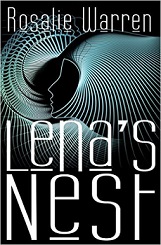
Roboticist Lena Curtis emerges from a coma to find her world has subtly changed. The truth, when she finally accepts it, throws all she believes about her life into question and has her desperately trying to find her children.
Lena Curtis, a robot scientist from our time, emerges from a coma into a world that is somehow not quite right. Slowly and reluctantly, she becomes convinced of the terrifying truth. Can she trace what has become of her children? Can she find a way to exist in this frightening new reality? Might friendship and even love be possible, or will she choose an alternative that, at great cost, will allow her to return to some semblance of her former life?
'Lena's Nest' explores some of the possible consequences of the development of artificial intelligent agents and virtual reality. Written by a former AI researcher, it explores both science and morals. The heroine, a young mother, has helped design intelligent robots and must now face some of the consequences of her own research.
'Lena's Nest', as well as being a tense psychological and sci-fi suspense story, explores some deep philosophical questions incuding self, identity and consciousness, as well as the moral and ethical issues involved in the development of AI. It also sounds the depths of some of humanity's deepest fears.
Named 'Book of the Year 2015' on McRenegades Review. 'Something beyond scifi and all the better for that... I've waited thirty years to read this story...'
"... A brilliant piece of writing! ... Exquisitely terrifying." [from an Amazon review]
Excerpt
She looked away and then back again. Something was wrong. The birthmark was not where it was supposed to be. Jewel’s birthmark was on her left cheek – of course it was. Lena remembered studying it for the first time, as her baby daughter lay in her arms after a long and complicated birth.
‘What’s the matter, Mummy?’ Jewel asked. ‘You’re staring at my face.’
‘Sorry, sweetheart.’ Lena gazed down at the bedcover. What was wrong with her?
It was an after-effect of the coma – it had to be. Lena’s brain was somehow muddling left and right. It wasn’t surprising, when you thought about it. She had been starved of external stimuli for weeks and it was bound to take some time to adjust. It would all settle down, no doubt, as she got used to being conscious again.
Other things were wrong, too. The lack of colour and the fact that she was uncomfortably cold. Her limbs didn’t seem to belong to her and there was a vague sense of something missing – as though something that used to be inside her was no longer there.
Ben reappeared, with his cheering smile. If something was really wrong, he’d know, wouldn’t he? Dr Jones would definitely know. The fact that they were so calm – it must mean everything was all right. Lena took several deep breaths.
‘How are you feeling, Mrs Curtis?’ Ben asked.
His hair, a little wavy, stuck up on the top of his head. He was young – not more than twenty-five. Not bad looking, with that lovely smile. It would be nice to see him in colour, she reflected.
‘I’m fine. Perhaps a bit cold, still.’
‘I’ll get you another blanket in a minute.’ He picked up her hand and squeezed it. It felt like a friendly gesture, but she assumed it was a quick way of testing her temperature.
She couldn’t possibly tell Ben or Dr Jones, could she, that her daughter’s birthmark was on the wrong cheek? They’d think she’d gone nutty, which she began to fear she had. Come to think of it, she had a distinct sense of having a third arm. It extended from the back of her neck, down her spine as far as her midriff. It was becoming uncomfortable to lie on and she wriggled in her bed.
‘Could you just check my back?’ she asked Ben. ‘It feels funny. Is there something there that shouldn’t be?’
‘Can you sit up a bit?’ He supported her as she leaned forward.
His touch set off a tingle in her skin. Her sexual feelings had obviously not been killed off by the coma, which, she supposed, was reassuring to know.
‘Everything looks fine,’ Ben said. ‘Maybe just a crease in your gown. You had no injuries in that region.’
She thanked him and settled back down. The extra arm was still there, but it was ignorable, more or less. She’d tell Dr Jones about it later, she decided – in a jokey, knowing way that would reassure the doctor she hadn’t lost her mind.
Anxiety woke Lena in the early hours, pulsing through her brain in successive waves, each new surge looking for a worry to attach itself to. There were voices in the background: unfamiliar ones.
‘Nothing new. I’ve done a few further checks but they only confirm what we already thought.’
‘No more on the nature of the crash?’
‘Looks like a standard motorway
accident, as far as we can tell. Not suspicious.’
‘Hmmm.’
‘Driving was a dangerous game back then.’
‘Crime was rife, too.’
‘It was a nasty plunge. Those kids were lucky to survive.’
Dr Jones had told her that she’d been driving her children along the Barford bypass, a few miles from home. There’d been a minor collision near a bridge, and somehow Lena’s car had plunged several hundred feet.
Why was she hearing those voices now? Another nightmare, she supposed. It was understandable, after all she’d been through. Not just the coma itself but the shock of waking up and realising that she’d missed out on several weeks of life – of her children’s lives. And the uncomfortable sensation that her body was not properly her own.
Professional Reviews
A story I've waited a long time to read - and it was worth the wait.
I’d say ‘Lena’s Nest’ is up there with Potters films ‘Karaoke’ and ‘Cold Lazarus.’ It’s something beyond sci-fi and all the better for that. Comparing the two I’d say that while Potter uses the flexibility of the visual medium to layer his complex story, ‘Lena’s Nest’ has to rely on the written word to achieve all this. And, remarkably, in my opinion, it rises to the task. It’s not a difficult read in terms of language, but the comfortable pace is all that’s comfortable about it. The dilemma faced by Lena is complex, horribly real and completely absorbing. (Again, maybe I add the caveat, if you’re interested in the relationship between memory, identity, belief and ask yourself ‘what is reality?’ on anything like a regular basis) If you don’t, you might enjoy it as sci-fi, but I think you’ll be missing out on what it’s really all about.
And what is it really all about? Well I’m not going to go into the plot or spoil the story in any way at all. But what I can say is that it kept me completely gripped. I was willing Lena to make some choices, devastated by others she made, and for the first time in a long, long time, I really felt like I was a part of the narrative as I read it. I was, if you want to use the common parlance, a ‘stakeholder’ in the action. It took me less time to read than the Potter epic, but it also took me outside of time itself into a completely other dimension. And that, for me, is the highest accolade one can give a book. All credit to the author!
You can currently pick up Lena’s Nest for a ridiculous £1.99 on Kindle as an ebook. I’m hanging out for it to come out in paperback so I can read it again. And again.
There’s a facebook page and a website for those who like that kind of thing.
I’ve read previous novels by Rosalie Warren (the pen name for Dr Sheila Glasbey) and enjoyed them all. I’ve even ‘met’ her – virtually at least, for a while I was in an online community alongside her – we’ve both moved on as you do. She also gave me some very good leads on reading matter – I was struggling with some experimental structural narrative issues and she introduced me to the strange but wonderful B.S.Johnson for example. But that’s all by the by. At least, it’s a by-product of the modern way in which one can find out about authors and books. Writers are real people too, and if you like their writing, why not get in touch with them and form virtual friendships? In a ‘real’ world that I find increasingly alienating, it’s good to know you can form, develop and ‘exist’ in communities of a virtual nature – and make friends without ever meeting them.
I know that some people are put off by reviews when they think the reader knows the writer – I understand that sycophancy isn’t the best recommendation for whether a work is good or not. But then Amazon reviews are all about ‘product’ anyway, aren’t they? For me, a review is a recommendation, a personal opinion and one that should be genuinely given. If I don’t like something I won’t review it. But when I’ve read a book of the year (which I only discovered by chance when idly scrolling through Facebook one day!) I don’t see any reason why the fact that I virtually ‘know’ the writer should mean my review has less impact. It’s a great book in my opinion. And hopefully I’ve managed to interest you enough to pick up a copy. I’m not on commission. I have no investment. I’m not in a quid pro quo deal. I just think it’s a great book, right!
Cally Wight, Amazon UK review
Exquisitely terrifying
I think we all have our own secret fears, something that once scared us. There’s an element of my own fears in this exquisitely terrifying tale of what our futures might hold.
Two things occur to Lena: she’s either lost her mind, or she’s lost her body.
Am I the only person who ponders what would happen if they discovered life was just an imaginary excursion, perhaps energised by some scientific experiment that either succeeded or went horribly wrong?
We can never really answer those ‘what if’ questions. Sci-fi is a very wide genre and to me this book taps into the essence of being human. What elements do we need to survive? What would we live without? Given the choice, would you pull that plug?
This book gave me shivers of fear and pleasure – a potent combo that this author fully exploited.
Helen Baggott, Amazon review
Back to the future?
Lena Curtis awakes from a coma, into a confusing reality, which rapidly becomes even more confusing, as she's plummeted 90 years into the future. Before her accident, Lena was a scientist in the world of robotics, interested especially in the idea of ethics and artificial intelligence and she discovers a future where many of her ideas seem to have become reality; but also that the world has developed even beyond her imaginings. This gripping novel takes the reader on a roller-coaster ride, and on the way raises questions of identity, personality and what it means to be human. Lena's Nest will leave you with plenty to think about after you've read the last page.
Snake Eyes and Boxcars is a collection of fourteen sci-fi/paranormal stories. Two of the tales are written in the first person and the other twelve authored in the third person writing style. The newly published work is author Jay Dubya's twelfth sto
Chaos on Earth began with an evil snake in the garden, peace can be restored by a Divine snake from the light of the small chandelier that has no power source. Can Jenny and Joseph get help from the planet Jupiter, in time?