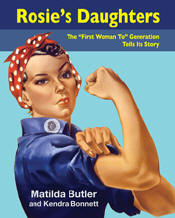
Meet Rosie’s Daughters in this collective memoir of American women born during World War II, the precursors of the Baby Boom generation. Their stories will inform, entertain, and surprise you. In these in-depth interviews, they are declaring their place in history.
Rosie the Riveter is a mythic figure in our culture, with good reason—she built ships, flew bombers and filled thousands of other essential wartime jobs, upending traditional views of “women’s work.” When the war was over, however, American industry thanked Rosie and sent her home.
Rosie’s Daughters flung wide the doors of employment opportunity that Rosie had unlocked. These women can claim more career “firsts” and greater socio-cultural change than any other generation.
Momentous events at critical crossroads in these women’s lives shaped their remarkable journeys—the post-war education boom, sexual revolution and the Pill, civil rights and gender equality, the Vietnam War, NOW and consciousness raising, Roe v. Wade, no-fault divorce, old fields to conquer and new ways to work.
To appeal to a wide range of readers as well as to trigger the reminiscences of all Rosie’s Daughters that pick up this book, the authors employ a variety of visual and written stimuli that capture the essence of the past six decades. The life experiences of a generation are explained, explored and reminisced through historical photographs (many from the National Archives); a timeline of events; interviews and quotations with more than 100 FW2-Generation women; and an interpretive narrative that strives to make sense of the actions and influences of a generation of women.
Excerpt
Rosie's Daughters
In the domestic sphere, most women in Rosie's generation raised their daughters [born between 1940 and 1945] with the same expectations of marriage, homemaking, and child rearing they'd had, but fresh memories of economic hardship and social disruption during the Depression and World War II made them wary of what the future would hold. Rosies encouraged their daughters to attend college and acquire employment skills. Their daughters obtained--though it was woven through marriage, childbearing, and divorce--much more education than women in Rosie's generation had received.
In preparing their daughters for an uncertain future, women in Rosie's generation passed along legacies of adaptability and self-assurance that have helped to make their daughters' lives rich in economic and social contributions as well as self-discovery.
Professional Reviews
Christine L. Borgman, UCLA
“This lively book will resonate not only with those born in the early 1940s but with those of us who arrived a decade later, when sex-segregated help-wanted ads still prevailed and when women interested in math and science careers were steered toward school teaching and nursing. Our daughters, sons, and grandchildren will learn of the experiences, triumphs, and failures of this generation through interviews, anecdotes, and historic photos in Rosie’s Daughters. Matilda Butler and Kendra Bonnett have given us a provocative personal history of our time.”
Walter Bortz, MD, and author of Dare to be 100
“Rosie's Daughters is a testament to the old, a recording of adventures experienced and lessons provided by a unique generation of women. There is much to learn. There is even more to enjoy.”
Betty Auchard, award-winning memoir author of Dancing in My Nightgown
“Diving into the memoir, Rosie's Daughters, was like reading a fun history book where I recognized five generations of my own family. I love the unique format of this book. If I were studying history, I could cram for the test just by riding the “fast track” timeline that runs across the bottom of each page. It is evident that Butler is not only a scholar and psychologist, but a compassionate human being who has added a significant chapter to our U.S. history books. Rosie’s Daughters should be required reading for women’s studies courses.”
The true story of Cheryl Pierson Cuccio who made headlines in 1986 and her husband Rob Cuccio. Cheryl was abused sexually and physically and Rob died for 43 minutes on Cheryl's 43rd birthday.
Inside the Methadone Clinic. Addiction to heroin, methadone, and other opiates. Destruction. The primal addiction" of the child, power and control over your own life, the institutions and the characters, the love between a mother and son. This book i