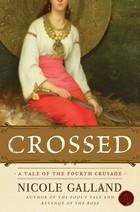
Constantinople, 1204: a sardonic British vagabond is 'adopted' by a German knight and dragged along on the Fourth Crusade - the one Monty Python could have made a movie about without changing much of anything.
Fore a more in-depth description (including photos!) please visit Nicole Galland's home page
Excerpt
ACT I: VENICE
From San Niccolo, that sweltering sand-bar of an island off the coast of Venice, rose a strange tent-city milling with ten thousand unwashed soldiers and their unwashed squires, whores, cooks, priests, horses, heralds, armorers and smiths. They called themselves pilgrims, having taken the cross, having sworn to carry out the pope’s wishes. This meant they were going to an unknown desert, to wrest an unknown city from its unknown inhabitants.
Their transports and warships, waiting in the lagoon – heavy, strong, capacious, lethal – had been built by the Venetians, would be sailed by the Venetians, and at this moment were being stocked with food and water by the Venetians. In two days, the army and its fleet would finally – finally – set sail, after a season of political and financial delays, to do great good for Christendom.
But before they decamped, this would be the site of a gruesome murder-suicide, of such ferocity men would speak of it in fearful whispers, crossing themselves, for years to come.
At least, that was my plan.
As with so many things in this life, I was mistaken.
I leapt from Barzizza’s boat when the water was ankle-deep, trudging angrily through the oily green until I had splashed myself to dry land and the edge of the army camp. Venice was mostly paving stone and water; this was the first time in a month I’d been on living soil. Earth felt comforting under my bare wet feet, but I didn’t want comfort – I wanted death, and was panicked at the thought of being cheated of it. I’d learned half a dozen languages, taught myself to play music I did not like and eaten food I could barely stomach, grown my beard and my hair and woken up every day forcing myself to go on, for three years, to prepare for my exquisite, redemptive death – a death I now feared I’d been robbed of.
I had no weapon, just a spit of iron small enough to fold my hand around: a spike with a hook on one end, stolen from Barzizza’s house, some sort of fishing spear. I don’t remember how I learned which pavilion was the high commander’s nor what trick I used to distract the guards at the door, but the trick was fast accomplished; I was still seething as I scrambled inside, I could still hear my heartbeat pulsing in my temples as my eyes adjusted to the darkness.
There were only two men in this cool, open space: the army commander himself, and a large young knight kneeling to his right, presumably his bodyguard. Both wore tunics decorated with broad gold braids. They were whispering together. Neither was the man I wanted.
“Where are the English?” I shouted.
They started, stared at me; the knight lumbered to his feet grabbing for the dagger in his belt, as the leader responded, in a droll voice, “They are in England, I imagine.”
So it was true, what Barzizza had told me; this final trek had been for nothing. A howl of humiliated rage escaped me. Across my mind flashed the journey back to Britain. I would never survive that. My one chance for revenge had been illusory; my intended victim had never even been in reach. With the warped logic of despair and rage, I decided then that I would still forfeit the one life that was yet mine to take: my own.
Both of the men staring at me now were armed. This would be simple, then: I had only to hurl myself upon the leader, and the bodyguard would kill me instantly.
When you know this one is your final heartbeat, time slows for a final savoring of the senses. In less than a blink I noticed more about my surroundings than I had in years: the feel of the woven-grass mats under my feet, the elaborate, bright decorations on the tent walls, the smell of rosewater and wooly must that pervaded the pavilion, the commander’s aristocratic handsomeness, the likeable face of the young man who was about to skewer me. He had both sword and dagger in his belt; I wondered which he would use.
I also noticed, in that flicker, that I was interrupting something significant. Although the knight had been kneeling, there was an informality between them, as if they were kin. The lord looked oddly relieved by my interruption – until I raised the spike above my head and threw myself at him.
The young man was quick for one so large, but he was nowhere near as quick as I was, and I realized that I could accidentally kill the lord. The lord cringed, but he did not move to protect himself, trusting his knight. I myself did not trust his knight, and as my hands descended, I shirked, pulled back a hair, so that the hooked point of the spike just missed the lord’s skull and only my knuckles glanced off his bald brow; by then the knight had me, huge left paw grabbing me around the throat, huge right one shoving the dagger-point against my liver. So this was it: I was over now, finally and despite everything. Suddenly I was flooded with euphoria and involuntarily, I grinned at him – my executioner, my liberator. His hair and beard gave his face a golden glow. I literally loved him more than my own life.
Our eyes locked; all my weight rested in his clenched left fist around my throat, the knife at my gut, as I waited for him to plunge it in.
He didn’t.
He yanked the blade away and shoved me hard to the matted ground, where I choked on a mouthful of straw.
Something had gone horribly wrong: I wasn’t dead.
The knight said something in a garbled language to the lord, who answered similarly. There was a brief debate, which to this day I cannot remember understanding. Listening in stunned outrage, I gradually recognized it as a Lombard dialect I was familiar with; at that point they could have been speaking in my native tongue and it would have sounded like so much nonsense. I was removed from my own skin, too dazed to understand what was happening.
By the time I registered that I was not only not dead, but – a far worse affair – completely alive, the young man had returned his attention to me. “You’re not a murderer,” he declared. “You’re a suicide. Suicide is a sin and by St. John, I will not assist you in it.”
I gawked. “I just tried to kill your master!” I protested. “Look, you stupid ass, I’ll do it again!” I scrambled to my feet, light-headed, fighting back the urge to scream and laugh hysterically at once, and unsteadily I raised the spike. This time I wouldn’t hesitate, I’d show the whoreson I meant business. He’d have no choice but to cut me down.
But everything seemed to slow. He grabbed me again, both of those meaty mitts reaching for my right hand, and again he heaved me down effortlessly. By the time I hit the floor of the tent, he held my spike. He tossed it away out of my reach. “You pulled back,” he announced. “We both saw it. You made sure not to hurt his lordship the marquis. You are goading me to kill you and I won’t do it. Nor will anybody else.”
He called out, “Richard,” and a sweet-faced boy with a colorless wisp of facial down trotted into the tent. The knight gave him an order and Richard moved toward me, matter-of-factly began to tie my hands in front of me.
“What are you doing?” I shouted, horrified.
“You are now my captive,” the knight informed me – as if I should consider myself lucky. “No more of this nonsense.” Inexplicably, although I no longer liked him, he still seemed to have a warm, earnest glow to him, as if this were his normal state.
“I’m a criminal,” I protested. “Execute me, idiot, do the world a favor.”
He grimaced disapprovingly and shook his head. And then, as if he were my loving older brother trying to teach me a lesson, he said, “From what I’ve seen, you are a sinner, not a criminal, and the burden of a sinner is to repent.”
This could not really be happening. “You want me to repent?” I repeated weakly.
He nodded. The elegant marquis, watching us, looked almost amused now. “You will repent the impulse toward self-murder,” announced the knight. “And whatever blackness is in your soul that drove you to such despair in the first place, you must also repent of that.”
“And then you’ll execute me?” I insisted, desperate.
The marquis laughed. The knight did not. The knight seemed to have nothing resembling a sense of humor at all. He was, it now seemed obvious, German.
Ordinarily I would not have sat there passively, letting some boy-child tie me in knots insufficient to keep a tree from running off. But I’d just tossed myself into the arms of Death… and Death had tossed me back. I was in a state of shock. So when the boy pulled me to standing, I stood. Then, almost as an afterthought, I struggled against his grip. Only because I dimly remembered that I probably should.
“Bind his wrists, but don’t hurt his hands,” the knight said to the boy. “Look at those hands. I think he’s a musician.”
I stopped struggling, startled. I followed the boy out of the tent, blinking stupidly in the brilliant haze of the Venetian afternoon.
Professional Reviews
New York Post
"REQUIRED READING... A funny (really!) look at this disastrous Crusade... It’s a raucous road trip set in the 13th century.”
—The New York Post
Publisher's Weekly
This epic historical adventure…succeeds in being a true guilty pleasure, a rousing shout-out to those past masters of bestselling historical fiction, Frank Yerby, Samuel Shellabarger and Lawrence Schoonover.”
-— Publisher’s Weekly
St. Petersburg TImes
Witty and observant...Nicole Galland is exceptionally well versed in the fine nuances of storytelling and illustrating the combustible nature of mixing religion, commerce and war."
-—St. Petersburg Times
Tralee, Ireland. September 1948.
An arrogant, and highly agitated, priest arrives home after 40 years.
Days later he's dead. Suicide? Or did his past catch up with him?
Dublin 1941. A brutal murder. Mistaken identity. And barman Eamon Foley is running for his life.
Nine months later Foley is in a crowded pub, and his brother-in-law is shot dead.
Shanghai Escapist grabs the faint-of-heart right from the get-go and serves up an ultimatum: What would you do if caught in the same circumstances? From the opening scene, the reader is tossed into the maze of daily intrigue as it existed in 1960s-70