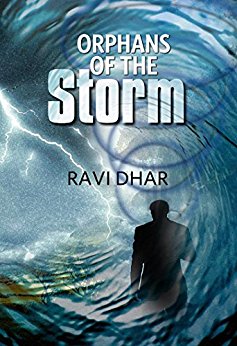
Orphans of the Storm is a novel about Siddhartha and his family, who are uprooted from their land of nativity Kashmir, by Islamist Terrorists, out to cleanse the valley ethnically of all traces of non-Muslim religious communities.
It is a novel about a boy who finds his family completely devastated by the outbreak of militancy in Kashmir valley. It is about his efforts to support his fathers efforts to eke out a living in the migrant camps of Jammu and to educate himself. In the inhospitable environment of Jammu, though he succeeds in earning a Masters degree in English, he sees no hope of settlement. He gets selected as a Lecturer in English in Nagaland University, where he falls in love in the midst of an overwhelming environment of political intrigue and racial conflict. The abrupt end of this love affair hits him hard. But as if this was not enough, he gets isolated in the campus politics that views him with suspicion for proximity to both the groups of faculty. The murder of the Dean draws him into a shell. Life begins to smile yet again when he completes his doctoral thesis and happens to travel together with his future wife from Nagaland to Delhi. The breakdown of the train by which they are travelling gives them the time to come close and by the time they are travelling back from home, the bond between them is already sealed.
Excerpt
The Valley Desecrated
December is the cruellest month of the year. For miles and miles, nothing except an endless carpet of snow … which greets the eye. The hills, the dales, the vudar, the house tops, the leafless willow, the chinar and at times even the streaming river are draped in downy snow. The sky is lifeless without the bulbul, the koel and the brags winging across its length and breadth. So are the khal and the khah. Fastened doors hold life within. All huddled around the bukhari or clinging to the kangri precariously placed between the feet holding fast the hem of the pheran. As night approaches, the eerie stillness deepens. For ages, parents in Kashmir have scared unruly children with the invocation of the name of brahmrachoke, a mighty one-eyed demon, forever wandering in the desolate snow clad fields. With electric lights often playing truant, Kashmiris have their meals in the wee hours of the night and then retire to bed in the comforting light of the storm lantern. The only sound that rips the silence of the night is the occasional thunder and the howling of the blizzard. Otherwise, life stands still both within and without.
The tourist who comes for a few days exults at the sight of snow. He frolics in snow and marvels at the beauty of the snowflakes falling soundlessly on the wide and buxom bosom of mother earth. The only other creatures delighting in snow are the boys and girls who spend hours sculpting new images out of the fallen snow. Some others fight mock
Orphans of the Storm
battles with the broken pieces of til katur hanging off the edges of the rooftops. All the while, the women of the house slog in the kitchen or outdoors to fetch water from the neighbourhood nag or provisions from the neighbourhood shop. The men find the going tough, especially if they have to run an errand some miles off. Trudging in the snow up and down the hillocks with a load on your back can be extremely precarious. Yet, life has to be lived. With this feeling of resignation to an all powerful and all humbling fate, the adult Kashmiri comes to terms with December, the cruellest month of the year.
But, not any more.
There were reports that Kashmiri Pundit girls had been molested in Govt Degree College Anantnag. And when some Pundit boys had objected, they had been roughed up. A warning had also been given to them that they must pay for the deeds of the Govt of India for subjugating the Kashmiri Muslims, that very soon, all of them would be wiped off except their women who will be married off to the Kashmiri Muslim men. Then the valley would be cleansed of the agents of the Indian Government and the infidels.
Reports had also started pouring in of the appearance of posters in public places asking Kashmiri Pundit men to either embrace Islam or prepare for its All Mighty Sword. In many villages, masked men were reported to have barged
10
Ravi Dhar into Kashmiri Pundit houses, ransacked them of all their possessions, abducted the women and shot the men dead. There were also rumours of processions and cavalcades of Islamists proclaiming Nizam-e-Mustafa and death for the Infidels and the traitors. They had seized control of the masjids, from where they had proclaimed their intent to liberate Kashmir from the clutches of Hindu India. Already, it was rumoured that they had increased their raids on Kashmiri Pundit houses, massacring their men, raping their women and using the most brutal and inhuman ways to torture them before killing them off. Kashmiri Muslim neighbours and friends threw up their hands in disgust upon this violent and diabolic distortion of a just religion and whispered to fellow Kashmiri Pundit villagers about their inability to stem this onslaught of the militant fanatics.
Nund Lal Pundit refused to believe these rumours. When he walked through the village, everyone stood up to pay regards to him. Not only the Pundits but the Muslims too bowed to him. He was a pillar of strength in the village. He was one of the biggest landlords. But, this did not make him haughty. Though very stern in his demeanour, he was very caring. His Muslim tenants would often come to him for help. And he denied help to none. Being initiated in the science of ayurveda, he was the first port of call for every sick person in the village. And as it is, diseases came unasked at the most odd hours in most households. And when these came, they rushed to Nund Pundit for relief. Nund Pundit would
11
Orphans of the Storm
scold the attendant for not taking precautions against the sickness while examining the patient and then give medicine.
Out in the fields, he worked like a stallion, never tiring of work. His Muslim tenants were in awe of his brawny personality and steely determination. They loved him from the core of their hearts. So, they did not mind being rebuked by him. Rather, the greater the scolding received, the greater did they feel a sense of proximity to him. He towered above all in the village.
Nund Pundit was deep in meditation in the thokur kuth, when his eldest daughter came rushing into the vot.
‘Baabi, baabi, do you know, Veshan Chikan’s family is leaving. They are loading all their belongings into a truck.
Raghu Nath Kaul’s daughter says that even they will be leaving today. Their truck will be coming in an hour’s time.
She was asking me when we will be leaving.’
‘How do I know, child. It’s for your father to decide.’ ‘Baabi, Veshan Chikan was saying that it is no longer safe for the Pundits to stay in Kashmir. He was saying that the Pundits in Srinagar have already left. And that if we don’t leave, not a single one of us will survive. They’ll kill us all’. Nund Pandit roared in, carrying the morning vermillion tyok in his hand.
‘They are all mad, scaring little girls and boys. Nothing of this kind will ever happen, do you understand that? We are all Kashmiris, brothers and sisters. So what, if one is Hindu
12
Ravi Dhar and another Muslim? Haven’t we all stood by each other in times of need?’
With these authoritative words, Nund Pundit foreclosed any more discussion on the subject. Silenced by her father, Phoola dashed away to the kuth upstairs. In class 10, she was one of the very few students in the village school to have secured a First Division and in Senior Secondary exam, she had repeated this feat. But as the village school of Zainapore was only till class 10, she had to stay back home and appear for the exams of the higher classes as a private candidate.
Five feet ten inches tall, she was the epitome of Kashmiri beauty. Blonde hair, red cheeks and equally red arms gave her an English look. It was only when she opened her mouth to speak that one could get to know that she was Kashmiri. It was also her dazzling beauty that restrained her parents from sending her to the Govt. Degree College in Anantnag. Already, she had created a flutter among the teenagers in the village who would look for opportunities to even catch a glimpse of her.
Feeling rebuked, she strode to the window of the kuth on the first floor, seated herself comfortably with the kangri well in place between her legs under the pheran and shot a glance at the distant horizon. Where exactly was this place… Jammu?
13
Orphans of the Storm
Doora had said that it would take them one day to reach there. Was it so far? What would they do there, without the fields and the orchards to look after? What would happen to their cows? Who would take care of them in their absence? And how would they support themselves in an unknown place? Perhaps, Taathya was right in objecting to this sudden surrender to fear.
‘Phoolaya, Phoolaya, where are you?’
This was her mother.
She got up quickly, shouting back, ‘Baabi, I’m coming’.
Her mother, unlike other women of her age had as yet not changed her traditional attire. The tarag on her head concealed the jet black luxuriance of her hair. A weathered and lean face showed signs of pain undergone in her early life. But, it failed to suppress the geniality of her beautiful matronly face. Gunavati was known in the village to be a deeply religious woman. She woke up even before the twittering of the birds, nesting on the sacred chinar tree in Ragina Devi Mandir. She was the first to enter the portals of the mandir and to offer prayers there.
By the time, the day dawned on the sleepy village of Zainapore; she had completed the cleaning of her three storied house and the filling of all the nate(s) and the gagar(s) with drinking water from the nag, a kilometre away from the house. While her husband prayed in the thokur
14
Ravi Dhar kutha, she busied herself with lighting the firewood in the oven to make sheer chai with czir czuta and food for the day. When she did not feel like making czir czuta, she would make do with takhtacha or the crunchy kulchas bought from the local village baker.
By the time Phoola entered the kitchen, her mother had already poured the sheer chai into the khoses with stems. ‘Where were you dear? Your father has been waiting for his morning tea. Jala kar, hurry up.’
Phoola skimmed the malai on the milk and poured it atop the tea in her father’s khosa. Picking up her father’s khosa with a neat napkin and the czir czuta in a plate, she walked over the low wooden barricade of the kitchen into the vot, where her father was seated near the window.
‘Taathya, please take the khosa of tea’.
Her father turned his face toward her. A fatherly smile of appreciation appeared on his stern face. He outstretched the cuff of his pheran and held the stem of the khosa in it. With another, he held one czir czuta.
‘Lasa bah, Prosper my dear’.
Nund Pundit used a male honorific to address his eldest daughter whenever he was in an affectionate mood. It effaced the memory of the morning outburst. Phoola was again her sprightly self.
15
Orphans of the Storm
‘Where’s your brother?’ her mother asked. ‘He must be still sleeping,’ said Phoola.
‘Go, give him his tea there only then,’ said her mother, pouring a handful of malai on his tea as well.
Phoola carried her brother’s tea to his room on the first floor. She pushed the door open with her toe.
Rattan Lal lay sprawled on his bed; his quilt thrown over the books lying half open, a copy of Filmfare crumpled underneath and the pillow way beyond his head. The room wore a similar disorganized look.
Phoola felt disgusted with the carelessness of her younger brother.
‘Rathov… Rathov…,’ shouted she.
But, there was no impact.
‘Rathov.’
She now shouted, at the top of her voice and also registered a strong kick on his shins.
‘What happened?’ said Rattan Lal, waking up with a start. ‘Chai, for His Majesty.’
He looked angrily at his sister and mumbled, ‘Why can’t you let me sleep in peace!’
He pulled the quilt over his face to go back to sleep.
Phoola enjoyed this daily morning routine of forcing his brother to wake up. She kept the tea and the plate of czir
16
Ravi Dhar czuta on the nearby chowki and walking up to him, she screamed into his ear, ‘chaiiiiiiiiiiiiiii’
Before she could be hit by his lashing arm, she had jumped back a safe distance away. But this foray into his dreamland had the desired effect. He finally woke up.
‘Rathov, you know Veshan Chikan’s family and Raghu Kaul’s family are leaving today.’
‘Who told you this?’
‘I saw it with my own eyes. By now they must’ve loaded the trucks fully.’
‘They are cowards. I will never quit Kashmir. All my friends are here. How can I leave my friends?’
‘Yes, you are right. Mine too. But if all leave..?’
‘Don’t worry, sis. Nothing of this kind will happen. They’re getting scared for nothing.’
‘But, haven’t you heard of what they did in Nadimarg? They wiped off a whole family.’
‘C’mon, be positive, sis. My friends have promised to come to our help if these Shaitans come here. Rajab Ali has assured me. And you know he’s my best friend. He will die if I leave. I can’t betray his faith in me.’
‘Phoolaya, Phoolaya’
‘Go, Baabi is calling you. And don’t worry. Your little brother is there to defend you all.’
Phoola felt proud of her brother’s courageousness. He was a very strong boy. He could lift a sack of rice in one jerk and
17
Orphans of the Storm
carry it for a mile without the twitching of a single muscle.
That’s why all his friends respected him. He had gone after his father in all respects save determination of purpose. He was not a very bright boy in his class. Phoola was not sure if he would be able to clear the Senior Secondary exam even in the second attempt, especially as he was loitering all the time with his friends, talking about films and heroes.
When Phoola walked into the kitchen, she found her little sister, Swati, prattling about their brother, reading in Sainik School Nagrota, Jammu.
‘Baabi, when will lakut veerji come?’
‘I am not sure, your father will know. Go ask him.’
Swati was a little girl of eight years, studying in class III in the village girls’ high school. She was the one who was excited most of all when Siddhartha would come on vacation from school. She enjoyed the tales he cooked for her, most of all the one regarding the monkey on the campus of Sainik School Nagrota. She never felt tired of asking him about the monkey even though he had been relating this story to her for nearly three years now. As it was December, it was time for Siddhartha to come on one month’s winter break.
‘Taathya, Taathya,’ she scurried, screaming to her father,
‘when will lakut veerji come?’ ‘Tomorrow, my child,’ said her father.
18
Ravi Dhar
Hearing this, her face beamed with joy. She darted out to carry this news to her friends, without bothering to hear the cries of her mother and sister, asking her to take her morning tea. Both had come out to watch the excitement on her little face upon hearing the news of her brother’s imminent arrival. She would not come very soon now. She was so sweet a girl that whichever house she would visit she would receive a royal treatment. Everyone treated her as a plaything. They would feed her, coaxing her to eat their best dishes to see her prattle more and still more.
Late in the day, news came in of the brutal killing of Tikka Lal Taploo. Though a Jan Sangh activist, he had always been free from any partisan feelings towards any community. In fact, it was said of him that he had been the saviour of many Muslim workers in the valley. He was a well known lawyer who fought for the underdog in the society. The news spread like wildfire. Mohd. Yusuf Tarigami, the local CPM MLA, came to bolster the sagging morale of the Pundits in the village.
‘Batov, pakhan kadiv vash, fear not, and stretch your wings… let not fear touch you or send you into a huddle. We are all sons of the same soil. How can anyone dictate to me that I should throw my Pundit brother out of Maaj Kashir? I give this right to no one. For the Pundit, they seek to throw out, is the son of this soil and my brother.’
19
Orphans of the Storm
There was commotion in the audience.
‘Hear, hear, what our leader says,’ said one CPM activist, who too happened to be a Muslim.
The commotion subsided.
‘Batov, no one can throw you out. If anyone dares to do that, he will have to throw me out first. And him and him and him and him,’ pointing to the CPM Muslim activists in the audience.
‘I ask these NC leaders, where are you now? You ruled
Kashmir as long as the going was good. When the situation worsened, you took to your heels. Remember, when this snow will melt and things will be beautiful again, they will come back to you for your votes. Ask them then where they were when bullets rained on you and your life was at stake. Look at me. Do I look like one of them? I have no millions to fly off to London and to enjoy in 5 star hotels while
Kashmir bleeds. I am, my dear brothers, like you, a farmer’s son. So, I understand what it means to be asked to flee from one’s fields and one’s hearth? I and my entire Jamaat stand by you in this hour of crisis. Fear not, Allah is Great and Merciful, unlike what these fanatics would make you think.’
The Pundits felt relieved. They thanked the Muslim activists and Tarigami for his support. All the way back home, they sang paeans of this young CPM leader who dared to take on the militants. That night, all the Kashmiri Pundits in the village had a hearty meal before going to bed.
20
Ravi Dhar
Towards the middle of the night, the door of Nund Lal Pundit’s house began to resonate with the pounding of rifle butts. Nund Lal and Gunavatti both sat up upon hearing the noise. So did Phoola and Swati, who came rushing into their parents’ room. Bewilderment turned to fear as the noise rose in pitch and volume.
Why should anyone be pounding the door of their house at this time of the night? The noise that came was clearly of gun butts hitting the door. Had they come for them then? The thought sent a chill down their spines. Each of them stared at the other as if searching for answers. Finding none, they prayed in their hearts. God, please extend your Grace. Save us today from these wolves of men. Nund Lal who in normal circumstances was not the one to give up courage felt helpless against the pack of blood-thirsty hounds of men. He pulled himself out of the morass of fear. He had to act fast. It wouldn’t be long before the door would give way. But, his mind was unable to think up anything. Every time he tried, it hit a stony wall of silence. He could hear the noise of the door giving way. The stairs resounded with the approaching footfalls. Nund Lal rued the time he had decided against quitting the valley. In a last desperate attempt, he fished out the axe lying in the kitchen and waited expectantly for the first of the pack to come in.
They came shouting slogans of ‘Naarai Taqdeer’, ‘Death to the Infidel’ ‘Rape the Batanya and Kill the Bata’ ‘What do
21
Orphans of the Storm
we want?’ ‘Pundit women, without the Pundits’, ‘Allah-o-Akbar’.
They stormed into the room. Nund Pundit raised his axe. But the tornado of fanatic frenzy swept them all off their feet. Gone was the axe and gone the distinction between the hunter and the hunted. The Pundit family was thrown apart, tossed about from man to man, punched, kicked and stabbed. Gunavatti’s tarag was gone and so was her pheran and so her shirt. They pulled her nipples, they slapped her buttocks, they squeezed her breasts, they bit her breasts, they flailed her right, they flailed her left, they stuck deep a stick in her vagina, they stuck deep a stick in her rectum, she cried, they laughed, she sought Mercy, they sought mirth. They milled out like a satiated cobra, leaving a trail of blood and pain.
Long after they had left, Nund Lal Pundit, badly bruised and wounded in every part of his head, trunk and legs, regained consciousness. His half blinded eyes struggled to look around for the trail of death and disaster left by the receding hurricane. Phoola was nowhere to be seen. His wife and daughter lay sprawled in a pool of blood. But, he could hear cries of pain coming from them. So, they were alive!
But where was Phoola? He tried shouting ‘Phoola’ but his blood choked throat could only spew blood. And then a faint memory of his son, Rattan Lal, surfaced. Where was Ratha?
He’d been sleeping upstairs. Was he safe? If safe, then why
22
Ravi Dhar wasn’t he coming to help? Or had he… Nund Pundit could no longer take the load of this agony. He slumped unconscious on the floor.
Outside, the hurricane bore its booty away. Like triumphant columns of Roman warriors bearing aloft the spoils of war, these Defenders of the Faith bore aloft the stripped-naked body of Phoola. Her cries had grown muted. She only whimpered now. The bruises on her body bore bloody pug marks of the wolfish delight with which she had been stripped naked and scratched and slapped and bitten. She lay supine on hands of lust. A sea of hands reached up to ravish her virgin beauty. Tender hands strong hands young hands old hands rich hands poor hands sick hands healthy hands familiar hands unfamiliar hands pious hands impious hands - -- all rose in nightmarish frenzy to satiate their primeval desires, while she mumbled all the while, hey Krishna dwarikavasi kasi yadavnandanah, imam avastha sampraptam anatham nirakhsase.
‘Hear, hear, hear her calling her gods for release,’ said one old man while pawing her left breast and twirling her nipple in sadistic carnal pleasure.
‘Down with her, down with her,’ called the army of lust-inebriated jehadis.
They felled her down like a log of wood freshly hewn off a huge tree.
23
Orphans of the Storm
‘On to her, on to her, ravish her, ravish her, fuck the honour of Hindus, fuck the honour of Hindu India. See how seductively helpless she is, this honour of Hindu India. Plunder her, sunder her, and avenge the subjugation by
Hindu India.’
They fell upon her like the neighbourhood dogs that come calling the moment a hoonyamete is thrown by a Kashmiri Pundit before having his meals. Only this time, the difference was that the hoonyamete was not a handful of boiled rice thrown as an offering to the dogs but a prized possession, snatched from an unwilling Pundit hand.
They bit her cheeks her lips her ears her nose they squeezed her arms her shoulders her breasts they bit her belly her thighs her vulva and then in the fury of lust entered her. She lay unconscious to her defilement. And so did Hindu India. Satiated from the living corpse of her body, they butchered her head, her breasts, her thighs, her legs and then in triumphant bravado threw her body parts around. One of them, who towered above the rest, declared as he kicked her head, ‘Batov, see, this is how we will plunder and sunder India.’ Letting out a blood curdling yell of pleasure, they filed out of the compound of Nund Pundit’s house into the lane and the darkness of the night.
Peace returned to the Pundit neighbourhood. The comatose sky batted not an eyelid. Nor did the air as much as whisper.
24
Ravi Dhar
The occasional hooting of the brags in Ragina Devi Mandir also stopped. While insensitivity and darkness conspired yet another plunder, Nature chose to be the accomplice with its mute testimony.
And then life stirred. A slight creaking of a door a slight squeaking of a window a grey head a black head a blonde head an oval head a square head a rectangular head jutted out of the half open apertures. And then the mice-men and the mice-women tumbled out. The stillness of the neighbourhood was shattered once again. The women commiserated. Some wailed some groaned some beat their breasts some bundled their children away and some fainted seeing the carnage.
The men were vociferous.
‘We told him, it’s no longer safe to stay here. But he was too obstinate to hear.’
‘Look, how he’s paying for that.’
‘It doesn’t help being a pacifist like Gandhi or a secularist like Nehru.’
‘Hey, don’t talk of Nehru. It is he who’s responsible for this.’
‘And how do you say so?’
‘Didn’t he ensure the exit of the Maharaja? Didn’t he thrust
Sheikh Abdullah upon us? It served him right when the Sheikh paid him back by reneging on his promises.’
‘Hey, don’t read history with coloured glasses.’
25
Orphans of the Storm
‘Ok, I won’t. As it is, there is no colour for us now. So, you may keep all the colours for all your Nehruvian enthusiasm.’ The chattering and the clattering continued unabated.
Helios is an award winning novel about a brilliant inventor of new technology, a fallen CEO seeking redemption, and an idealistic youth who comes of age in corporate America.
3 WAY MIRROR is about a lost identity as experienced by a twenty-eight-year old who thinks he's Charles Randall, until strange events suggest otherwise.