Category:
Literary Criticism
Type: Non-Fiction
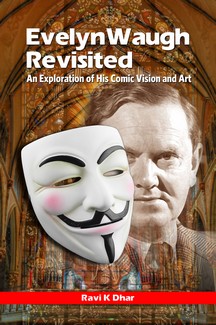
This book appraises Waugh as a major literary voice of his time, speaking for sanity and preservation of eternal values of life, as enshrined according to him in the Roman Catholic Church. The book argues that the emphasis on Roman Catholicism does not take away the universality of his artistic appeal for the readers in different parts of the globe. It extolls Waugh for effecting a sublime transmutation in the comic art.
Contents
Foreword i
Acknowledgements ii
1. Introduction 1
2. The Lesser Comedies 32
Decline and Fall 33
Vile Bodies 56
Black Mischief 76
A Handful of Dust 94
Scoop 111
Put Out More Flags 130
The Loved One 145
The Ordeal of Gilbert Pinfold 167
3. The Greater Comedies 185
Brideshead Revisited 186
Helena 213
The Sword of Honour Trilogy 232
4. Conclusion 265
Index
Excerpt
Chapter 1
Introduction
This book seeks to inform the readers with the ways in which Evelyn Waugh, an early twentieth century novelist, shapes his comic art and vision with his unique understanding of the nature and significance of change and progress in life. The usage of the qualifier, ‘comic’, calls for an explanation here in the context of its application to Waugh. But before it may be done, it is essential to understand the attitude out of which it is born. This, in effect, takes us into the area of historiography, as Waugh understood it.
The onward march of time leaves in its wake a trail of change. Whether this change is progressive in character or not has been a topic of much debate among historians. Two irreconcilable approaches are, however, discernible: one progressive and the other, cyclical. The first approach, traceable to theories of Enlightenment, runs through the thought of both Humanist and Romantic historiography. The second, advanced by cyclical historiographers like Arnold Toynbee, John Dewy and Oswald Spengler, disputes the overwhelming faith in the inevitable progress of mankind. It regards change as cyclical and hence, the idea of progress, a delusion in the long run. Himself a former student of history at Oxford, Waugh inclines to the latter belief.
He maintains:
Progress, as it has been understood since the eighteenth century, has proved a disappointment. For every gain, there has been a compensating, or even preponderating loss. Former ‘progressives’ suspect that they have gained all that is attainable and are in danger of losing it, while others believe that for a century the ‘spirit of the age’ has been moving in a wrong direction.
While Waugh shares with the latter contempt for the false claims of progress, he differs from them in two major respects. Change, according to the cyclical historiographers, travels along a spiral-shaped path which, in spite of obliterating all chances of betterment, does not prevent one from touching a new point at the end of one revolution. Waugh’s notion of change rules out even that possibility. He believe that the circuitous course of change brings one back to one’s original position at the end of each revolution.
The second major point of difference lies in their points of view. While the cyclical historiographers view change from the secular angle, Waugh surveys it from the religious as well as the secular angle. The realization of progress depends on the individual concerned. If he seeks to achieve it through secular change, he shall be caught in the futility of circuitous change. But, if he wishes to do so through religious change, he shall move along a linear path, starting from the unstable circumference and ending at the ever-stable transcendental hub of the wheel of life. The end of such a spiritual odyssey promises hope and regeneration. It is this idea of progress that is central to Waugh’s attitude to change and progress. That is why Waugh writes:
I believe that man is, by nature, an exile and will never be self-sufficient or complete on this earth; that his chances of happiness and virtue, here, remain more or less constant through the centuries and, generally speaking, are not much affected by the political and economic conditions in which he lives; that the balance of good and evil tends to return to a norm.
As Waugh’s comic vision and art are rooted in both these attitudes of change, it is useful to understand the word ‘comic’ in the context of both. The comic vision of life that emerges out of the secular attitude to change is of the nature of absurdity. The man, who attempts to achieve progress though secular change, is caught in the demonic circle of meaninglessness and futility. The ‘comic’ here connotes absurdity, in the sense in which Eugene Ionesco defines it as ‘that which is devoid of purpose, …. Cut off from his religious, metaphysical, and transcendental roots, man is lost; all his actions become senseless, absurd, useless.’
However, in order to understand the comic nature of the persons deluded by the apparently progressive nature of secular change, we also need to define the word ‘comic’, after the manner of Plato in Philebus, as ‘a vice which gets its name from a certain habit of mind, and is that particular form of this vice which exhibits the contrary of the state of soul spoken of in the inscription at Delphi.’ Put more precisely, it may be said that comic characters suffer from a ‘foolish false conceit of themselves’.
By mistaking change for progress, the comic character exposes himself to our ridicule. Yet, our ridicule is never allowed to touch the borderline of condemnation, as the comic writer also makes us sympathise with the ignorance of the comic character. This saves characters in a comedy from becoming the butt of satiric ridicule. Plato plays up the significance of sympathy in ‘comic catharsis’ when he distinguishes between those suitable for ‘the singular blending of pleasure with pain’ and those who are not.’ In a somewhat similar strain, Northrop Frye maintains that the comic catharsis ‘raises sympathy and ridicule’ . It may, therefore, be said that comedy unlike satire, elicits the sympathy of the reader for the person ridiculed. Reacting to Bergson’s suggestion that the comic is unfeeling, Eric Bentley too observes:
Precisely that anti-emotional attitude which Bergson attributes to the comic in general belongs… to farce in particular. Farce, not comedy, is ‘unfeeling’. Conversely, the bitterness and sadness that so readily come to the surface constitute our first, best evidence that in comedy feeling is not only present but abundant.
In marked contrast with the comic vision that emerges from secular attitude to change is the comic vision that is forged by the religious attitude to change. Gone is the ennui and futility of an absurd world. It is replaced by hope and meaningfulness of life imparted by the regenerative character of religious change. No wonder then that the superior vision of life realized here also has a sublimating effect on the meaning of the word ‘comic’. In view of this development in Waugh, I have redefined the word ‘comic’ here on the lines of Northrop Frye and Eric Bentley. Frye seeks to restore to the comic art the grandeur which the classical notion of comedy had taken away, when he observes that the ‘ritual pattern behind the catharsis of comedy is the resurrection that follows the death, the epiphany or manifestation of the risen hero.’ This is precisely the pattern that emerges in those of Waugh’s novels, which unfold his ultimate comic vision of life. That such a view of comedy is often ignored by critics who argue, on the lines of Aristotle, that comedy deals with low action performed by low characters should not deter us from endowing the comic with grandeur and splendour. Eric Bentley has rightly observed:
Yet, if comedy begins in the kitchen and the bedroom, it can walk out under the stars. It can attain to grandeur. If this is not generally admitted, it is only because any comedy that has grandeur is immediately stamped as Not a Comedy.
Echoing Frye, he maintains that the ‘comic dramatist’s starting point is misery; the joy at his destination is a superb and thrilling transcendence.’
In the comic vision of this kind, the comic character, by transcending the limitations that render him ridiculous, attains grandeur and splendour both in his conduct and personality. The word ‘comic’, thus, undergoes a semantic volte-face in its application to character here. It no longer signifies foolish conceit. Instead, it connotes freedom from ignorance and admission to the wonderland of truth and meaningfulness. Eric Bentley has, therefore, rightly remarked, ‘Now the art of comedy is an undeceiving, an emancipation from error, an unmasking, an art, if you will, of denouement or untying.’
Evelyn Waugh represents the post-modernist tradition in modern British fiction. In marked contract with the avant-garde movement, it emphasized solving “the problems of ‘structuring’ history in literature… in rather a different way – for instance, by allowing the concern with crisis and change to become part of the matter of literature, rather than as a feature of its experimental form” Ronald Firbank stood for Waugh as a shining example of this change in fictional style. In an essay on Firbank, Waugh explains how the former solved the problem of representation in fiction. He remarks:
Other solutions are offered of the some problem (representation in fiction), but in them the author has been forced into a subjective attitude to his material; Firbank remained objective and emphasized the fact which his contemporaries were neglecting that the novel should be directed for entertainment.
Taking a cue from his literary ideal, Waugh preferred to retain the classical attitude of objectivity toward his work for the sake of entertaining his readers rather than confusing them in a subjective maze. This did not, however, adversely impact upon his concern with communicating his personal vision. The recurrent use of symbolic images and a highly stylized plot convey the author’s comic vision of life amply.
However, a prominent stream of literary criticism has tended to condemn Waugh for his supposed lack of values owing to its inability to see though his objective style. Waugh is treated as a splendid entertainer devoid of any significant attitude to life that can earn him place among the literary greats. This attitude is discernible among both, the reviewers and the critics. Among the reviewers, Gerald Gould , Arnold Bennett and Desmond Shawe-Taylor are appreciative of Waugh’s brilliant sense of humour but not of the equally profound philosophical point of view that informs it. Similarly, Eric Linklater and Ernest Oldmeadow not only fail to understand Waugh’s comic vision but also castigate him for reasons that are not supported by facts in the novels. The former accuses Waugh of being ‘so abominably subversive as to mock the idea of progress’ and the latter contends that his novels are ‘a disgrace to anybody professing the Catholic name’ . John Brophy is candid enough to confess his inability to locate the moral centre of Waugh’s comic vision. In considering ‘Europe a more effective background…than the other continents’ in Waugh, Derek Verschoyle disregards Waugh’s preoccupation with the idea of change and progress that shapes his comic vision and art. Though Waugh’s early novels received rave reviews from Rose Macaulay, yet they too are myopic in getting at the significance of Waugh’s comic novels. She is of the opinion that Waugh is one of those gifted writers who ‘step aside, turn an oblique glance on the world they know, reject it, and, half deliberate, half instinctive, compose one of their own making, a would within a world, in which they can move and invent with greater felicity, sureness and ease’. Her praise does more harm than good. By dissociating Waugh from the world of reality, she deprives the comic vision manifest in his novels of any sound metaphysical basis. Her dissatisfaction with the Catholic novels, in which Waugh reveals the philosophical basis of his comic vision and art, is understandable in the context of her desire that ‘he should speedily retrace his steps’ to the ‘baroque circus tent’ of his imagination.
A survey of recent criticism reveals that Waugh’s art of objective narration continues to act as a Kafkaesque castle for a number of critics also. Louis O. Coxe opines:
A high moral purpose, working in the fury and mire of human veins, and low shifts men stoop to: this is the double theme of classical comedy and satire, and it is just here, I believe, that Mr. Waugh fails for all his real virtues of wit and style.
Even though Gilbert Highet accepts Waugh’s works as examples of successful satire, he does not attribute any definable set of values to them. He argues quite unacceptably that both virtue and vice are ridiculed in Waugh. He remarks:
The main point of this is the double-edged satire that the good are dull and stupid, and that the beautiful and rich are corrupt and ruthless: the world is not governed by moral principles, or even by orderly reason, but by chance and the power of the absurd.
Highet overlooks the fact that the absurdity found in Waugh’s comic universe owes not to a lack of principles but to man’s decision to abjure them and to lead a secular life of self-delusion. By suggesting that Waugh writes “at once social chronicle and fantasy in a spirit of comic delight that absolves him from consistent moral presentation” , Malcolm Bradbury takes up a familiar stand. Though A.E. Dyson grants success to Waugh in ‘the fineness of his style’, yet he deprives his works of any morally coherent comic vision, when he argues:
Much of his success depends on the fineness of his style; ‘fine style’ thought of in the old fashioned way, as felicity of utterance, wit, charm, rather than as vital union of form and moral content. His bons mots deserve to be repeated exactly. Take away the verbal precision, and you crash down too violently on the meaning.
Martin Green mistakenly observes that Waugh is ‘both for and against everyone, or rather no one’. By arguing thus, he muddles up the moral issues in Waugh’s comic vision of life. Though James F. Carens recognizes the positive aspect of the works beginning with Brideshead Revisited, he does not do so in the case of the earlier novels, which he regards as ‘generally negative and destructive; and, consequently, Waugh is criticized for lacking a high moral purpose and writing satire without a moral centre.’ Graham Martin’s analysis suffers from the same malady that has plagued the preceding ones. He fails to see ‘any alternative position in whose terms the attack (on modern civilization) can be understood’. Therefore, he contends, ‘Except in a kind of brilliant faking, Waugh never goes beyond the external accuracy of observation which served him in the satires.’ His indictment is, perhaps, one of the best examples of how one of Waugh’s artistic strengths, his objective style, turns into an artistic weakness, in the eyes of some critics. They ignore that language and the form of fictional work can be made to reveal the author’s personal vision of life even without direct authorial intrusions. That Waugh could do so speaks of his firm and commendable grasp over the technicalities of his art.
While the impenetrable objectivity of Waugh’s fictional style has led some critics to the point of denying the presence of ‘an implied author’ in his works, his much too vocal public persona has misled others to superimposing the views of Waugh, the man, on Waugh, the ‘implied author’. Waugh’s personal life style and stray remarks betrayed a predilection for the antiquated rather than the modern. His biography by Christopher Sykes records how he preferred to stay in imposing gothic houses rather than in a modern one. But Waugh was not unaware of this shortcoming in his own self. In A Little Learning, he confesses to having fallen a victim, early in his life, to the Englishman’s confusion of the antiquated with the sublime.
But critics have preferred to stonewall the significance of this introspective condemnation and Waugh is shown to be playing up the importance of old English values as enshrined in the obsolescent institution of chivalry. He is, thus, misunderstood to be representing in modern English literature, a reactionary trend to the valuelessness of modern times. As Martin J. Stannard has rightly observed, ‘In an age of egalitarianism, Waugh has often seemed a redundant elitist’. Prominent among the reviewers who have followed this line of critical approach are Donat O’Donnell, J.B. Priestley, David Pryce-Jones, V.S. Pritchett, Gore Vidal and Simon Raven. Donat O’Donnell argues that ‘the main emotional constituent of Mr. Waugh’s religion – using the term in a wide sense - is a deep English romanticism.’ Similarly, J.B. Priestley notices in Waugh an attempt to bolster redundant aristocratic values apart from those enjoined by Roman Catholicism. He observes that he ‘is an author pretending to be a Catholic landed gentleman’. David Pryce-Jones stresses that ‘it is the old order that matters to Evelyn Waugh’ and that he tries ‘to enlist (in his works) our sympathy for the old order, our sorrow at the financial and moral collapse of the aristocracy...’ In a way, V.S. Pritchett accepts the idea of class-snobbery in Waugh, when he tries to play down its significance by observing, ‘To object to his snobbery is as futile as objecting to cricket, for every summer the damn game comes round again whether you like it or not.’ Gore Vidal argues that Waugh indulges in ‘romantic day dreams which are not only quite as unpleasant as the things he satirises, but tend in their silliness to undermine his authority as critic.’ Though Simon Raven recognizes the significance of Roman Catholicism as a symbol of order and goodness in Waugh, yet he too imputes aristocratic values to him. Waugh was justifiably stung by these reviews. A cardinal principle of literary criticism is violated here. The man with whom the works are associated is substituted for the artist-narrator who created them. Consequently his works are condemned for what they themselves reject.
A survey of the somewhat comprehensive criticism reveals the continuation of this tendency in a good number of critiques on Waugh. It goes to Stephen J. Greenblatt’s credit that he should have focused attention, perhaps for the first time, on the significance of the wheel-imagery in understanding the comic vision of life in Evelyn Waugh. But, it is precisely in doing so that he errs. Though there can be no two opinions about the primacy of the wheel-imagery noticed by him, his inference from it is unacceptable. He misconstrues the circular motion of the wheel to imply the meaninglessness of action or change merely in modern times. As a result, he too localizes the moral centre of Waugh’s comic vision in ‘the value structures of the past’ . He argues that the circular motion of the wheel in Waugh is symbolic of an example of the upper-class novel and attributes to it the limited and fragmentary vision of such a novel. He also detects an ambivalent attitude towards the upper classes in Waugh’s novels: ‘the need to defend at certain crucial points, an upper-class world which is also satirized’ . Bernard Bergonzi, in his initial appraisal of Waugh, adopts the right stand. In his review of A Handful of Dust, he had rightly maintained that
...in its treatment of the doomed Gothic hero – not yet a Catholic hero – it points forward to such ambitions later novels as Brideshead Revisited and, in particular, the Sword of Honour trilogy where Guy Crouchback, a more complex and developed version of Tony Last in the early novel… realizes the insufficiency of the gentlemanly ideal and is stripped of his romantic illusions.
But in The Situation of the Novel, Bergonzi seems to have changed his stand altogether. He argues here:
The total pattern of Waugh’s work reveals a consciousness that is indeed dedicated to looking backward, to reliving the past and trying to preserve its values, and which ultimately is unable to resist the pressures of modernity, although it never willingly surrenders to them.
The thrust of the analysis by Jeffrey Heath is on showing how Waugh’s own search for a refuge that promises order and harmony from the cramping confines of an irrational and chaotic world gets carried over into his novels.
His search was so urgent that it inevitably carried over into his novels, where it became a major motif, and if we examine the refuges in Waugh’s fiction we may discern a pattern which illuminates the core of his work and personality.
Accordingly, he classifies his fiction into two segments: the one written before Brideshead Revisited and that written after it. While in the former, ‘Waugh’s protagonists typically find solitary refuges which are false’, ‘in the fiction of later date they discover the correct refuge which has been adumbrated by the false ones; the Household of the Faith’. The adoption of a biographical approach, however, tells upon his critical insights. Like Terry Eagleton, he discerns in Waugh an ambivalent attitude towards the objects of his comic ridicule. He presumes that ‘Waugh disapproves of what delights him, and is fascinated by what he deplores.’
S.M. Pandeya, in a more recent analysis, argues after Peter Green, that the romantic nostalgia for the ancien regime provides the moral centre to Waugh’s comic vision and art. Pandeya bases his argument on a passage in Decline and Fall that reads:
‘English spring’, thought Paul. ‘In the dreaming ancestral beauty of the English country’. Surely, he thought, these great chestnuts in the morning sun stood for something enduring and serene in a world that has lost its reason and would so stand when the chaos and confusion were forgotten?
Its interpretation by David Lodge aptly invalidates Pandeya’s stand.
The preceding analysis of criticism on Waugh may foster the impression that criticism has run completely amuck in the case of Waugh. But it is not so. There has been a steady stream of literary criticism that has recognized the moral centre of Waugh’s comic vision and art in the Roman Catholic values of life, as opposed to any secular values. Accordingly, the merits and demerits of Waugh’s comic vision and art, as unfolded aesthetically, have been pointed out and his literary achievement been assessed. Traces of it can be found even in the early reviews. John Bayley, F.J. Stopp, and Brigid Brophy best represent this section of reviewers. John Bayley emphasizes the primacy of Roman Catholicism in Waugh, when he remarks that both ‘Evelyn Waugh and Graham Greene are writers who use their Catholicism as a weapon and probe; they explore vice and anarchy from a definite standpoint’.
But the point of his argument lies in his hope that “Evelyn Waugh and Graham Greene will not be taken too seriously and will not attract too many disciples’. By calling his concern with the Roman Catholic values of life as partisan, he detracts attention from the aesthetic significance of Waugh’s view-point. F.J. Stop has, in a way, set criticism right on this point. He not only draws attention towards the Catholic standpoint of the novels but also warns against judging the artist’s achievement in a manner other than aesthetic. He rightly argues:
Lord Marchmain’s change of heart and Charles Ryder’s conversion, Helena’s heroic virtue and her discovery of the fragments of the True Cross… are all matters which are the appropriate subjects of aesthetic delineation. But they are not problems for solution, since the novel is not a spiritual case- history. It is enough for the novelist that such things are humanly possible: his task is limited to making them humanly and poetically probable.
Brigid Brophy too has rightly noticed Waugh’s concern with the rejection of the inadequate past and the acceptance of Raman Catholic values. She observes:
Mr. Waugh, after stating that Brideshead in contrast to the first novel by Waugh, was ‘not meant to be funny’ declared its ‘general theme’ to be ‘romantic and eschatological’: the really extraordinary thing is that precisely the same is true of the general theme of Waugh’s novels.
She, however, does not speak of the simultaneous rejection of the modern way of life in Waugh. It is essential to do so in case one is to understand the supremacy of Roman Catholic values of life over the temporal ones.
The problem with the reviews on Waugh is that they are either sketchy or inadequate. Detailed attention to this concern in Waugh is more forthcoming in critiques written by Stephen Spender, Christopher Hollis, A.A. De Vitis, David Lodge, and Richard Johnstone. Spender considers the emphasis on Roman Catholicism as self –defeating and an artistic blunder on the part of Waugh. He argues:
It is when he identifies his prejudices with a moralizing religion that qualities anachronistic and absurd in his view of life – intolerance, bigotry and self-righteousness – work against his talent, and even tend to caricature the very ideas he is supposed to be supporting.
Far from undermining his art, the Roman Catholic thrust of Waugh’s fiction gives his comic vision and art depth and stability. Christopher Hollis recognizes Waugh’s development as a novelist alongside his pre-occupation with perfecting a literary form that could adequately convey his religious interest. But he refrains from showing how this affects ultimately his comic vision and art. A.A. De Vitis takes a provincial view of comedy when he argues that Waugh succeeds only in the so-called early comic novels and not in the ‘confines of the traditionally serious (Catholic) novel’. He ignores the sublime heights the so-called traditionally serious novels attain. Also, he overlooks how language and fictional form are made to blend with his comic vision to achieve a unique aesthetic expression. David Lodge’s analysis, though brief, is decidedly superior to that of most other critics in this group and also an improvement over Stephen Jay Greenblatt’s work. Unlike the latter, he does not commit the mistake of associating the moral centre of Waugh’s comic vision with the value structures of the past. He recognizes that Waugh’s Christian anti-humanism leaves no room for the acceptance of any secular value system.
But the thrust of his critique is on Waugh’s success in the artistic portrayal of the ‘myth of decline’. David Lodge’s analysis focuses attention only on the degradation that creeps into human society when it tries to achieve progress through secular change. It, therefore, takes a partial view of the vision that emerges from Waugh’s works. Though Richard Johnstone has rightly perceived the significance of Roman Catholic values of life in Waugh’s comic vision, yet he is concerned more with trying to show Waugh’s lack of intellectual conviction in it than in trying to show how it grows out of his work artistically. He argues:
The order imposed here by Waugh’s Catholicism is, like Updike’s Marxism, no more logically convincing than any of the other means of ordering existence that are dismissed in Journey to the Border or in A Handful of Dust. The power of the belief springs not from any inherent compelling logic, but from the individual’s overwhelming will to believe.
By asking for logical necessity in a work of art, he overlooks the fact that a work of art is not a logical treatise but an aesthetic expression of the narrator-author’s vision of life.
In order that a true estimate of Waugh’s artistic capabilities and achievements may be made, it is of paramount importance that his comic vision and art be understood not only from the Roman Catholic point of view but also in terms of his singular attitude to change and progress. I, therefore intend to show, in the following pages of this book, how Waugh’s comic vision of life grows effortlessly and, above all, with artistic facility, out of his singular approach to the concept of change and progress. In trying to substantiate that, I would also like to underline the fact that Waugh’s genius is quintessentially comic and not satiric, as many critics have tended to suggest.
The world that confronted Waugh was not only caught up in the cyclorama of change but was also obsessed by it. The sense of change felt by man in the twentieth century has been unparalleled compared to any other age. The world has presented so changing a face that it has been difficult to reconcile with the long and continuous string of changes. Malcolm Bradbury has rightly summed up the modern situation thus:
Living now is not at all like living then. We live in a world of persistent change, where the past is dead and the present is dying; our pressing imperatives are drawn from a temporal location somewhere between the present and the future. Our problems are persistently novel; and precedent and the past are unpromising guides. And so to be modern is not only to live now, but to live now in a certain way.
What Bradbury emphasizes while defining ‘modernity’ is the act of living now in a persistently changing environment. Bradbury seems to echo Jung, who maintains in a somewhat similar strain:
…the modern man is a newly formed human being: a modern problem is a question which has just arisen and whose answer lies in the future; the exemplary modern man is moving towards a fuller consciousness of the present and finds that the ways of life which correspond to earlier levels of consciousness pall on him.
Behind this unprecedented pace of change lie, however, the hopes and aspirations of the Humanist and Enlightenment historiographers who by their secular utterances have helped man humanize history to the point of seeking fulfilment with its bounds. The urbanisation and democratization that the English and other European societies have undergone in the wake of industrialisation have particularly proved their point right. Progress can be achieved on earth through means totally within man’s reach. Man only needs to quicken the pace of change by ushering the world into a technological era.
It is at this very moment of celebration of man’s progress through secular change that a strong anti-progressive view of history was shaping itself in the unsettling revelation of Freud’s psychological theories and those of the new generation of physicists. Freud belittled the significance of reason in human conduct when he drew attention to the tendency of human mind to rationalize the subliminal desires pressing for satiation. Suddenly, reason lost the pre-eminence it was granted by the Enlightenment theorists and it was reduced to the rank of a handmaid of the powerful irrational unconscious mind. The savage in man stood revealed and man could no longer turn a blind eye to this overwhelming reality. If the reason of man could not be trusted, then how could the notion of secular progress be accepted? The civilized man, by being vulnerable to the same irrational drives of the unconscious mind as the barbarian is, presented a picture of helplessness and stagnation.
The advances in physics compounded this feeling of uncertainty and anti progressiveness. The concern of science with ‘models of reality’ rather than reality itself came to be recognized. This introduced a note of subjectivity in the hitherto objective science. The knowledge, that science uncovered relative truths and not the absolute one, added to the intellectual confusion. Man began to realize the amorphous nature of a relativistic world. Both science and reason proved inadequate guides to progress that could be lasting and true. The modern age has thus concretised the fears and apprehensions of the cyclical historiographers in a way that no other age has done. That Waugh was not insensitive to this obsession of the age with change is obvious from what he has to say about the nature of its occurrence in rural England:
The process is notorious and inevitable. Expostulation is futile, lament tedious. This is part of the grim cyclorama of spoliation which surrounded all English experience in this century…
In coming to terms with it, however, he chooses a path which resembles neither that of the progressives nor that of the anti-progressive cyclical historiographers. Even though it is individualistic, yet it is not outside the tradition of Roman Catholic Church. Waugh is one with the cyclical historiographers in rejecting the claim of linear secular change. In his opinion, the quest for progress through secular change is a sheer mirage. He sees a ray of hope for humanity in only the religious transformation of man’s outlook and conduct. According to him, man can hope to progress if he gives up the secular outlook and elects religious change as the high road to progress. It is this dual approach to the phenomena of change and progress that informs his profound comic vision of life. It speaks highly of Waugh that he should have been able to outline this metaphysic right in his first major novel, Decline and Fall.
The image of the revolving wheel that Waugh invokes here is central to an understanding of the metaphysical basic of his comic vision of life. Its significance is persistently felt in its recurrent use, obvious or concealed throughout the entire length of Waugh’s fictional work. The wheel is metaphorically compared to life. At this point, however, a distinction is made between the commonly held notion of life and the one suggested here. This difference is clarified with the help of the imagery of the wheel that is placed in a circular room with seats for spectators. The rotating wheel offers three choices. One can simply be seated in the spectators’ gallery and watch the fun, signifying the decision to simply play the role of an objective observer of the action of life. The other choice offered is of jumping on to the wheel and daring to race along its circular motion by overcoming its unsettling motion, signifying the decision to jump into the action of life, braving the instability of change. There is a third option too. After jumping on to the rotating wheel, one could choose to pierce through its mazy motion towards its stable centre, signifying the decision to choose an action that is directed towards peace and stability. Waugh observes:
People don’t see that when they say “life” they mean two different things. They can simply mean existence, with its physiological implication of growth and organic change. They can’t escape that even by death, but because that’s inevitable they think the other idea of life is too – the scrambling and excitement and bumps and the effort to get to the middle, and when we do get to the middle, it’s just as if we never started. It’s so odd.
It goes to the credit of Waugh that he expounds his vision of life in a somewhat tongue-in-cheek manner through a character who least qualifies for this role. But, as the narratives in novel after novel testify, this is the presiding imagery around which his works are woven. It, therefore, becomes important to understand the significance of this primary image.
Waugh clearly draws a distinction between three modes of living life. One, in which a person withdraws from the normal business of life and only accepts change inasmuch as it is unavoidable such as the biological processes of life. Such people are indolent and can be found peopling his works in the rural settings, where the laid back life of agricultural economy allows them the luxury of such a withdrawal from the hectic action of life. Waugh calls them static characters. The second mode is one in which people struggle to build empires, big or small, by virtue of their individual industry. Such people can be found peopling his works in the urban settings, where people try to match the breakneck pace of social and economic change with their individual enterprise to steal a march over the other. Waugh calls them dynamic characters. Comic fun arises when a static character strays into the world of change represented by the wheel and tries to ape the ways of the dynamic denizens of the world of secular change. He is rescued only when he realizes that he is unfit for the world he has strayed into.
The philosophical basis of Waugh’s comic vision and art, however, runs deeper than that. Apart from the static and the dynamic modes of life, there is a third mode as well. Unlike the first two, the third mode of life does not negate life by withdrawing from its action by seeking refuges like the one offered by the fast disappearing rural economy or engaging in the thoughtless pursuit of success through secular change as glorified in the project of modernity by the Enlightenment historiographers. It accepts life as it is and seeks to transform it by heading for the transcendental core/hub of the wheel of life, which alone promises true and abiding progress. Just as the hub of the rotating wheel transcends the absurdity of its circuitous motion, Roman Catholicism, the faith of Waugh’s own deliberate volition, transcends the absurdity of secular change for it is the temporal representative of eternal and transcendent reality in this life. In the story Out of Depth, Rip Van Winkle wakes up after five hundred years of slumber and discovers to his utter surprise that the entire world has changed beyond measure but for the Church. In this utterly changed world, Rip sees one sign of permanence: the Roman Catholic Church. Only it has not undergone any change, the service in Latin continues and the sacrament is administered without any change, Again in Edmund Campion, the Jesuit priest expresses similar views in a striking manner.
‘Make the best of Rome’, he (Edmund Campion) wrote later to Gregory Martin. ‘Do you see the dead corpse of that Imperial city? What can be glorious in life, if such wealth and beauty has come to nothing? But who has stood firm in these wretched changes – what survives? The relics of the Saints and the chair of the Fisherman.’
Suffice it to say then that the Roman Catholic Church stood for Waugh as an eternal reminder of an immutable reality. Keeping out of the Church means, therefore, losing the eternal perspective of Roman Catholicism and gaining a secular outlook on life, which is akin to racing on a rotating wheel.
Consequently, a person who steps on the wheel of life is confronted with two options. He may either choose to go along with the circular motion of the wheel or else direct his efforts towards the hub of the wheel by cutting through the circular motion of the revolving wheel. The desire to go along with the motion of the wheel implies readiness to participate in secular change for human betterment and progress. This is what the progressive thinkers have been emphasizing and this is what science has been trying to achieve with its cocksure positivism. However, as the graph of this change indicates such efforts are foredoomed to failure. Progress involves not merely a movement in time and space, as change does, but a considerably perceptible shift in the position of the individual or the society undergoing change that is amenable to value judgment. This, however, is precisely what the circular motion of the wheel does not impart to the secular efforts of man. The wheel of life with its circular motion brings the subject, undergoing change, back to its original position once it completes one revolution. Moreover, no position on the circle of the wheel can be adjudged better than another. Eugene Ionesco’s definition of absurdity aptly defines the nature of secular change. Cut off from the transcendental source of his existence, man gropes in the dark when he undertakes to achieve progress through secular change. His fate is as absurd as that of Sisyphus. The fact that the participant in this change, called dynamic character by Waugh, refuses to see the absurdity of his action in the beginning renders him comic. The shattering of the illusion makes his end grim and gives the comic vision unfolded here, a dark tinge. That is way, Waugh has also been called, many times, a writer of black humour. The incipient tragedy within the comic situation obtaining here precludes the censure of the individual. It demands, instead, our sympathy for the person ridiculed. A suitable example of such a dynamic character in Waugh is Seth, the Emperor of Azania, in Black Mischief. The novels that unfold the comic vision of absurdity have been classified in this book the ‘lesser comedies’. In choosing and using this term for these novels, I have been guided by the quality of vision unfolded in them.
The rejection of the circular motion of the wheel of life for the linear motion directed toward the stable hub of the wheel of life implies a desire to achieve progress not through delusive secular change but through religious change. This is precisely what Roman Catholicism aims at: deflecting men from the ‘wasteland’ of sin towards the rejuvenating world of prelapsarian reality. As the graph of this change indicates, such an effort is bound to meet with success as the linear course of this change is very much amenable to value judgment. Besides, as the person, undergoing this change, approaches the hub, he has to face less and still less the destabilising impact of the circular motion of the rotating wheel. This means his progress becomes perceptible in the degree of stability he has achieved on the linear course of religious change. The final moment of triumph comes when he reaches the transcendent hub of the wheel of life for no sooner does he reach there than he is liberated from the shackles of the secular world of change. The moment of arrival is accompanied with the bliss of immutable transcendental reality. In Waugh, such an act is conveyed through conversion to Roman Catholicism and a staunch adherence to its doctrine. The best example of such a character in Waugh is Helena. I have called the characters willing to undergo this change, ‘spritual elites’ for their superiority owes to their superior attitude to life. Some of these characters, however, do not realize this in the beginning. It is then that they become butts of comic ridicule. But no sooner do they reject the path of secular change and embark on that of religious change than they cease to be so. Yet they continue to remain essentially comic characters, for the act of emerging out of ignorance into the light of knowledge is also a part of comedy, as Eric Bentley has also emphasized. The comic vision that is unfolded here is of the nature of resurrection and epiphany. This makes the comic outlook presented here at once Christian and universal in appeal. The sense of joy and transcendence of misery at the end of the comic hero’s journey is the hallmark of greater comedies. Accordingly, I have termed the novels which play up this sublime comic vision, ‘greater comedies’. These comedies speak of the artistic maturity and insight that Waugh achieved in his literary career and shall, therefore, remain the foundation of any valid evaluation of Waugh as an important twentieth century writer.
In trying to gauge the extent of Waugh’s ability in conveying his comic vision of life successfully through his comic art, I have been guided more by aesthetic considerations than any other. Primacy has, therefore, been given to the ‘implied author’ in the literary works rather than the man with whom the works are otherwise associated. This has necessitated a distinction between Waugh as an author and Waugh as a man. The task of doing so is made easier in Waugh as he himself inclined to this literary approach. The words of Pinfold- Waugh in The Ordeal of Gilbert Pinfold are revealing in this regard.
Mr. Pinfold gave nothing away. Not that he was secretive or grudging by nature; he had nothing to give these students. He regarded his books as objects which he had made, things quite external to himself to be used and judged by others.
This, however, does not imply that useful sidelights offered by Waugh’s life and utterance have been ignored. It only means that they have been considered for their supplementary value only and so far as they do not damage the argument contained within the works themselves. This has meant reliance on a close textual analysis of the works. Such an approach is particularly rewarding as it concerns itself essentially with the neat and successful aesthetic expression of the comic vision of life in Evelyn Waugh.
The task of aesthetic analysis differs widely from that of a logical analysis. While the latter demands of the writer that he should explain the situation in his works, the former does not. Here, it would be pertinent to point out that that the logic of a work of art is revealed in its skilful use of artistic devices and not in a logical disputation for a work of art is not a piece of argumentative prose but an aesthetic whole. The novel is placed uniquely in this regard. The novelist, as Iris Murdoch has observed, ‘has a blessed freedom from rationalism… he has always been …. a describer rather than an explainer’. This distinction is particularly useful in Waugh as he, like Ernest Hemingway, believes in using language suggestively and sparingly.
In keeping with the division of Evelyn Waugh’s fictional output into ‘lesser’ and ‘greater’ comedies, this book undertakes an exposition of his comic vision and art by critiquing his thirteen novels in two chapters. Such a division is rewarding as it enables the reader to have a glimpse of the myriad manifestations of one kind of vision in different novels at one place and also in tracing the shift in the artist’s comic view and art. Accordingly, the second chapter of my book presents how Waugh use his artistic skills in the lesser comedies for successfully conveying a vision of absurdity about a world that has steeped itself in the quest for progress through secular change. The novels studied here are: Decline and Fall (1928), Vile Bodies (1930), Black Mischief (1932), A Handful of Dust (1934, Scoop (1938), Put out More Flags (1942), The Loved one (1948), and The Ordeal of Gilbert Pinfold (1957). The third chapter of my book deals with the novels which fall under the title, ‘greater comedies’. These are: Brideshead Revisited (1945), Helena (1950) and The Sword of Honour Trilogy which includes three novels: Men at Arms (1952), Officers and Gentlemen (1955), and Unconditional Surrender (1961).
As the names of the novels listed above may have also suggested, my study of Waugh’s comic vision and art is limited in its scope to the eleven major novels of Evelyn Waugh: the three novels included in The Sword of Honour Trilogy being treated as one. In doing so, I have been guided by the feeling that the other minor works are more in the nature of long short stories rather than novels. Besides, the graph of Waugh’s artistic achievement comes through more clearly in the major novels than in the minor fictional works.
My study of Waugh’s comic vision and art is based on the Penguin editions of his novel, by and large. The Penguin editions, apart from their easy availability, also mirror truly the real artistic intentions of Evelyn Waugh. Based on the British first editions, which continue to be the authoritative version of almost all Waugh-novels, the Penguin editions make a departure in the case of Brideshead Revisited and The Sword of Honour Trilogy only. So far as the variations in the latter are concerned, the have been critically evaluated in the analysis of this novel.
|