AuthorsDen.com   Join | Login    
Where Authors and Readers come together!

SIGNED BOOKS    AUTHORS    BOOKS    SAMPLE CHAPTERS    AUDIOBOOKS    eBOOKS    STORIES    ARTICLES    POETRY    BLOGS    NEWS    VIDEOS    SUCCESS    TESTIMONIALS

Featured Authors:  Mel Hathorn, i Armand, iRobert Wood, iD. Enise, iCynth'ya Reed, iCharlene Proctor, iMartin Treon, iMargot Dillard, iWilliam Cottringer, iDebra Kraft, i

  Home > Language > Books Popular: Books, Stories, Articles, Poetry      Authors: A B C D E F G H I J K L M N O P Q R S T U V W X Y Z     

James J Counsilman

 Follow Me  

· Contact Me
· Books
· 6 Titles
· Add to My Library
· Share with Friends!
·
Member Since: Feb, 2008

James J Counsilman, click here to update your pages on AuthorsDen.


The Easiest Way to Learn Mandarin
by James J Counsilman  James J. Counsilman and Shi Huijing 
Books by James J Counsilman
· The Little Chinese Dreammaster
· Journey Into A Far Country
· The Superior Men of Xinjiang    >> View all

See larger image

Amazon
SinoAmerican Books
SinoAmerican Books

Category:  Language
Publisher: SinoAmerican Books

ISBN-10:  0976925958

Pages: 220

Copyright: 
Sept 30, 2008
ISBN-13: 9780976925958


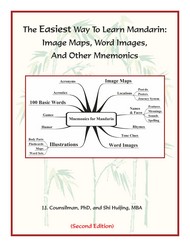
"The Easiest Way to Learn Mandarin: Image Maps, Word Images, and Other Mnemonics" applies more than a dozen established memory techniques to the study of Mandarin, most for the first time.

"The Easiest Way to Learn Mandarin: Image Maps, Word Images, and Other Mnemonics" applies more than a dozen established memory techniques to the study of Mandarin, most for the first time. The mnemonic methods include a mnemonic dictionary of over 1,400 Mandarin words; 660 clipart illustrations, a dozen large image maps; the 100 most common Mandarin words; illustrated body parts; spelling, sound, and meaning of Chinese names; and more. The book's greater value lies in its potential for helping users expand their knowledge of Mandarin beyond the presented material through the use of mnemonic methods.

Excerpt

For the student of Mandarin today, many learning tools are available, from simple word lists to sophisticated computer programs with voice analyzing functions. All have one thing in common: they require a massive amount of time because they are based on rote memorization. This book is the first to provide multiple short-cuts to learning Mandarin.

The book’s short-cuts, more formally called “mnemonics,” aid memory through clues to something unfamiliar in something familiar. For example, the phrase, “Mnemonics Neatly Eliminate Man’s Only Nemesis: Insufficient Cerebral Storage,” is a mnemonic for remembering how to spell “mnemonics.” It is a type called an “acrostic,” which uses the first letter of words in a phrase (something familiar) to identify another series of words (something unfamiliar). By far, most mnemonics are acrostics. For learning Mandarin, however, they have limited value because of the large number of Mandarin (pīnyīn) syllables that begin with j, q, x, y, and z; absence of any that begin with i, u, or v; and few that begin with o. As the graphic below illustrates, many other types of mnemonics can be applied to Mandarin. Rather than just being visual in nature, these mnemonics may provide clues that are visual, auditory, kinesthetic, or combinations of these modes of learning.


Want to review or comment on this book?


Need a FREE Reader Membership?

Popular Language Books
  1. Object Marking in Japanese: A Self-stu
  2. Guide to Learning Japanese
  3. Bridging the Gap: Police - Japanese (
  4. Miasmatic Mystical Heavenly Orbits Tak
  5. Tenses and Active Passive Voice: Learn
  6. All about voice
  7. All about tenses
  8. German in Action
  9. Inermediate German
  10. Au Pair in Ireland

Free Book Review Program
Select a book to read and review today!

Object Marking in Japanese: A Self-study Programmed Lesson (Paperback by Robert Wood

This programmed, self-paced lesson focuses exclusively on the use of postpostions (ga and (w)o) with grammatical objects in the Japanese language without wavering or getting off track in the labyrinth of Japanese syntax and other grammatical issues.  
Member BookAds

Bridging the Gap: Police - Japanese (Paperback only) by Robert Wood

Nonverbal Japanese language communicator primarily for English speakers. Easy to use reference. Proven and effective tool. (Print only.)  
Member BookAds

Object Marking in Japanese: A Self-study Programmed Lesson (Paperback by Robert Wood

This programmed, self-paced lesson focuses exclusively on the use of postpostions (ga and (w)o) with grammatical objects in the Japanese language without wavering or getting off track in the labyrinth of Japanese syntax and other grammatical issues.  
Member BookAds