Category: Memoir Publisher: Mary E. Trimble
ISBN-10: 0615667945
Type: Non-Fiction
Pages: 325
Copyright: August 5, 2012
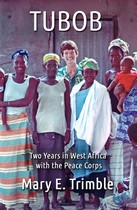
Tubob: Two Years in West Africa with the Peace Corps, a memoir. A newly married couple discover themselves in new light as they work and learn about a different culture
Tubob: Two Years in West Africa with the Peace Corps is a memoir of a newly married couple who discover themselves in new light as they work and learn about a different culture in a third-world country. They find strength and frustration trying to make a difference. Caught up in a military coup, they seek refuge in a house with 116 other people, wondering if their lives will ever be the same.
Excerpt
MORTARS THUNDERED close to the house where 118 of us sought refuge. A particularly loud and close-sounding explosion made us jump and the house shudder. Not for the first time, I thought, Is this the end?
My Peace Corps supervisor Meri Aimes and I crouched under a small table with space only for the two of us. Others scrunched in where they could find room. My husband, Bruce, safely tucked under the desk he’d converted to a radio station, clutched the radio mic.
True, it was the American Ambassador’s house, but, though nice, it wasn’t the grand residence usually associated with a high-ranking officer’s home. At four thousand square feet, the concrete house wasn’t particularly large, not for this many people at any rate.
Our group of leaders had taken over the ambassador’s bedroom as a sort of headquarters, since the ambassador himself was “detained” at the embassy in The Gambia’s capital city, Banjul. Families occupied the other two bedrooms; otherwise, people squeezed in where they could.
Meri’s eyes were huge. Her African American face was always expressive, but never more so than just then.
“This isn’t looking good, is it?” I said, trying to sound calmer than I felt.
Meri looked at me like I’d just made the understatement of the year. “Not really, no.”
“I’m wondering if Bruce and I will ever be able to get back to our village.”
“Right now I’d say it was doubtful.”
We both instinctively covered our heads at the sound of a close-by explosion. I broke out in sweat.
“I need to tell you something.”
Meri’s raised her eyebrows in question.
I waited until another flurry of rifle shots subsided. “We have about twenty-five hundred dollars buried in our chicken coop.”
“You what?”
“Well, what else can you do with American dollars? You can’t put it in a Gambian bank, we couldn’t keep it inside–we’ve already had our place broken into. We were converting our Gambian money into American cash so we’d have it when we left.”
Meri nodded. “You guys will probably be evacuated, but George and I likely will stay to get things wrapped up.” George Scharffenberger, Peace Corps Director, and Meri Aimes, Assistant Director, were the two highest ranking Peace Corps staff in the West African country of The Gambia. We were lucky they were both with us, safe. For the moment, at least.
Meri touched my arm. “I promise I’ll do everything I can to recover your money. Draw me a map showing me just where it is.” She shook her head. “Only you and Bruce would think to hide money in a chicken coop.”
A runner, gasping for breath, banged on the bedroom door. “Someone is coming!” Bruce sprang out of his shelter and, quick and smooth with practice, dismantled the radios, forbidden to us by both the rebels and nationalists. He stuffed them into boxes kept under the desk. Within seconds he crawled back under the desk, cramming himself in front of the boxes. He was good. I was so proud of him.
Bruce’s and my eyes locked. As we had joked many times in the past two years, we silently asked, “Whose idea was this anyway?”
Tom Mosier, head of United States Agency for International Development (USAID) in The Gambia, and George Scharffenberger came out from their safety places to greet our visitor. “Stay right where you are, folks,” Tom said, his voice tight.
The door opened and a man strode in. He was probably an officer in charge; he reeked of authority. We couldn’t tell if he was a nationalist or a rebel from the local security force, Field Force they called it, which, together with disgruntled leftists, had started the coup several days earlier. He was a big man and to me he looked sinister. My stomach clenched. His black face glistened with sweat. He carried a rifle and wore a hand gun at his side. His eyes darted around the room. “This is good. Stay under cover. I have ordered that this house is not to be hit, but you never know...”
He nodded to Tom and George, and left. No one spoke until we heard a soft knock on the door. He was gone. Bruce sprang up and reassembled the radios just as a signal was coming through. He brought the mic with him back under the desk.
“Candyland, Lollypop. Candyland, come in. You guys okay?”
Bruce responded, his rich voice calm. “Lollypop, Candyland. Yes, we’re okay. One of the local officers just paid us a visit and...” An explosion, even closer this time, drowned out his voice.
Professional Reviews
Would I have gotten off that plane?,
It was July 20, 1979, when a big Pan American 747 touched down in Senegal's Dakar airport. Stepping from the comfort of air conditioning onto a stifling, muggy tarmac, Mary Trimble and her husband Bruce stretched their weary limbs and went to collect their luggage: two medium sized trunks for two years. They were Peace Corp Volunteers destined for The Gambia, Africa.
Tubob is a true story of immense beauty, love, and frustration for the Gambian people and their often shocking culture.
From page one, I was captivated and anxiously followed this unforgettable journey. Immersed in the day to day life of the Gambia, Mary worked to educate mothers in well baby care, while Bruce struggled to provide wells for clean water amidst absentee laborers and faulty equipment. To top it off, they end up caught in the middle of a civil coup, dodging bombs and gunfire.
Looking back on this incredible story, I asked myself: Knowing what I know now, would I have gotten off that plane?
Mary Ann Hayes, Author of Adeline
Tubub: A Learning Experience
Not many award-winning American novelists respond with a smile of recognition when referred to as a "tubob". Mary E. Trimble views this as such a treasured term she titles her new book, a memoir, Tubob: Two Years in West Africa with the Peace Corps.
A couple of tubobs is what they were, Mary and her husband, Bruce, during the two years they spent in The Gambia. Mary kept records in a health center; Bruce supervised a well-digging project: learning experiences for both. What makes Tubob an engrossing read, however, is watching people meeting people. Mary shares the stories and Bruce, the photographs, in this fascinating, fast-paced memoir.
Gloria MacKay, Author of Chalk Dustings
Up Close and Personal
TUBOB is the memoir of Mary and Bruce Trimble's two years in The Gambia, West Africa, a tale that carries the reader deep into the experience of another culture. From their initial shock as new Peace Corps arrivals, through the frustrations, physical discomfort, and bewilderment of the training period in a country where nothing seems to work, to their arrival at their assigned village, we feel firsthand the trials of culture shock. Through Mary Trimble's honestly told encounters with the weather, the lack of facilities, and, most importantly, the people, we live with them the frustrations and rewards of a very unique experience, and like them, emerge changed.
Judith Kirscht, Author of Nowhere Else to Go
This is not a drill. The attack on Pearl. They were the ghost planes of the night, deadly, illusive, sharp-clawed Black Cats. The Memoirs of ARM H.P. Lawrence, a Pearl Harbor survivor, Black Cat, and decorated war veteran.