|
Amazon
Category:
Mainstream
Publisher: SynergEbooks
ISBN-10: 0744303575
Type: Fiction
Pages: 352
Copyright: Jan 1 2000
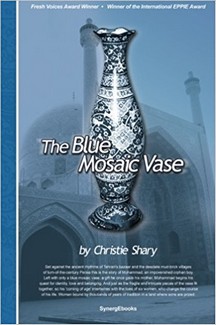
Through the sympathetic eyes of an impoverished orphan boy named Mohammad, "The Blue Mosaic Vase" explores the role of women bound by thousands of years of tradition in a land where sons are prized. Left with only the beautiful blue mosaic vase, a gift he once gave his mother, Mohammnad begins his quest for identity, love and belonging. And just as the fragile and intricate pieces of the blue mosaic vase fit together, so Mohammad's coming of age intertwines with the lives of these women, set against the ancient rhythms of Tehran's bazaar, the desolate mud-brick villages of Turn-of-the Century Persian, the impact of Islam upon their lives. Mohammad first explores his world in the footsteps of his mother, Pargol, victim of the bazaar's harshness and disease; next through his brother's child bride, Feredeh, bound by ancient religious tradition; and by the suffering of the harlot, Leila, shackled by hunger into a life that has few options. He experiences life within the dark, liquid eyes of his first love, Sherine, forced by the solemn promnise of her father to marry another; through his wife, the beautiful Amira, driven by gold and lust for one she cannot have; and from the pain of the little servant girl, Batool, imprisoned by her society and left with only one choice--to bury her disgrace in the murky waters of the jewb. Although disillusioned by the unfairness and cruelty that reign in his world, Mohammad is determined not to give up. His journey finaly leads him to the widowed village weaver, Najmeh, who brings real meaning to his life. Filled with love and compassion, yet free and unbound as the shifting desert sands that surround her village, she answers only to herelf. But will Mohammnad find the strength to break the bonds that bind him? He knows he must.
Tehran, Iran
1909
Although it was early morning, the air was already hot. A heavy mis rose from the murky waters of the jewb, a large stone ditch that ran alongside the dirt road, one of the few sources of water for the southern part of the city.
A woman dressed in a black chador twisted through the maze of dustry streets that comprised the ancient bazaar. Only her eyes, the same color as her body-length garment, showed through the small opening below her forehead. She carried a swathed bundle in her arms, clutched it to her bosom.
On a slight rise, she paused, watched a drowned cat float by in the Jewb's waters. She forced herself to turn away, grabbed her bundle more tightly. She hurried on, the only sounds the plop of her faded embroidered shoes upon the ground, the jingle of the two rials in her pocket.
Hardly enough to feed herself, let alone a child. She looked into the water again, hesitated. Why did he have to die? A woman needed a man to survive.
The aroma of sizzling kabob over a vendor's charcoal sharpened her hunger. She inhaled, hoping the smell of the broiling lamb cubes woujld fill her empty belly. Instead, her insides twisted with pain. She turned away from the vendor--dressed in baggy plaid pants, a turban aorund his head. She tried to concentrate on the tall turquoise minaret in the distance, the muezzin's call for morning prayers echoing from its tower and throughout the city.
A bearded man led a donkey laden with banging copperware around her. The string of bright blue beads to ward off the "evil eye' caught her attention. She squeezed the bundle in her arms. The baby stirred, started to wine. Soon the whimpering turned to a wail.
"Oh, my little one." The woman looked down into the baby's dark eyes, traced her hand over his smooth cheeks. "Your eyes, they are so much like your father's. Do not cry, please do not cry my little Mohammnad. Your mammon will take care of you."
But the baby did not stop crying, so she paused in a wide doorjamb and sat down on the cracked step. Parting her garment, she took the infant to her breast. But her milk was gone. It had been for quite some time.
She knew she had no more choices. She must to to the home of her eldest son, Jamal, a shopkeeper, husband of two, father of seven. But he, too, had too many mouths to feed. She felt the suckling of her hungry baby, his lips tugging uselessly at her nipple.
"You will survive. You will." She pulled him from her breast and let the chador once more close around her, covering her body like a cocoon. The baby screamed, but she tucked him firmly to her bosom and hurried through the twisting, arch-covered streets to the crumbling mud-brick hovel of her son.
|