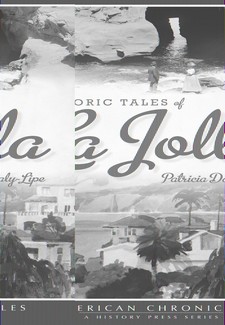
Category: History Publisher: History Press
ISBN-10: 1467135992
Pages: 176
Copyright: Jan. 23, 2017
ISBN-13: 9781467135993
The stories of the people who came to La Jolla, why they came, and what they did for La Jolla and what La Jolla did for them.
The first settlers arrived in La Jolla in 1869. Since then, La Jolla has attracted artists, architects, writers, scientists, and actors. All of their stories shaped the history of this seaside village. Pirates and smugglers hid in Sunny Jim's Cave. Ellen Browning Scripps, the Godmother of La Jolla, founded institutions and recreation areas not only for La Jollans, but for the rest of the world. Theodor Seuss Geisel derived inspiration for his art from La Jolla's landscape and its people. 'Historic Tales of La Jolla' is a collection of stories about the people who molded the village of La jolla into a natural and cultural wonder.
Excerpt
Theodor Geisel, aka Dr. Seuss
If you don't get imagination as a child, you probably never will.
I like nonsense. It wakes up the brain cells.
Fantasy is a necessary ingredient in living.
It’s a way of looking at life through the wrong end of a telescope.
Which is what I do.
And that enables you to laugh at life’s realities.
Ted Geisel was born in 1904. His mother, Henrietta, as a young girl, sold pies in her family’s bakery. To lull her children, Ted and his sister, Marnie, to sleep at night, she would chant a long list of pies. Ted told his biographers Judith and Neil Morgan (both La Jolla journalists and old friends of Ted Geisel), his mother was responsible “for the rhythms in which I write and the urgency with which I do it.” Ted’s father was from a prominent Springfield, Massachusetts family. Two generations of Geisels were master brewers—that is, until Prohibition. In 1931, Ted’s father, Theodor Robert Geisel, known as T.R., was appointed as Springfield’s superintendent of parks, a position he held for thirty years. Part of the park was the Springfield Zoo. Young Ted often visited the zoo with his sketch pad. From 1926 to 1927, Ted was in Paris. Two years prior to Ted’s arrival, André Breton had started a movement called Surrealism. This involved uniting the conscious and unconscious mind. For Breton, the unconscious was the source of imagination. This period of time in Paris was special for Ted and one he never forgot. The idea of surrealistic art would be integrated into his work for the rest of his life.
Ted attended Oxford and took a class titled “Anglo-Saxon for Beginners.” This is what he scribbled while there:
I do not like you, Dr. Fell.
The reason why I cannot tell.
But this I know and know full well,
I do not like you, Dr. Fell!
(Doesn’t the rhythm remind you of Green Eggs and Ham? “I do not eat them in a house, I do not like them with a mouse. I do not like them Sam-I-Am. I do not like green eggs and ham.”)
But it was not Ted who wrote the original. This is a poem dating back 250 years written by Tom Brown about his professor Dr. John Fell. Nevertheless, it clearly reflects Ted’s feeling for the class.
Also in this class was a young lady named Helen. Early on, watching Ted, she recognized his love of drawing and told him he was crazy to think of becoming a professor. He must have listened to her because soon he had his first professional sale. It was a cartoon for the Saturday Evening Post. He was paid twenty-five dollars, and the cartoon was published July 16, 1927. This was all the encouragement he needed, so he moved to New York City at twenty-three. By the end of the year, he was earning seventy-five dollars a week as a writer and artist for a magazine called Judge. Now employed, he proposed to Helen. They were married in November.
From the cover of Judge to other leading magazines, Ted’s cartoons were soon on the covers of several leading magazines, including Life.
In 1928, on a trip west, Ted and Helen fell in love with La Jolla. Ted called it a place where the climate would allow him to “walk around outside in my pajamas.” But it wasn’t quite time for them to move.
When the Great Depression descended, the Geisels survived by Ted doing advertising for Standard Oil (1928–53). “It wasn’t the greatest pay, but it covered my overhead so I could experiment with my drawings,” Ted told the Morgans.
In the summer of 1936, Ted and Helen sailed for a vacation trip to Europe. But as he boarded the ship for their return trip to the United States, he couldn’t help but realize that a man called Hitler was threatening his ancestral home as well as all of Europe. Once back in New York, he showed a politically charged cartoon to a friend. His friend shared the cartoon with the editor of a “popular front” paper called PM. As a result, Ted became the paper’s editorial cartoonist. The first cartoon appeared January 30, 1941.
During World War II, Ted also worked at the U.S Military’s Office of Information and Education. He created animated training films for soldiers getting ready for war using an animated funny character as a trainer. His own art was put on hold. On his own, however, it was always art, sketches on scraps of paper, on menus, on leftover stationery, that kept Ted occupied. After the war, it was back to drawing and writing to share with all of us. For Ted, art wasn’t a vocation. It was a way of life, and it must have been a relief to return to his passion as a livelihood.
Finally, twenty years after their first visit, the Geisels returned to La Jolla and purchased what was nicknamed “La Jolla’s Tower.” This was a rundown structure built for observation atop Mount Soledad. The Geisels built their home around this tower. World War II had ended, and with the postwar baby boom, it was a perfect time to write children’s books. However, his first book, And to Think That I Saw It on Mulberry Street, that he both wrote and illustrated was turned down by twenty-seven publishers before a friend had him send it to Vanguard Press. Of course, the book was a success. Thus began Ted’s new career. “I’m subversive as hell. I’ve always had a mistrust of adults.” 089
Soon he and Helen became enmeshed in La Jolla’s society and in its various artistic institutions, including the La Jolla Art Museum (now the Museum of Contemporary Art) and the La Jolla Playhouse. Of course, this also created a “playground” for Ted to tease his fellow La Jollans artistically. He called himself a “bird watcher on the social scene.” Most of these paintings, however, were hidden until after his death.
When The Cat in the Hat came out, Ted Geisel had already been writing children’s books for twenty years. In 2007, U.S. News & World Report wrote, “In the 50 years since The Cat in the Hat exploded onto the children’s book scene, Theodor Seuss Geisel has become a central character in the American literary mythology, sharing the pantheon with the likes of Mark Twain and F. Scott Fitzgerald. Of his many imaginative stories, The Cat in the Hat remains the most iconic.” For years, this famous cat became more than a book character for Ted. He seemed to morph into his alter ego, resurfacing in several paintings as a surrealistic rendition of himself. Disguised as nonsense, these paintings combine Ted’s imagination with his thoughtful understanding of human nature. Truth was hiding behind art. Remember his study of Surrealism in Paris? Now it was coming through and not just for himself but for all of us to enjoy!
Professional Reviews
Love La Jolla
Well, my dear Patty, Was it worth waiting for! YES! Your book is terrific. It is crammed with so many wonderful things about La Jolla, and unforgettable people, but most of all incredibly well written because, although it is full of the history of our beloved La Jolla, it is also such a joy to read. But again, congratulations on a wonderful book, not only so informative and interesting, but how well you write! Thank you for writing this wonderful History of La Jolla. Anne M. Ring
The heroic story of how a small group of people, few of them TB experts, found the cure for the greatest killer in human history. But the battle needed to be extended to all sufferers. Why have we failed to take the miracle to the developing world?
325 letters my father wrote to my mother during his time in World War II.
Woven together in a timeline of events of three of his brothers, 5 brothers-in-law, and one cousin, all 10 of them were in WWII at the same time.