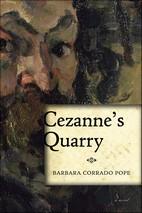
A beautiful young woman is found murdered… and the clues to her death point to her spurned lover, Paul Cézanne
In this historical mystery, Cézanne’s Quarry (Pegasus Books, June 2008), a mysterious and beautiful young woman named Solange Vernet arrives in Aix-en-Provence, France with her lover, a Darwinian scholar named Charles Westerbury, and several months later is found strangled in a quarry outside the city. The young and inexperienced magistrate, Bernard Martin, finds his investigation caught in the crossfires of a raging cultural debate.
Initially assuming that Solange’s murder was a simple crime de passion by either a jealous Cézanne or a betrayed Westerbury, Bernard soon finds himself on a mission to unravel the secrets of Solange and Cézanne’s hidden past—the key to which may be a series of his paintings which depict the strangulation and violation of a woman with golden-red hair.
With deep and meaningful themes and provocative plot, Pope explores art, history, science, religion and the roles of women that persist even today - Cézanne’s Quarry - A Mystery
Could Paul Cézanne be a killer? Do pieces of canvas reveal his guilt? Will the novice Bernard Martin grow into his role as an investigating judge before more lives, including his own, are in jeopardy? Can Cézanne’s best friend, French writer Émile Zola deliver the clue that will solve a murder?
Professional Reviews
In baffling case, Aix marks the spot
The Boston Globe
By Hallie Ephron | June 29, 2008
Cézanne's Quarry
By Barbara Pope
Pegasus, 352 pp., $25
Barbara Pope takes a whiff of historical evidence that artist Paul Cézanne had a love affair with a mysterious woman when he was painting the mountains and quarries of Aix-en-Provence, France, in 1885 and spins it into an elegant murder mystery. "Cézanne's Quarry" opens with the murder of Solange Vernet, the woman with whom Pope imagines Cézanne became besotted. With experienced judges away on summer holiday, the investigation falls in the lap of Bernard Martin ("a judge with little experience and no family or connections in the South of France"). Naďve and lacking in self-confidence, Martin is at the mercy of the gruff, ruthless Inspector Albert Franc, who wants to dispose of the case as quickly as possible.
Pope graphically depicts the hot journey by wagon to the quarry where Vernet is found dead. The reader can almost smell the rotting flesh and hear the flies as Martin examines the quickly decomposing body. Martin had once crossed paths with this beautiful, independent woman when they both sought a copy of Darwin's "The Origin of Species." Martin is outraged but not surprised at Inspector Franc's contempt for the victim, and later notes to himself that "the abuse of young women was by far the most commonly committed and least prosecuted crime in all of France." Flourishes like this remind the reader that the author is both a historian and a feminist scholar.
Inspector Franc zealously pursues the investigation, eager to pin the murder on Vernet's longtime lover, self-taught geologist Charles Westerbury. Failing that, he builds a case against Cézanne. Westerbury and Cézanne are a study in contrasts - one a scientist who studies the mountains, the other an artist who paints them. Martin, growing into his role as investigator, becomes convinced that neither man is responsible. The ending delivers a satisfying twist.
"Cézanne's Quarry" is a highly accomplished, compelling novel. Beneath an exquisite veneer of historical detail lurks a thoughtful exploration of science and religion, of old values and new, and of a woman's place in the world.
The higher you go into the hills, the deeper the secrets...
A seemingly innocent piece of mail shatters the illusion of Beverly Hills luxury, forcing a terrifying statement from a powerful action movie mogul: "they can't kill us fast enough."