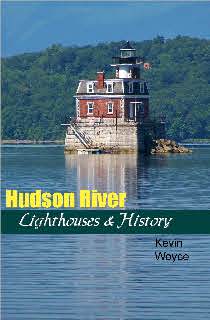
Begins with Henry Hudson's exploration of the River in 1609 and includes a chapter on each of the river's historic lighthouses.
Henry Hudson explored the river that now bears his name in 1609. The arrival of the steamboat 200 years later, and the opening of the Erie Canal in 1825, made the Hudson one of America's busiest rivers. From 1826 until the middle of the 20th century, more than a dozen lighthouses guided ships past its islands and shallows.
"Hudson River Lighthouses & History" is an illustrated tour of these lights, past and present, and of the river they marked--from its Revolutionary War battlefields and early industries to modern-day cities, bridges, and parks.
Illustrated throughout, with more than 3 dozen original black and white photographs of Hudson River lighthouses, bridges, and historic landmarks.
Excerpt
In April 1609, English explorer Henry Hudson sailed from Amsterdam to search again for an all-water route to the rich ports of China and India. He had already tried twice, once by sailing northeast into the Arctic Ocean, once by crossing the Atlantic. Neither voyage was successful, but the Dutch East India Company sent him to try the eastern route again, across the top of Russia to the Pacific Ocean.
Finding the Arctic route blocked by ice, Hudson and his Dutch and English crew decided to take their tiny Half Moon, only 84 feet long and 22 feet wide, across the Atlantic. Instead of the eastern route, they would hunt for the fabled “Northwest Passage,” a water route across the top of Canada. Captain John Smith had recently returned to England from Jamestown, bringing detailed maps of the eastern coast of North America and native stories of grand rivers and what historians now believe to be the Great Lakes. To Hudson, and to many others, these as-yet-unknown lakes sounded very much like the elusive Pacific...
Expands beyond the safety of pages bound by predictability to explore and often confirm exciting creative possibilities. A shimmering collage of memoir, creative nonfiction, literary journalism, and dizzying flights into poetic observation, this is t