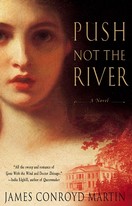
A historical novel based on the diary of a countess in 1790s Poland. Critics have called it a European Gone with the wind.
A panoramic and epic novel in the grand romantic style, Push Not the River is the rich story of Poland in the late 1700s--a time of heartache and turmoil as the country's once peaceful people are being torn apart by neighboring countries and divided loyalties. It is then, at the young and vulnerable age of seventeen, when Lady Anna Maria Berezowska loses both of her parents and must leave the only home she has ever known.With Empress Catherine's Russian armies streaming in to take their spoils, Anna is quickly thrust into a world of love and hate, loyalty and deceit, patriotism and treason, life and death. Even kind Aunt Stella, Anna's new guardian who soon comes to personify Poland's courage and spirit, can't protect Anna from the uncertain future of the country.Anna, a child no longer, turns to love and comfort in the form of Jan, a brave patriot and architect of democracy, unaware that her beautiful and enigmatic cousin Zofia has already set her sights on the handsome young fighter. Thus Anna walks unwittingly into Zofia's jealous wrath and darkly sinister intentions.Forced to survive several tragic events, many of them orchestrated by the crafty Zofia, a strengthened Anna begins to learn to place herself in the way of destiny--for love and for country. Heeding the proud spirit of her late father, Anna becomes a major player in the fight against the countries who come to partion her beloved Poland.Push Not the River is based on the true eighteenth century diary of Anna Maria Berezowska, a Polish countess who lived through the rise and fall of the historic Third of May Constitution. Vivid, romantic, and thrillingly paced, it paints the emotional and unforgettable story of the metamorphosis of a nation--and of a proud and resilient young woman.
Excerpt
PROLOGUE
Wherever you go, you can never leave yourself behind.
—A Polish Proverb
Sochaczew 1779
Anna’s eyelids fluttered briefly in the morning light, then flew back. The girl felt the pace of her heart increase. This was the day she had awaited, the first of June. Her birthday. She sat up immediately and looked to the table near the window. On it sat the package wrapped in red paper. She gave out a little sigh of relief.
She sprang spritelike from her bed, pulling at her nightdress. She washed and dressed quickly, donning the blue dress trimmed in lace and the glossy white leather shoes. These were worn only for special occasions. She worked overly hard at brushing her brown curls. She was too impatient, she knew, and when she drew the brush through a tangle, she saw herself wince in the mirror. It was a very grownup expression. One she had seen her mother use.
She brushed and brushed. A bad job would bring a light scolding from Luisa when it came time for braiding. Still, her mind was not on the task at hand. Time and again, her amber-flecked green eyes would shift in the mirror to where the red package sat in her sight line. Tired as she had been the night before, she fought off sleep for as long as possible, fearing that the present might disappear somehow. But it had not. It was here and it was hers. She had only to look at it, red as a ripe apple and many times more inviting, to make certain.
Her morning rites finished in record time, Anna gingerly slid the package from the table into a tight, twoarmed grasp. Taking special care with the opening and closing of her bed chamber door, she moved out into the hall and to the stairway. The aroma of coffee and breakfast sausages was a usual one, but this was no usual day. She reached high for the banister, and descended with the hesitating care of an old woman, stopping on each stair.with a little jolt, until at last she came to the main floor of the country manor house.
Her mother was breakfasting in the dining room while the maid stood at her side pouring coffee into a china cup. Several pans steamed on the sideboard.
The darkhaired Countess Teresa Berezowska glanced up, smiled. “Good morning, Anna Maria. Happy Birthday.”
“Happy Birthday, Anna,” Luisa said in a happy tone. “How old is my little lady?”
Anna smiled, delighted at the attention. “Five!” she said.
Her first instinct was to hold up the fingers of her right hand to underscore the fact, but she realized in the nick of time that doing so would cause her to drop the package. Her heart beat faster at the thought.
“A bowl of kasza with milk and a poached egg this morning,” Luisa was saying, “and if you finish that off there will be some fluffy baba for this happy day.”
Taking small, measured steps, she moved, as was her mornng routine, to give her mother a kiss on the cheek. The countess leaned over to accommodate her daughter. Anna thought her mother the most beautiful woman she had ever seen. Her father’s chair was empty, so she went directly to her own place. Carefully, she positioned the package next to her plate. Freed of her treasure, she clambered up onto her chair.
Luisa was just placing Anna’s breakfast before her, humming very prettily. Anna was determined to eat every bite, for she could smell the delicious iced baba. Where is it? she wondered. The light, sugary cake with its hidden raisins was her favorite.
Lifting the first spoonful of egg to her mouth, the girl noticed that her mother’s violet-gray eyes were locked upon the red package. And that her smile had died away.
A little bell of alarm sounded in Anna’s head. She put down her spoon. Her immediate thought was for support. “Where’s Papa?”
“He’s gone off on business,” the countess replied. “Always some farm business.”
Her mother’s tone frightened the child. The countess’ eyes moved from the package to her.
“Now what have we here, Anna Maria Berezowska? Is this your new doll?”
“No, Mama.”
“I see. I thought not. The package seems neither the correct shape nor size. Where is it, then?”
Anna’s lips were dry. “I . . . I didn’t choose a doll.”
The countess’ mouth tightened. “But your father took you all the way to the capital yesterday for the expressed purpose of buying you a doll, one with a painted face, glass eyes, and real hair. Were there none to be found in all of Warsaw?”
“Oh, yes, there were many dolls, Mama, only—”
“Only what?”
“Only I chose this.”
“You did, did you? You were quite deliberate, then, in going against my wishes. You were to have chosen a doll.”
Anna didn’t know what to say. Her mother did not raise her voice to her, never had. But Anna recognized the seriousness in her tone and steady gaze. Her little limbs trembled; she would not cry.
“Would you leave us now, Luisa?” the countess asked, smiling.
Anna’s heart dropped. She had seen that smile before. She had learned that it wasn’t a real smile. She longed to have old Luisa stay but knew to say nothing.
The maid curtsied, then crossed the room toward the kitchen door. She smiled at Anna, a smile that was a smile. The girl knew Luisa meant to give her courage, but it didn’t help much.
“Open it up,” the countess said, once the maid had vanished behind the swinging door. “Let’s see what can be more amusing to a little girl than a new doll.”
“Shouldn’t we wait for Papa?”
“Open it, Anna Maria.” The countess was not to be put off by the cleverness of a five-year-old.
Anna had been so caught up in the wonder of the gift that she had not thought about her mother’s reaction. She started to tear clumsily at the well-wrapped package. Her hands were sweating.It had been her first trip to the capital. Wide-eyed, she had sat on her father’s lap as the carriage rattled along for what seemed hours and hours. They entered the suburb of Praga, then across the River Vistula, the wheels vibrating on the wooden bridge, then clacking along the cobbled streets of Warsaw. It was the most amazing thing, this city, like something from one of her books. “Oh, Father!” she cried. There passing before her was the Royal Castle.
“Does the King live there? Truly?” Her father was smiling. “He does, indeed.” They passed the Cathedral of Saint Jan, and the city mansions of the nobles—the veryrich ones.
Magnates, her father called them. “Why aren’t you a magnate?” she asked. “I have all the wealth I need,” he laughed, hugging her to him. In the castle’s outer courtyard the two of them craned their necks up at Zygmunt’s Column. The bronze figure of the long-dead King held a cross in one hand, a sword in the other—like some warrior saint. He had been the one, her father told her, that had moved the capital from Krakow to Warsaw. Years later she would remember the Royal Castle as merely massive and daunting, but the memory of her father’s embrace— his strength, his warmth, and the faint scent of a shaving soap—these she would carry with her always.
They continued then to the Market Square, a glittering honeycomb of shops and stalls. And Anna did see dolls that she liked, too, dolls of every description and recent style. Beautiful dolls. But once her eyes settled on that sparkling object she was now unwrapping, nothing else would do. “Is this what you truly wish, little Ania?” her father asked, using her diminutive. She looked up at him, realizing at once that her wish was his wish. “Oh, yes!” she cried. It was then—in the enchanting city of Kings—that the notions of birthdays and wishes and magic were sealed together in her mind, it seemed, forever.
The red paper was tearing away at one corner, then another. Something under it flashed and gleamed.
Professional Reviews
Linda Linguvic, Amazon top 100 reviewer, The Greenwich Village Gazette
This historical novel by James Conroyd Martin is based on the true story of Countess Anna Maria Berezowska, a young woman who lived through the tumultuous events in Poland during the years 1791-1794. The author discovered the diary that had been kept in sealed wax for almost two centuries by the Countess' family, and has been researching the historical period it covers for the past 25 years.
I was immediately drawn into the story of the young Anna Maria and the dramatic events that shaped her life. Orphaned at 17, she's sent to live with her aunt, uncle and cousin Zofia who is her own age. These two young women are very different and there is conflict between them throughout the book. However, the author's skill in developing Zofia's character kept the story from falling into the trap of stereotyping and these two characters emerge as complex individuals.
The story is rich with romance, intrigue, passion and love. And it's all set against a backdrop of Polish history. There's a bridge in New York City named after the patriot Tadeusz Kosciuszko, but until now I had no idea who he was. Neither did I think about how the events of the French revolution directly affected the rest of Europe and Poland in particular. I learned about these things in this book as I followed Anna Maria's story, my eyes racing over the pages and holding my breath through her many ordeals. It's a fast and easy read, and, in spite of being 608 pages long I yearned for more when it ended. Hopefully the author will sit fit to write a sequel.
Push Not the River
"James Conroyd Martin's vivid historical novel captivates the reader with its sweeping depiction of a bygone society on the cusp of violent change. Combining politics with intrigue and romance, Push Not the River gives us a glimpse into the turbulent era of late eighteenth century Poland and its people. Aristocrats and peasants, patriots and traitors come alive in this story, and the Polish soul is beautifully illuminated through ancient myths, folkways, and wisdoms. With his juxtaposition of the personal and political, Martin weaves a compelling tale of transformation--both of a remarkable young woman and her remarkable nation."
-Jennifer Donnelly, author of The Tea Rose
Push Not the River
"Push Not the River contains all the sweep and romance of the classic romantic epics such as Gone with the Wind and Doctor Zhivago, with a heroine who remains strong in the face of both personal and political tragedy. An enthralling tale of courage, survival, and hope, Anna Maria's story is at once timeless and timely."
-India Edghill, author of Queenmaker
Third Book in Five Book Series - Southern Swallow - a tale of 12th Century China. Li K'ai-men becomes entangled in an intrigue that becomes his undoing.