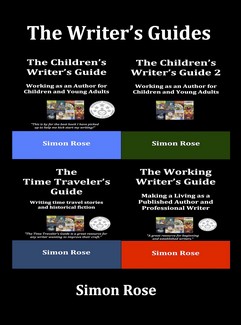
These four writer’s guides offer invaluable tips and advice for both aspiring and established authors in all genres.
These four writer’s guides offer invaluable tips and advice for both aspiring and established authors in all genres.
The Children’s Writer’s Guide examines working as an author for children and young adults. Topics include getting started as a writer, dealing with writer’s block, where ideas come from and how writers turn them into stories, choosing names for characters, the importance of revision, writing science fiction and fantasy, the use of magic in stories for children, author visits to schools and libraries, and marketing and promotion.
The Children’s Writer’s Guide 2 further explores working as an author for children and young adults. Topics include writing what you know, creating characters and dialogue, the importance of book covers, age levels and word counts, study guides, the value of blogging, networking and writers groups, and submitting your work to publishers.
The Time Traveler’s Guide is an excellent resource for those writing time travel or historical fiction stories for both children and adults. Topics include defining time travel and historical fiction, imagining time machines, methods and devices, historical eras and settings, creating characters and dialogue, plausibility, description, and plot, the importance of research, issues with time travel stories, time travel into the future, alternate history and parallel universes, and more.
The Working Writer’s Guide examines the professional life of those who have chosen to pursue writing as a career. Topics include book sales and royalties, teaching and workshops, coaching and editing, business and technical writing, websites and social media, public speaking and events, and more.
Excerpt
Introduction
This book talks about getting started as a writer, creating time and space to pursue your craft and dealing with lack of motivation and writer’s block. It also looks at where ideas come from and how writers turn them into stories, choosing names for characters that are appropriate to the story, the importance of historical research if your novel is set in a different era, writing science fiction and fantasy and at the use of magic in stories for children.
It examines the role of editing and revision and how to deal with what is often the inevitable process of rejection, at least until good fortune comes your way. I also recount some of my experiences with marketing and promotion, such as book launches and in-store signings, websites, blogs, and social media, and presentations, workshops and author-in residence programs at schools and libraries.”
Professional Reviews
The Children's Writer's Guide
“Writing books for children is a marathon, not a sprint.” So claims children’s author, Simon Rose. With quite a few children’s books published and in circulation, the author knows the amount of time and effort that goes into writing a book. And the work never slows down. It’s more than just writing. As he points out in his book, The Children’s Writer’s Guide, there is a great deal of discipline and dedication that goes into pursuing an idea from its roots to the final product of a published book. And the work doesn’t stop there, as all writers today will agree. There’s the promotional package, the book signings, the in-school visits and presentations, and much more. Writing a book, any book, is a job that never really comes to an end.
Simon’s guide is a valuable resource for both beginner and established children’s book writers. In the first chapter, he provides some basic groundwork for all writers, with subsections with headings like: “In the Beginning” and “No Happily Ever After.” He continually stresses that writing is more than just generating a great idea. It’s hard work and lots of it. So writers need to be organized and committed to what they propose to write. He leads you through the initial concept of finding the great idea to inspire the book, how to hook the reader, and some less traditional writing guide topics like choosing the right names for your characters and dealing with rejection. Using examples from his own experience and his own published works, Simon provides a clear and concise guide to writing a good children’s book. Very useful.”
The Children's Writer's Guide 2
“The Children’s Writer’s Guide 2 by Simon Rose is a writing/publishing book and is part of a series. It is a succinct and short guide. Simon Rose writes about writing while being a well-established and recognized author, which means that his advice and remarks are all relevant, sound and directly usable by would-be authors. However, some of the chapters are bound to be useful to authors in their own right too. They range from blogging to improving one’s trade in any way possible. Each chapter in Simon Rose’s book encourages writers in an engaging fashion to be better writers. Indeed, Simon often refers to his own wide experience and provides extremely valuable examples of what to do or not to do!
The Children’s Writer’s Guide 2 by Simon Rose is a tremendously worthwhile read when you are a writer and want to keep improving, as I am. (Yes… I read the part about adverbs and adjectives, even if I use too many in this review!) This book is truly inspiring, probably because it tackles such topics as inspiration, creativity, developing as a writer, fleshing out characters or scenes, the creative process, plot, everything a writer ought to think about really ranging from the initial stages of the story to synopsis writing, the book cover, tenses… in a straightforward fashion. I have been writing for years and am a literature teacher, but this book gave me valuable ideas such as writing a study guide for my books, for instance. Thank you so much! That is why I highly recommend this book!”
The Time Traveler's Guide
“The Time Traveler’s Guide: Writing Time Travel Stories and Historical Fiction serves as a go-to reference when writing both historical fiction books and novels that include elements of time travel. The book begins by asking the question: What is time travel? The concept of time travel is portrayed in both books and movies and, as such, a writer should be aware of the problems associated with time travel. The author should also note that time travel goes hand-in-hand with historical fiction in many cases and, with the exception of traveling into the future, it is crucial to know the facts about certain time periods. Author Simon Rose stresses the importance of accuracy in depicting historical eras, and making sure to incorporate realistic backgrounds and landscapes. In other words, the writer should make sure modern items such as cell phones, zippers, or even foods are not used in the wrong time period. The book also mentions how time travel is used in popular stories, such as Back to the Future and the Harry Potter novels.
I enjoyed reading The Time Traveler’s Guide: Writing Time Travel Stories and Historical Fiction and learning about how to construct stories in genres that might include the topic. In particular, it was useful to learn about the ways time travel might be accomplished, such as magic, machine, and even sleep. My favorite part of the book was the list provided of different time periods, including Egypt, medieval times, the Renaissance, the Victorian era, and the pirate era. Author Simon Rose also provides writing tips in general, such as character description (flaws and fears) and how to pace a story. This is a unique book, overall, and I recommend it to writers and those interested in methods of time travel in general.”
Based on your background and experience, I can see why you wrote these guides. I am surprised how many authors here don't seem to have a clue when it comes to writing and writing well. I often get inquiries from people needing my help. I'm sure your guides can help them if they wish to take the opportunity to read from a book rather than other sources like directly on the Internet, discussions with other authors and questions like you and I get.
By the way, I probably won't read your guide, but right now according to physics, the only way to travel to travel through time is to slow it down by approaching the speed of light. There is no physics describing going backward in time.
My Georgia Journal helps readers spark their interest with historical trivia and tidbits about Georgia. It’s an interactive journal designed to nurture creativity and self-motivation.
The second portion features one side for drawings, sketches, o