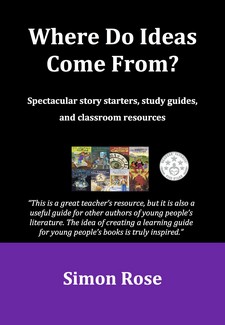
Where Do Ideas Come From? provides suggestions and recommendations for teachers developing classroom projects based on the books but might also serve as inspiration for aspiring writers of all ages.
Where Do Ideas Come From? examines how The Alchemist’s Portrait, The Sorcerer’s Letterbox, The Clone Conspiracy, The Emerald Curse, The Heretic’s Tomb, The Doomsday Mask, The Time Camera, and The Sphere of Septimus can be used to create workshops and creative writing exercises.
These include writing time travel stories, creating superheroes and comic books, inventing imaginary worlds and fantasy kingdoms, exploring fascinating historical eras, imagining future technological developments, and examining ancient mysteries and civilizations.
Where Do Ideas Come From? provides suggestions and recommendations for teachers developing classroom projects based on the books but might also serve as inspiration for aspiring writers of all ages.
Excerpt
Introduction
Many of my novels can be used as the basis for workshops and projects in the classroom. The Alchemist’s Portrait, The Sorcerer’s Letterbox, and The Heretic’s Tomb are all time travel stories and can be used as the basis for workshops in which students create time machines and stories set in a different era. All three novels are also ideal for studying the different historical periods depicted in the stories.
The Alchemist’s Portrait can be the starting point for workshops using pictures for inspiration, creating stories based on artifacts found in museums, or for creating unique characters. The Sorcerer’s Letterbox might inspire children to learn more about the Tower of London or other medieval castles, as well as study the mystery of the Princes in the Tower, the Wars of the Roses, and medieval life.
The Heretic’s Tomb can be used learn about the Black Death, medieval society, the beginnings of healthcare, or the role of the medieval church. There are also strong female characters in the story and this can lead to students learning more about the very important women that lived in the Middle Ages. Teachers can use The Clone Conspiracy as a starting point for projects about the development of technology or what students might except to see in the world of the future. The Emerald Curse is an excellent novel for projects in which the students create their own superheroes and comic books.
The Doomsday Mask can be used to study ancient civilizations, ruined cities, and the extinctions of animals that took place at the end of the Ice Age. The Time Camera lends itself to wonderful projects related to the history of photography, writing speculative stories about alternate history, and finding inspiration from old photographs. The Sphere of Septimus has a wealth of potential for projects in which students create their own fantasy kingdoms, along with the people and animals that inhabit their imaginary world.
Where Do Ideas Come From? provides suggestions and recommendations for teachers developing classroom projects based on all the novels but might also serve as inspiration for aspiring writers of all ages.
Professional Reviews
Readers' Favorite
“There is nothing better than a good story to sweep one’s imagination away to another world. But these stories originated somewhere and there are always some interesting tangents that a reader can pursue based on a good story. Teachers are always looking for new and exciting ways to expand on a story shared in class. Simon Rose’s Where Do Ideas Come From? does just that. He takes the content of his own published stories and provides a wonderful teacher’s resource with many interesting and diverse avenues for young readers to explore.
Simon is the author of several books for young readers. The Alchemist’s Portrait is a time travel story that starts with a visit to the art gallery. The main character, Matthew, travels to various historic time periods that in itself provides topics for class projects. For his young people’s novel, The Clone Conspiracy, Simon makes suggestions to help teachers and students explore the scientific and very controversial topic of cloning and other medical marvels. Simon explores each of his young people’s novels and presents innovative exercises and projects to help teachers expand on the class’s learning as well as to heighten their awareness of specific topics, historic, scientific and artistic, and inspire them to want to read more. As Simon points out, “A novel might also inspire children to create their own stories.” This is a great teacher’s resource, but it is also a useful guide for other authors of young people’s literature. The idea of creating a learning guide for young people’s books is truly inspired.”
Lined and Unlined
Fun Tidbits and Trivia about each state.
Journaling can help improve mental health and happiness, provide a creative outlet, and give a perfect place to record life's precious events. Grab your journal today. Perfect for everyon
“If you are not using Huna, you are working too hard.”
Max Freedom Long, author of “The secret Science Behind Miracles.”
A modern application of ancient Hawaiian mysticism (i.e., Huna) with many practical exercises to understand the st