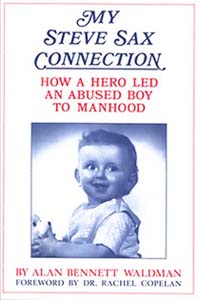
Category: Biography Publisher: Astor Street Publishing
ISBN-10: 0962629812
Type: Non-Fiction
Pages: 272
Copyright: October 1, 1990
ISBN-13: 9780962629815
This is the intimate story of a psychologically abused boy who fulfilled his dream of writing his book to Steve Sax, his favorite major league baseball player.
By envisioning his favorite player as his big brother, he promoted a positive identification, which helped him free his soul from his inner prison, confront his pain and become a man.
In his chilling, yet inspiring and critically-acclaimed autobiography, Alan Waldman vividly illustrates how the psychological abuse inflicted by his alcoholic father halted his emotional growth. To overcome his scars and rebuild his psyche, he closely identifies with former major league baseball star Steve Sax, who shared a strong bond with his father. Through his identification with Sax, Waldman discovers that parents' unconditional love is the essential ingredient necessary to create a child's positive self-image.
Excerpt
Absolute Power
Life in our household mirrored my image of a police state. Dominated by the relentless grip of the volatile dictator. Embodied by the sullen and paranoid inmates. Destined to be decimated by a titanic explosion. It was simply a matter of time.
Rules were based solely upon Dad's dictatorial ideology. Since he provided financial support, we were obliged to reciprocate with an unquestionable respect. Violation of his stringent edict or non-compliance with his wishes provoked virtual banishment from his kingdom.
Each day, Mom, my sister and I lived with unyielding tension. Though peaceful lulls were quite common, violent explosions were imminent. But what would provoke them? And when would they occur? We wondered. Watched. And waited.
Guests of the big house empathized with the inmates' daily angst. Most, especially members of Mom's family, would coordinate their visits with Dad's absences. They rarely accepted dinner invitations, opting to flee before the commandant returned.
During holiday family gatherings, tension was pronounced. Though everyone attempted to remain cordial, Dad's relationship with Mom's family was strained. All gatherings ending without an incident were punctuated with a collective sigh of relief.
Outside his domain, however, Dad discovered he was merely one of the peons. Like every other liquor salesman, he was forced to co-exist and compete with the dreck of the planet. Unfortunately, co-existence often proved to be extremely difficult. Dad's boss, also an aggressive man, was notorious for screaming at his employees during weekly meetings, making Fridays at our house a day of consummate misery.
Our lives maintained a timeless quality. Rarely was there a moment when anyone truly felt relaxed. Inmate survival was based upon one stringent adage: Dad always was right. Regardless! Based upon his angry reactions to mere whimpers of protest, rebellion would have been grounds for capital punishment.
Routine expectations of each household member were clearly defined. My primary responsibility was to act as man of the house during Dad's absence. By protecting my sister, who was two years younger than me. By being self-reliant. Mature. And decisive.
My sister's primary task was to be Daddy's little girl. On cue, she would smile brightly and display her charm. When she wasn't praising Dad for being a wonderful father, her conversations with him were personified by three guilt-laden phrases: "Thank you so much." "You're right." And "I'm sorry".
Unfortunately, my sister sometimes attempted to add a little variety to her rigid existence by engaging in the art of spontaneous conversation. Her fatal flaw was her inability to think before she spoke. She had a penchant for spewing useless and asinine verbiage, which assaulted the intelligence of mankind. Once, she incurred Dad's wrath for the most innocent comment imaginable.
While seated at the kitchen table one Saturday afternoon, Dad, my sister, our housekeeper and I were bantering about roles in our household. The conversation was lighthearted. The mood was unusually relaxed. That is, until my sister referred to our housekeeper or "the maid."
"She's your friend," Dad said, with a lilt in his voice.
"She's the maid," my sister playfully replied.
"She's your friend," Dad snapped.
"She's the maid."
"SHE'S YOUR FRIEND, DAMN IT! SHE IS NOT THE MAID!"
Immediately, the mood became tense, as Dad stared angrily into my sister's eyes.
"DO YOU UNDERSTAND ME? SHE'S YOUR FRIEND! YOU DON'T CALL HER 'THE MAID'!"
Overcome with anger, Dad stormed out of the kitchen. My sister and I just looked at each other. Our housekeeper shrugged and shook her head in disgust, as she watched my sister quiver.
"Don't worry," she said. "I don't why he...I mean I AM the maid!"
Mom's role was inordinately complex. Paralyzed by Dad's intimidating behavior, she rarely intervened during his tantrums. Quite often, she acted as his echo, warning that unless we behaved as expected, we would risk another torture session.
My mother's multitude of warnings date back to my infancy. One morning, she attempted to awaken me as I slept in my crib.
"Don't wanna get up," I said.
"You'd better get up," she warned, "or Daddy will get mad."
Dad overheard the conversation and immediately appeared in my bedroom. Donned in a T-shirt and boxer shorts, he wiped the stream of saliva and toothpaste flowing from the side of his mouth. A flush of anger colored his expression.
"YOU'D BETTER LISTEN TO YOUR MOTHER WHEN SHE TELLS YOU TO GET UP! NOW GET OUT OF THAT CRIB," he roared, stunning me with a jolt by kicking the crib. "AND STOP GIVING YOUR MOTHER A HARD TIME!"
In addition to being my father's silent ally, Mom also was a commiserator. Having experienced the intense pain Dad's tantrums provoked, she employed manipulative tactics to spare my sister and I potentially volatile confrontations. Foremost among them was serving our dinner before Dad arrived home from work. Thus, I was free to drop silverware to my heart's content.
Somehow, Dad knew that maintaining control of our household during his absence virtually was impossible. Perhaps he suspected Mom was not always fulfilling her duties as First Lieutenant. What he needed was some sort of mechanism that would act as a surrogate commandant. Something intimidating. Yet inconspicuous. Something powerful. Yet simplistic. Where oh where would someone find such a tool? Why, at a Los Angeles tourist trap, that's where!
It was called The Dog House. Cute. Innocent. Colorful. And proven to be more frightening than the entire Russian Army equipped with freshly sharpened machetes.
Four cut-out pictures of dogs, each about two inches in height, hung from individual hooks, which were mounted on a four by seven inch piece of decorated wood. A fifth hook, surrounded by a three dimensional outline of a dog house, eagerly awaited a misbehaved prey.
With a black marker, Dad printed our names on the white strip spreading diagonally across each dog's picture. Dad was a Saint Bernard. Mom was a Basset Hound. My sister was a Schnauzer. And I was a Beagle.
Upon posting the ominous overseer on the kitchen wall, Dad stared at my sister and me, while offering an austere warning:
"I don't want to ever, EVER come home from work and find either of you in the dog house. Do you understand me?"
From the moment it was perched upon the kitchen wall, this brilliant piece of dimestore ingenuity was used to control our behavior. Whenever I was sentenced, I would spend the ensuing hours contemplating my father's reaction.
Obviously, he would explode. But how loud? How long? Would he hit me? Would he want to? Would I cry? Would he hit me for crying? Minute by minute. Hour by hour. I just wished he would get home so we conclude the ordeal. The anticipation proved to be more tormenting than his worst tantrum.
And just who did the sentencing? Primarily, housekeepers and baby sitters. Several appeared to thrive on the sadistic power generated by scooping my dog off that--that hook.
"Do you want me to put you in the dog house?" one baby sitter snapped, as she waved my dog before my eyes.
"No! Please!" I cried.
"Then do what I tell you to do!"
The threat engendered by The Dog House, however, did not substantiate Dad's dictatorship. Despite frequent threats, he rarely hit me. But I was scared. Especially when he threatened to strike me with something other than his hand.
One Monday night, when I was about six-years-old, my sister and I invented a game where we would stand stiffly at the foot our beds, fall backward and BOOM! our head would hit the pillow. However, on my third turn, I lost my balance and fell forward, crashing onto the floor.
Footsteps dashed through the downstairs living room and into the hallway, warning me that trouble was imminent. I quickly scampered into my bed, as Mom and Dad hurried up the stairs.
"What happened?" Mom cried, as her hand anxiously scanned the wall in search of the light switch.
"Nothing," I softly replied.
"We heard something fall," she insisted. "Now what happened!"
"Nothing."
"DON'T YOU LIE TO YOUR MOTHER!" Dad roared.
"Alan fell off the bed," my sister announced.
"WHAT DO YOU MEAN ALAN FELL OFF THE BED!"
"We were playing," I nervously explained, "and I fell off."
"Did you hit your head?" Mom asked sympathetically.
I nodded.
Mom brushed her hand against my forehead, searching for the point of impact. "Come over here, under the light, where I can see better."
Dad's piercing glare followed my trek to the foot of my bed, where I quietly sat as Mom examined my forehead.
"I don't see anything." She then turned to Dad. "Go down to the kitchen and get a knife."
Dad stormed out of the bedroom and marched downstairs. Silverware rattled loudly as he opened the drawer and then slammed it shut. I looked at Mom. She kissed my forehead.
"Daddy's mad," I whispered.
"He's just worried. We don't want you to get a bump."
After racing up the stairs and into the bedroom, Dad stood before me. His face was bright red and teeth were tightly clenched. Mom held out her hand, silently asking for the butter knife. As Dad stared into my eyes, he raised the knife above his head.
"I OUGHT TO USE THIS TO CUT YOUR HEAD OFF!" he yelled.
My heart skipped three beats. Three and a half beats.
"Oh, please!" Mom retorted.
"WHAT DO YOU NEED IT FOR? YOU NEVER USE IT!"
Fortunately, his decision to employ Stalinist tactics did not extend to actual execution. But I was scared. That man had a knife. And I was scared.
Despite the frequency and intensity of Dad's outbursts, the most difficult aspect of life was created by his inconsistency. There were many days when my mishaps did not provoke his anger. Though I was grateful to have been spared his wrath, I still endured the pre-tribunal anxiety.
Once, while in grammar school, I was punished by school administrators for sliding on ice in the playground. The assistant principal gave me a note that was to be signed by my parents and returned to her the next day. I was petrified!
I delivered the note to Mom and begged her to refrain from telling Dad. She understood and agreed. That evening, before Dad arrived home, Mom, my sister and I went shopping. Upon returning home, we were greeted by Dad, who had the note in his hand.
"Hey! I see you got reported!" he laughed.
Suddenly, hours of self-inflicted torment had been deemed worthless. Yet, those hours proved to be a preview of the life I would endure. For although I have escaped my father's prison, I remain my father's prisoner.
Professional Reviews
How 'Steve Sax Connection' Changed a Life
By Jack Russell, The Times (San Mateo, CA)
SAN FRANCISCO—Alan Bennett Waldman was so shy at the University of Illinois that he nearly flunked journalism because he could barely interview people.
On his first assignment he retreated to his dorm to interview his roommates for a "man in the street" assignment because he was so terrified of talking to strangers.
Yet today he travels the country, ranging from his home in Encino to festivals in New York City, speaking to groups and on talk shows about his remarkable recovery from self-doubt planted by an abusive father.
What caused the change is told in his moving autobiography, "My Steve Sax Connection," published by Astor Street Publishing of Encino.
Waldman, desperately seeking a father figure as a role model, adopted second baseman Steve Sax and the Sax family with its tightly knit relationships.
Waldman was in the Bay Area recently after spending days in Sacramento where Sax was reared.
"I only met Sax once," said Waldman, an unabashed fan. "He was signing his own book, 'Sax,' in Los Angeles.
Waldman grew up in Chicago where he and his close friend, identified only as Lee, followed the Cubs. Lee's personal her was third baseman Ron Santo and his identification with Santo is similar to Waldman's loyalty to Sax.
Waldman became a Sax fan when he...moved to Los Angeles after his family split up because of divorce.
The author said that he confronted his father with the abuse which he details in the book. "All he said was that the road to hell is paved with good intentions," said Waldman.
The author's own therapist, Dr. Rachel Copelan...met the father and was convinced that he had been abusive to his young son.
She writes in the foreword, "This is the true story of a boy who grew up without male bonding. He had no father to trust and no brother to offer consolation. He finally discovered a way to survive his personal holocaust by finding a hero, Steve Sax, who provided the pivotal role for him to fulfill his need for male identification.
Waldman even emulates Sax' strict dieting and hatred of tobacco, alcohol or drugs. "I put on some weight on my book tour so I started following Steve's brown rice diet," said Waldman. He noted Sax and his brother, who also is a baseball player, follow strict regimes because their father and grandfather died of heart attacks before they were 50.
"Steve's father had to retire before he was 40 because of heart troubles. he died at 47 but he was a wonderful father who inspired the boys," said Waldman.
The book has been getting heavy play at mental health and child abuse clinics as well as among sports fans.
Waldman weaves his own tale with his salute to a fine role model who is now with the New York Yankees. He said that he began writing the book when he read about Steve's own problems with a mental block, which caused him to throw wildly from second base to first base.
"When I saw Sax go through a string of errors I identified with his trying to be concentrated and to satisfy the fans," he said. Waldman began his own therapy 11 years ago and visited a dozen doctors and several therapists before connecting with Copelan.
"My Steve Sax Connection" (Alan Bennett Waldman, $12.95 paperback, Astor Street Publishing).
By Larry Lawrence, Abilene Reporter-News
This is an unusual book on self-healing written by an individual who overcame the traumas of childhood abuse by focusing his attention on Steve Sax, a major league baseball player. By identifying with the New York Yankee second baseman, Alan Waldman was able to overcome the effects of the psychological abuse he suffered as a child.
Waldman writes that by identifying with Sax, he was able to sense the feelings nurtured by a devoted father which fostered his (Waldman's) emergence from the traumas of the verbal beatings he suffered from his own alcoholic father. The author says he "buried" his emotional self and "became a self-created robot" acting as his father's echo. He was never afforded such an opportunity during his youth.
Writing of the book was triggered by Waldman's buring desire to "compensate Mr. Sax for the pain he experienced during a maddening streak of throwing errors...he, too, suppressed his emotions and became a self-created robot. This book is intended to be a gift, which will tell him that he is a special person." Also, Waldman says, the book pays honor to Steve Sax's father by indirectly using him as a positive father figure (as opposite of his own abusive father).
Waldman's book is not written to be read lightly as it is a serious personal study on the healing of mental injuries which easily could have ruined the author's adulthood. It is an interesting look into psychological abuse and successful self-recovery.
Sports book roundup: A masterful anthology, saved by Sax, and sympathy for Starbury
From Chicago Reader: The Sports Page
by Whet Moser on March 8th 2007
I found this in the free bin at Powell's in Hyde Park, and for better or worse I'll never be able to shake it. Certainly, I'll never read a more strange book about athletics of any kind. It's the memoir of a Chicago native and his harrowingly awful childhood and the disillusioned life that follows, during which he comes to view Los Angeles as an oasis and Dodgers second baseman Steve Sax--famous more for his bout with Steve Blass disease than his relatively distinguished career--as an indirect "positive father figure." Yes. That does not begin to describe what a soul-crushingingly odd book this is, however; noting that there's a dreamlike scene involving Sax and Frank Sinatra might be a first step. As one of my friends noted (this was passed around my college newspaper office like a rare treasure), if it was fiction, it would be a left-field masterpiece. As it's a memoir, I can't even begin to qualitatively evaluate it. You can preview it at Waldman's site.
This book has been eight years in the making. It is mostly a jumble of thoughts written down in old spiral notebooks and hidden in the bottom drawer underneath various manuals for software packages and hardware long since turned obsolete.
A book for every Muslim and everyone wishing to know about their way of life. The Diary of the Camp Manager at Mundihar following the South Asian Earthquake - October 2005. An account of life after the Earthquake in one of the largest of the 161 camp