Category: Political Science Publisher: Lulu.com
ISBN-10: 0557000262
Type: Non-Fiction
Pages: 368
Copyright: August 19, 2008
ISBN-13: 9780557000265
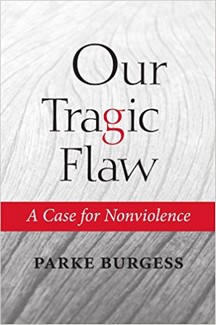
Our Tragic Flaw is a work of serious nonfiction that deeply examines the modern human and ecological crisis, determines its root cause, and explores the best possible solutions.
For the first time in the history of life, a single species has acquired the means to destroy itself and all other living things on the planet. By most indications—if we ignore what it says but examine what it does—this species seems perversely bent upon its own destruction. This species, of course, is us. How did we come to imperil ourselves? And why do we continue to do so? Is it too late to change course? If not, how can it be done?
Looking deeply into these questions, Our Tragic Flaw locates the root cause of our collective perversity in the “logic of violence.” Embedded in our biology, psychology, and culture, this logic is the tragic flaw that threatens humankind. But author Parke Burgess does not accept that this flaw inevitably dooms us to self-destruction. Another way is possible, now as never before. The logic of violence can, in fact, be transcended through a conscious and intentional process of deepening self-awareness, and a corresponding process of sharing power and increasing collaboration in our social relations.
Our Tragic Flaw challenges many established paradigms. It deconstructs most conventional assumptions of modern American culture, which are entirely steeped in the logic of violence. And it confronts violence in traditional leftist ideas about social change and revolutionary struggle. This book is visionary and revolutionary, providing a unique and persuasively argued perspective on the most urgent questions of our age.
This book is essential reading for anyone interested in the ultimate fate of our species.
Excerpt
The Paradox of Existence
I began the first chapter by distinguishing the logic of violence from violence itself. This chapter will explore the origins of both. What we normally call violence represents but the tip of the iceberg, and what I call the "logic of violence" represents the iceberg itself, in toto. Violence is often implicit,subtle, and unacknowledged, but it tends to lead toward increasingly explicit, apparent, and catastrophic forms of expression. In the previous chapters I argued that this pattern of self-destructiveness has reached a new high. If we are to survive this global, annihilative cycle of self-destructiveness, we must first begin to understand how it works. Like the detonator of a terrible bomb, it cannot be disarmed unless we know the mechanics of its wiring - we must know whether to cut the blue wire or the yellow wire. Using the principles of emerging neuroscience just enumerated, the proposed theory seeks to provide a narrative understanding of the mechanism of violence so that we can cut the right wire, and, if we're lucky, escape the worst potential consequences of that violence.
This theory unfolds in two phases: the early phase in which the conditions for violence arise normally and naturally but violence itself has not yet appeared, and the later phase in which dysfunctional development occurs almost universally among humans - for entirely understandable reasons, but with tragic results. I will argue that the world as we find it, given the kind of brains we have, presents an unavoidable problem. Violence is one way of solving that problem - though it turns out to be a rather poor solution. Nonviolence solves the same problem much more satisfactorily. However we choose to solve it, I submit that the problem is universal, inherent in the human experience, and sharply salient to the choices we make and the meaning we lend to our lives. This fundamental problem is the paradox of existence.
The paradox is this: each individual thing that exists is both a unique and discrete thing and it's an inseparable part of that totality we call the universe. The sun, for example, may be defined as a specific and limited set of physical characteristics and mechanical features, but it may also be described as a part of the brightness of the Milky Way, the heat of a warm September afternoon here on Earth, and guardian to the bevy of planets and moons that comprise our solar system. The sun has a distinct individual history and yet cannot be divorced from the story of the Big Bang or the story of a single baby spider hatching from its egg on a dewy spring morning.
While this may seem abstract in the case of suns and spiders, now reflect on the human dilemma. I am both completely unique and autonomous, restricted to a certain position in space and moment of time, and I am utterly a part of this body called the human race, and, within it, Western culture.I am a strand in the vast web of life, a mere atom in the living system of the Earth's surface (which includes other atoms, like worms, waterfalls, and white noise). We continually experience our autonomy, both in the sense of our own power of will and in the sense of our fragility and mortality, and we continually experience our oneness with everything, as we become swept up in powerful forces much larger than ourselves and as we experience the subtlest nuances and intimate harmonies of relationship.
Though it may be obvious and uncontroversial that we are each individual,with a unique existence, body, consciousness, and history, this way of seeing the world is not complete. It captures only the more obvious half of the truth. That we are completely interdependent, interrelated, and interpenetrated with the whole universe may be less obvious, but it's no less true. We are not only among all things, but also fundamentally inseparable from all things. This feature of our experience is what Thich Nhat Hanh calls interbeing.
I say that our oneness with the universe is less obvious, but perhaps it's so obvious we hardly notice it. Though my body seems uniquely mine and separate from the rest of the physical universe, countervailing evidence abounds. The small body that emerged from my mother's womb was nothing more than my mother's body dividing itself in two, with the help of my father's act of fertilization and his contribution of genetic material. And though we are now separated by space, my body and her body did not really begin to diverge while I continued to breast-feed. Aside from oxygen, all my nutrients were still provided by my mother's body. The material that allowed me to grow and change in those early months was still almost entirely derived from her. Even now, decades later, how can I distinguish between my body and my parents' bodies? Each cell of mine still contains the minute secrets held in theirs. Indeed, my body is nothing more than the flesh of my whole ancestry, all the way back to my/your/our amoebic origins.
When I sit in a forest and breathe, the trees and I breathe each other in. The huge Douglas Fir's excrescence, oxygen, is my treasure - just as the carbon dioxide I exhale, a poison to me, builds the very body of the great fir. Humankind would wither and die were it not for the plants that supply our oxygen. This relationship between us and plants can be, and usually is, described as the exchange between two independent bodies; but it can be described equally well as a single though complex organism, a unified cycle of respiration, a symbiosis.
When I eat a leaf of lettuce, I combine my body with the body of the lettuce. The sunlight it absorbed through its life cycle I absorb; the rain it drank from the air and soil I drink; the minerals it drew from the dirt I draw from it. And so it goes with everything I eat, whether vegetable or animal. Food is nothing but sunlight, moisture, and minerals formed in the meat and matter of what we find delicious. And, lest we forget, we too are food. Mostly, we are food for the microorganisms that will see to our decomposition. Then we become soil, mineral. Enriched by moisture and combined with the energy of the sun, we will give birth to new plants that will, in turn, sustain the life of animals, and so on, around and around and around.
The miracle of life began, we are told, deep in the ocean - a miraculous chance encounter of water, minerals, and heat. Our bodies, even these many millions of years later, are still mostly water. Just as we never entirely escape our mother's body, so have we never escaped the ocean. We are still water and salt, though organized magnificently as a byzantine empire of cells and code. We are pouches of ocean, patches of sunlight, a packets of minerals - a protoplasmic stew made of the simplest ingredients drawn from our immediate environment. We are the world and the world is us. Physically, this is inescapable. As it turns out, our interconnectedness with the world is equally pronounced on a psychological and social level.
Like all paradoxes, no actual, irreconcilable contradiction obtains here. The problem it poses is not existential or ontological; it is perfectly possible to be autonomous and interdependent, of course. The problem, as it turns out, is principally moral. The paradox of our autonomy and interconnectedness reverberates through every thought we think, every word we utter, and every act we commit. Our every act is motivated and serves some interest. But motivated by whom? Serving whose interest? To the extent that we see ourselves as unique and discrete actors in the universe, we operate out of a correspondingly narrow construal of our self-interest; and to the extent that we see ourselves as inseparable from the totality of a holistic universe, we operate empathically and altruistically. For most of us, the struggle between these equally true perspectives never abates, and we veer ambivalently from one to the other and back again, leaving behind a confusing and disorganized legacy.
The paradox of existence, as refracted through human thought and action,provides the basis of human meaning-making and establishes the landscape of moral agency. Our specific interpretation of the paradox determines how we assign value to behavior, which, in turn, powerfully influences the functioning and organization of society. Competitive social systems, for example, tend to flow out of the perspective of autonomy, and cooperative ones out of the perspective of interdependence. The social function of moral systems, I believe, concerns the effort to restore some balance to our (usually) too selfish response to the paradox of existence. A strong presence of violence in society indicates such an imbalance.
This is a political treatise that deals with the China issue from a completely new perspective. Disparaging as he may sound, from page to page, toward "the old system" and the Communist Party's various wiles, the author demonstrates his mysteriously