
Kindle Edition
Amazon
davidpagebooks.com
Category:
Health/Wellness
Publisher: Praeger, ABC-CLIO,LLC978-1-4408-4477-5
ISBN-10: 1440844771
Type: Non-Fiction
Pages: 284
Copyright: 2017
ISBN-13: 9781440844775
Price: $48.00 (eBook)
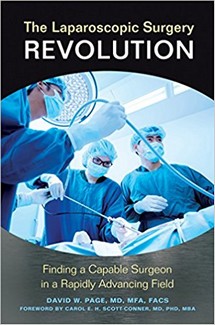
This book describes the historic origins of minimally invasive surgery, the problems surgeons and their patients now face having to master too many open and laparoscopic procedures and the new potential threats posed to uninformed patients.
The modern general surgeon is a dying breed. There is also a grave shortage of surgeons which places added pressure on surgeons to try to do operations with which they may have litlte experience. At a time when the combination of traditional open (incision) operations and 'band-aid' or 'keyhole' laparoscopic operations have exploded in number, you, the patient have no way of knowing the skill level of the particular surgeon to whom you have been refrerred. This book explains how laparosopcic surgery began, as well as the terrible complications that occurred, for example, doing keyhole gallbladder removals: catastrophic common bile duct injuries (the tube to which the gallbladder is attached) rose three to five times that of open gallbladder surgery. Now, there is a way to do almost every traditional operation using a laparoscope. No single general surgeon can perform all of the operations listed as part of our profession. There are answers to these dilemmas regarding how to choose the surgeon you need. I spell them out in the book. Also, informed consent must now be more rigorous and patients need to ask about their surgeons actual experience and training. The book covers topics such as surgical innovation, where you may be on your surgeon's 'learning curve', the surgical personality and the difficult workplace for surgeons.
Excerpt
Writing about patient safety, like performing intricate surgery, has moral
consequences. Readers and patients must be able to trust the practitioner
to do the right thing.
The practice of surgery has always carried with it
the freighted obligation to do only that with which the surgeon has extensive
experience. True informed consent requires that the individual surgeon’s
actual
expertise—as contrasted with the profession’s overall claim
of mastery—be shared with the patient. In today’s
cluttered practice of general
surgery, the obligation to be transparent about personal training and
experience stands out as the biggest challenge for practicing surgeons.
Thus, the topics I have chosen to discuss regarding surgeon capability, such
as surgical innovation and learning curves, hinge on the deeper meaning
of our moral obligation as surgeons to communicate honestly with our
patients.
|