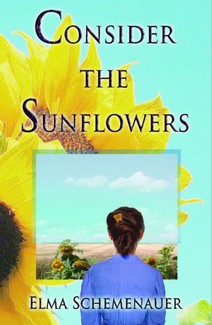
A 1940s-era story about love, Mennonites, faith, and betrayal. Set in Vancouver (Canada) and rural Saskatchewan.
Consider the Sunflowerspaints a colourful picture of life on the home front during World War II and beyond.
As the story opens, it's 1940 and Tina Janz doesn't want to marry the man her pious Mennonite parents have chosen for her. He's as boring as turnips compared with her half-Gypsy boyfriend Frank Warkentin. Obsessed with the dashing Frank, Tina leaves her job in Vancouver to marry him.
However, her joy is soon overshadowed by loneliness on Frank's farm in the prairie community of Coyote, Saskatchewan.
Her loneliness deepens when she realizes she was mistaken in believing her husband to be a Christian. She tries to win Frank to faith in Christ, but he says she should accept him as he is, not nag him to change.
When Frank shuns local Mennonites because some of them scorn his mixed parentage, Tina is torn between her Mennonite heritage and her husband. Their son's death drives the couple farther apart. Then Tina's former Vancouver boyfriend shows up, setting off a series of events that send her and Frank stumbling toward a new understanding of love, loyalty, faith, and freedom.
"It's a heart-warming story with lots of surprises and a strong Christian message. The settings are not mere backdrops but vivid portrayals." – Deborah Gyapong, journalist
"A must-read for those who appreciate a good love story enhanced with adventure and historical accuracy." – Ray Wiseman, columnist
The novel effectively evokes many aspects of Mennonite life in the 40s, and moves well.–Helen Martens, author and professor emeritus at Conrad Grebel (Mennonite) College
Excerpt
Municipality of Coyote, Saskatchewan, March 1940
Chapter 1
Tina felt like liverwurst in a sandwich, trapped in the stalled truck between her dad and the man he wanted her to marry. Rich, boring Roland Fast.
From the looks of things, she might not survive to marry anyone. Freezing to death seemed more likely. All she saw through the windshield was blowing snow. Occasionally she glimpsed the fence beside the ditch they were stuck in. Beyond the fence, only a wilderness of white glittering in the afternoon light: no Saskatchewan prairie, no horizon, not even a telephone pole.
She stamped her boots, trying to warm her icy feet. She should never have agreed to come along and sketch Roland's horses. She liked horses but getting stranded in a blizzard wasn't supposed to be part of the deal.
To be fair, she couldn't blame Roland and her dad. They weren't expecting this storm. It had howled in from the northeast with hardly a whimper of warning.
Her nostrils tingled with cold and the green-banana stench of Roland's hair oil. She pulled the collar of her jacket higher, nudging him with her elbow. "How about trying the ignition again?" If they got the truck going, they'd at least have some heat.
Roland slumped over the steering wheel, his apple-cheeked profile making him look younger than his twenty-eight years. "It's no use. This stupid truck isn't going to start."
"Don't blame the truck, Roland," Tina's dad said. "There's probably snow in the engine."
Roland's sigh puffed out white in the frigid air.
Tina almost felt sorry for him. According to Roland, his 1940 Ford was the most modern half-ton on the road. No other new model had such a powerful engine. But all that horsepower under the hood was useless without a spark to get it going.
Something like her and Roland. There wasn't any spark between them.
Her dad shifted on the seat, jostling her onto Roland's wide shoulder.
She edged away. "Could we brush the snow out of the engine?" she asked, sounding more hopeful than she felt.
Roland gave her a bleak smile, his face too close to hers. "I doubt it in these conditions."
"Okay, I just thought I'd ask." She didn't know how Roland felt about her. Not knowing made her nervous. He was awkward with women, but she sometimes caught him watching her with a certain softness in his eyes.
Whether he was interested or not, she should quit letting her parents throw them together every time she came home from Vancouver. She should simply tell her folks, "Look, I don't want you interfering in my life. I'm a grown woman; I've got a job in the city. Anyway I'm in love with someone else."
She shuddered to think of the avalanche of questions her parents would ask. She wasn't ready to answer them, not yet.
The wind whooped around the truck, rattling the windows.
Roland reached behind the seat, grabbed his hat, and plunked it over his blond curls. "I think we should walk to Frank's house. It's the closest."
Tina's heart jumped at the mention of the man she loved, but she kept her expression blank. She didn't want her dad or Roland guessing how she felt about Frank. They'd be shocked. Her dad would scold and rage. He wanted her to marry a church-going Mennonite, preferably the owner of this impotent truck.
She jerked her chin toward the bottle of pills in Roland's pocket. "What about your mare? I thought she needed that medicine."
"We'll get it to her as soon as we can, but we'll want someplace to get warm along the way." His voice reminded her of a radio announcer booming out news of Hitler's war.
Her dad rummaged under the seat, crowding her against Roland.
She moved away.
Her dad sat up, his head bobbing. "Roland, do you have any blankets? I think we should stay here till the storm lets up. It's too dangerous to walk in weather like this."
Roland shot him a narrow-eyed look. "Obrom, we've got no heat in here. We could freeze to death, even with blankets. This storm could last for days."
"We could freeze outside, too." Tina's dad pulled his handkerchief out of his pocket and gave his nose a honk. "The snow's blowing too thick. We might get lost and wander around like drunkards."
"Not if we follow the pasture fence," Roland said. "It'll lead us right to Frank's." He raised his eyebrows at Tina. "What do you think?"
She peered out into the arctic blankness. If they stayed here, they'd probably freeze unless someone came along and helped them—not likely. If they braved the blizzard, they'd either reach shelter or die trying. "We can't be far from Frank's," she said. She remembered passing his neighbour's granaries before the storm hit.
"It's about a quarter-mile," Roland said.
Tina sucked in a chilly breath. "We can make it." It was better to face danger head-on than wait around to see what would happen, wasn't it? She reached into her pocket for her fuzzy woollen cap and tugged it down over her ears.
Her dad's brow puckered like it did when he was deep in thought. With all her heart Tina hoped she and Roland were making the right decision.
Her father sighed, then glanced from her to Roland like they were a couple. "I guess you young people are right." He put on his cap and lowered the earflaps. Tina helped him tie his scarf over his nose and mouth. Then he opened the passenger door and she plunged out after him.
The wind hit her hard, whistling through her cap and making her ears smart. She pulled her scarf from under her jacket. Fighting the wind, she tied it over her cap.
Her dad motioned for her to follow Roland, who was plowing through the ditch toward the fence. She struggled along in his footsteps with her father close behind. Snow spilled into her boots, shocking her with coldness.
The drifts were shallower on the pasture side of the ditch. Strands of barbed-wire appeared and disappeared between blasts of snow. God willing, that elusive fence would lead the three of them to her boyfriend's house. Tina dared to smile. The good Lord must have a sense of humour.
"We'll walk in the pasture, away from the ditch," Roland bellowed above the yowling wind. He set one boot on the lower wire of the fence, held it down, and lifted the upper one, creating a gap for Tina to climb through. She scrambled between the wires, careful not to catch her jacket on the barbs, then stepped aside as her dad and Roland ducked through.
"Come on," Roland called, heading along the fence. "Single file. Stay together."
Tina followed, admiring Roland's boldness in spite of herself. She knew why her parents wanted her to marry him. He was strong, worked hard, and came from a family who had owned an estate in the old country. Roland's ancestors had the same Dutch-German-Mennonite background as hers. According to her folks, that shared heritage would make a solid foundation for marriage and children.
But Roland was as boring as turnips compared with Frank. Her Frank was hot peppers, red cabbage, and wild mushrooms. He was adventure, music, and laughter. Some people said he didn't have the gumption to buckle down to farming, but they didn't know him like Tina did. He just needed a good woman to settle him down.
Her hands ached with cold, even in the coyote-skin mittens Frank had given her. She clenched and unclenched her fists, trying to get her circulation going, then peered over her shoulder to see how her dad was doing. His tall figure loomed through a whirling smoke of snow. The scarf over his nose and mouth was white with frost from his breath clouding into the air. She motioned for him to shift the icy patch away from his face and turned to follow Roland again.
She didn't see him. Where was Roland?
She took a few steps forward, feeling like a ship without a rudder, and almost bumped into a lumpy snow-covered mound. It seemed big, wider than an outhouse though not as high.
"Tina!" Roland's shout came from ahead and to her right. "This way."
Relief shot through her as she spied Roland chugging along beyond the obstacle. She checked to make sure her father was still behind her, then followed Roland, grateful for the partial shelter offered by the mound of whatever it was.
A rock pile. Of course. Frank's father had picked tons of rocks off his land when he farmed here. This must be one of the places where he'd chosen to dump them. She fought the wind to the far side of the rocks. Once she was clear of them, she caught sight of the fence again and turned to wave to her dad.
He wasn't there.
Tina's heart fluttered like a bird caught in a fox's jaws. She drew a breath to call to Roland, then saw something long and dark slumped beside the rocks. "Roland," she shrieked, "Something's wrong with Dad." She stumbled toward her father, fell, picked herself up, and hurtled forward.
Professional Reviews
Richly-woven tapestry of prairie life in the 1940s
REVIEW BY JANET SKETCHLEY
Tina and Frank marry for love or at least fascination, but it's a rocky trail. They each have insecurities, attitudes and suspicions, and Tina is keeping a secret that may come back to hurt them both.
Consider the Sunflowers is a skillfully crafted literary novel that opens a window onto small-town life in World War Two-era western Canada. Little snippets of news and daily life help us understand the times, while Tina's and Frank's efforts to save their marriage will resonate with readers today.
Readers learn about Mennonite culture and prairie life, and about feeling like an outsider. There is a spiritual thread that's organic to the novel, but it's not about preaching. It's about how the believers live their lives. Frank is honest about his inability to believe.
We also see the effects of self-pity, complaining, self-exclusion and manipulation, and in the seeing we may gain insight into our own lives. There's a point in the story where Tina sees an amplified negative trait in another character and realizes she needs to change herself. As we watch her begin to change, it might inspire us to do the same.
Consider the Sunflowers
REVIEW BY COLLEEN CARBOL
What would you do for love?
Would you leave a cushy job in Vancouver for an uncertain future on the windswept Saskatchewan prairie?
That’s what Tina Janz does in the 1940s-era novel Consider the Sunflowers by Kamloops author Elma Schemenauer.
Tina’s reason?
She’s crazy about her hometown Saskatchewan sweetheart, the dashing half-Gypsy Frank Warkentin.
Her parents, who are Mennonites, want her to marry a wealthy church-going Mennonite.
However, Tina wants to marry Frank — and she does.
The couple’s story, published by Borealis Press, is a colourful and, sometimes, heartbreaking portrayal of life on the home-front during and after the Second World War.
At first, Tina is happy on Frank’s isolated farm. She doesn’t miss the conveniences of city life. She doesn’t complain about heating water on a coal-burning stove or using a washboard to scrub sheets, towels and Frank’s long underwear.
However, her joy is soon overshadowed by loneliness.
Her desolation deepens when she realizes Frank doesn’t share her Christian faith, as she had led herself to believe.
She tries to convert him, but he says she should accept him as he is.
Tina thinks she’d feel less lonely if she and Frank lived closer to town.
He won’t hear of moving. He loves the farm on which he grew up.
“If you won’t move,” Tina says, “let’s at least plant some trees around the house.”
Frank doesn’t want trees. They’d make him feel trapped.
The birth of the couple’s son, Herbert, draws them closer together. The baby’s death drives them apart again.
Is there any hope for Tina and Frank’s relationship? Yes — and it comes from a surprising source.
Elma (Martens) Schemenauer’s early years as a Mennonite on a remote Saskatchewan farm inspired the novel.
Several other Western Canadian authors have written books based on their Mennonite backgrounds. They include Andreas Schroeder (Renovating Heaven), Miriam Toews (All My Puny Sorrows), Janice L. Dick (Other Side of the River), Rudy Wiebe (Sweeter Than All the World), Sandra Birdsell (Children of the Day) and Darcy Friesen Hossack (Mennonites Don’t Dance).
Consider the Sunflowers is a page-turning addition to the list, including supplementary documentation of interest to the history buff.
Tina’s father wants her to follow Mennonite tradition. He also wants her to marry Roland, a rich man, but she’s in love with Frank, a half-Gypsy who doesn’t share her faith. The novel pulled me right in with an extremely visual opening scene. Tina, her father Obrom, and Roland are trapped in a snow storm when their truck gets stuck in a ditch. This in 1940 Canada, and winters are brutal. Not far from there, however, is Frank’s farm -- Frank, the half-Gypsy Tina is in love with -- and after much effort the trio makes their way to the farm.
By alternating the chapters from Tina’s viewpoint to Frank’s, the author offers glimpses inside the love they share as well as the obstacles standing in their way. For example: what would Obrom do if Frank asked for Tina’s hand? Get very mad. Also, Tina wants to follow tradition Frank is not keen on following. Aware of this, he wants to break it all off, as he and Tina weren't that good together. Too many rules, angry words, accusations.
The author does a masterful job describing time and place. When Tina moves to Vancouver to work as a secretary, we see through her perusal of the Vancouver Sun, that Hitler still threatens to invade Norway. Germany and Italy to form alliance against UK. America remains neutral but for how long?
Also, in Vancouver, Victor Graft, a carpenter, enters the story. While Tina corresponds with Victor and sees him, her heart remains with Frank, the half-Gypsy back home.
Eventually, Tina and Frank find their way back to each other when she returns to Dayspring. The author’s descriptions of place and character are beautiful, with lines like: Frank with eyes so brown. She could lose herself in those eyes, follow their promises to the ends of the earth.
Theirs is not an easy relationship, and that is what captivates. Frank is an interesting but complex character. Having lost his mother as a child, he carries a certain burden with him, a situation complicated by the fact that he’d rather associate with Scandinavian and British than Mennonites in Tina’s community.
When they do become a couple, the tension only intensifies. We see Tina struggle to accept life on Frank’s farm as she hopes that even though he doesn’t accept her faith he will change. Later, we see her suffer a close and personal loss, a serious test of faith.
The author leaves us with a sense of hope, beautifully accentuated by artistic descriptions. Be sure to read the timeline at the very end. It summarizes the history of Mennonites who emigrated from Russia to North America as well as those who came from Switzerland and Germany.
I very much enjoyed reading this novel and highly recommend it.
Consider the Sunflowers can be ordered from Chapters Indigo http://tinyurl.com/nsylp5j or the publisher, Borealis Press http://tinyurl.com/lfdo9pf . E-book coming later. More information is at http://elmams.wix.com/sflwrs.
I loved your opening line – feeling
like liverwurst in a sandwich – who wouldn't want to keep reading?
The book was full of suspense.
Many times I chuckled at the Plaudietsch (Low German) expressions, nicht, shteefmuttachye, (I really had to study that one) and the characters, Obrom, Adeline, Lottie and more. What a hoot.
I particularly liked the way you closed your book; with an invitation for salvation. Here is the opportunity for any reader to make that commitment. God bless you for that.
This is the first time I can say that I know the author of the book I have read, outside of The Bible, of course.
Tina Janz, her father, Obrom, and Roland Fast, the man Tina’s father wants her to marry, are caught in a Saskatchewan blizzard. My senses are so piqued as I jump into the first scene of the story that I shiver in the biting wind, the pelting snow, fearful of the disappearing fence posts that are supposed to lead these people to safety. An apt beginning to a book about troubled relationships and, ironically, hope.
Tina does not want to marry “rich, boring Roland Fast,” because she is in love with dark, handsome Frank Warkentin, a half-Mennonite, half-Gypsy much maligned in the Mennonite community of Dayspring, Municipality of Coyote, Saskatchewan in 1940. Tina’s parents only want the best for her, but she has a mind of her own. She’s sure that if she can marry Frank, he will fulfill her purpose in life.
Frank is attracted to Tina partly because she is proper, something he secretly aspires to be. Haunted by his mother’s desertion in childhood, he reacts with distrust and anger to the meanness of those around him. This burden proves a considerable obstacle to his happiness and the achievement of his inner goals, both in his own life and in his marriage.
Consider the Sunflowers involves many intricate relationships including love triangles, childhood abandonment, societal insecurities, spiritual hypocrisy, peer friendships, to highlight a few. Characters are realistic, portrayed with both strengths and weaknesses, acting/reacting in plausible ways. Settings mirror the dreary isolation Tina feels on the treeless prairie of southern Saskatchewan, yet also offer a hint of hope for something better ahead. The book is hard to put down, with tension-filled chapter endings and well-crafted flashbacks, as well as a tightly wound plot.
Elma Schemenauer, seasoned author and editor of more than seventy books, enriches this difficult story with figurative language apropos of the farming community of the 1940s: “Sunlight was spilling across the snowdrifts like broken egg yolks,” and “more wide awake than a pig the day before a sausagemaking festival.” The people of Dayspring still remember much of their homeland in Russia before immigrating to Canada, and “Hitler’s War” is constantly in the news. Consequently, the Mennonites are suspicious of outsiders and remain resistant to infiltration by “English” people.
Schemenauer has included an impressive, comprehensive Mennonite timeline at the end of the story as well as a study guide for readers. An excellent work worthy of recommendation.
Paperback 299 pages $19.95, ISBN 978-0-88887-575-4, AVAILABLE FROM THE PUBLISHER, Borealis Press http://tinyurl.com/lfdo9pf . Also available online at Chapters Indigo http://tinyurl.com/nsylp5j by about November 15. E-book coming in 2015. For more information, please visit http://elmams.wix.com/sflwrs
Available Now! Rated 5 ***** by readers and listeners.
Sweet Revenge is a powerful and romantic saga of th mid 1800's, recalling pirates and those trying to rid the seas of such vermin. Shawn, a debonair captain, gets caught up in
A novel about a family during World War II, set on the homefront in Springield, Mass., and in the South Pacific. The book focuses on four characters and how their lives were affected and changed during the war years.