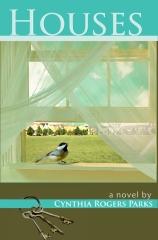
Forty-year saga of one woman's search for the meaning of home.
Lacey Winters measures her life in houses. That's always been the way she divides the befores and the afters, the success and losses, the endings and beginnings. To hear her tale you will have to hear about the houses—the American ranch, the Georgian Colonial, the restored farmhouse, the Cotswald cottage—that hold her memories of loss and betrayal, birth and death, struggle and triumph.
From the turbulent 60s, through the psychedelic 70s, the materialistic 80s, and the booms and busts of the end of the century, Lacey will try and fail and try again to build her own version of the Great American Dream.
If you’ve ever been house proud, house poor, or homeless, ever envied a home you couldn’t have, hated one you had, or found peace or made beauty in the structure that sheltered you, you are likely to identify with Lacey Winters and see yourself somewhere on her journey through a half-century of American history and the chain of houses that hold
the chapters of her life.
Excerpt
Wood, I think, and the examples of trees, can provide a lovely metaphor for human experience. In our first seedling stages we are weak and vulnerable, dependent on luck, protection from the elements, the nutrients in good soil for giving us a start. We can go almost any way then. Whatever is asked of us, we’ll try to accommodate. Train or trim or stake us unnaturally, we’ll grow to your aberrant design. Deprive us of sun, a little water, the barest of natural necessities, our growth will disappoint. But usually, even with the slightest, the most unenthusiastic encouragement, we become sapling youths, flexible and fast-growing, capable of reaching ridiculous heights without even half trying. In the beginning we are all softwoods—pines, spruces, larches or firs—and like these, terribly impressionable. You can dig your fingernail and leave a mark. A careless word will leave permanent scars.
But in time most of us become hardwoods, and like the broadleaved oaks, are harder to damage, harder to bend, more resistant to change and the vicissitudes of storm. We begin to develop what we call “character”—that same quality that reveals itself in the growth rings of trees, in the variation of light and dark that bespeaks seasonal change and varied experience. Wet, quickening springs. Long dry summers. Brilliant but melancholy falls. Bitter cold winters. They all start to show. In our core. In our mirrors. In our souls.
Professional Reviews
A gem of a book and an instant classic
Most of us remember our lives via key events forever lodged in our memories; who we were with, what was making headlines, etc. However, Lacey Winters memories are dictated by the houses she has lived in. For many of us that lived in many places that is an easy way to mark time.
The story is the 50 years of Lacey’s life that are shared with the reader. We are along for the journey from her Grandmother’s home to the home her own grandchildren visit. As a reader, I was pulled into the story, truly caring about the characters and feeling the happiness, sadness, and sorrows she felt throughout her life.
This novel is so well written that I had to remind myself that it was a novel and as far as I’m aware fictional. It truly felt as though I was sitting with a good friend as she relayed the stories of her life.
The imagery is fantastic and the details are perfectly balanced with a storyline that keeps the reader turning the pages and engrossed so deeply that you feel you actually know these characters as people. I finished "Houses" in 2 days because I simply could not put it down.
The chapters of Lacey’s life are heartwarming, heart breaking, irritating and honest. Anyone that reads this book can relate to most every scene that plays out, either in our own life or in those we have met. Even though I do not personally remember many of the events that transpire in this book (we all know them from history) the accounts given by Cynthia Rogers Parks give it a sense of realism that truly makes it much more real than anything experienced in a textbook.
"Houses" is a gem of a book and instant classic.
Reviewed by Melissa Koltes for RebeccasReads
Want to review or comment on this book?
Need a FREE Reader Membership?
Reviews for "Houses"
Reviewed by Betty Gelean
1/21/2011
Houses, a Novel by Cynthia Rogers Parks
Publisher Leigh Walker Books
This simply titled book was a pleasant surprise to me. It is written as a memoir and I had to keep reminding myself that this is a novel, not Cynthia Rogers Park's memoir, although I'm sure there is a great deal of herself in the book. "Houses" is the memoir of Lacey Winter. It is also a snapshot of historic moments of the U.S. through the 1950s, 60's, 70's and on toward the millennium; the growth of changes after WWII, through the Viet Nam era, the deaths of President John F. Kennedy, Ted Kennedy, and Martin Luther King Jr. A time she measures by the houses she lived in.
Everyone has a method of recording the events in their lives. To me, it is generally the ages of my children, but after reading this memorable book, I find I identify with Lacey's memories of time, attached to which house she was living in. It seemed only right that she would eventually work in real estate. Lacey's story begins as a child living with her Grandmother and her younger sister with very rare visits from her father. Her mother died in an accident and he is "looking for a new mother". From this point on, Lacey seems to spend her life moving from house to house, sometimes it's a good thing, sometimes bad. Sometimes the houses are "happy" and sometimes they are not. All houses take on a personality that she tries to imprint herself on, but many times the houses imprint her. Sometimes she is upgrading, sometimes downgrading, according to her life and the turns of national economy.
In the real time period of this book, life sped up so fast, it was hard to know what would be thrown at you next. Segregation was still in effect, women were on the edge of being recognized, but these and wars, and yes, even the hippie movement all meant huge changes in the country. And for every change, another house, another hopeful start. I feel that the author has done a very good, tightly written novel of so many opposing factors, keeping the theme of houses commensurate with life. For many of us our home or lack of home, even shared home was our life. This would be a good book club read deserving discussion, as well as for individual readers who grew up in this era. I found the book to have a very intriguing style and a believable storyline. I liked the book very much. It covers a lot of ground and demonstrates a definite slice of life in the last half of the twentieth century, making it real.
Houses: A Novel
Author: Cynthia Rogers Parks
Publisher: Leigh Walker Books
ISBN: 978-0-615-32893-5
We all measure our life using markers as milestones. For some, it's by decade, by age of the firstborn child, by family births or deaths. Lacey Winters measures her life in houses. Each house she's lived in marked an era of her life. For example, early childhood was spent in her paternal Grandmother's home. Her mother only a faint memory, Lacy and her younger sister Sophie had Grandmother, a traveling salesman father and Thelma, her Grandmother's trusted houseworker. Later, it would be a new ranch style suburban home purchased by her father and his new wife, Maureen. Daddy and Maureen now worked together, on the road most the time, the girls looked after by Nana, Maureen's mother. The subdivision was new, with just planted trees and raw soil, still too new for the grass to have taken hold in the yards. The girls played with neighborhood children, and time passed on, from the 1950s and into the turbulent 60s, where we follow Lacey throught the growing up rites of passage: first love, excitement of new beginnings, and heartbreak with the 60s world-changing events as a backdrop.
Author Cynthia Rogers Parks has written a truly captivating novel with well developed and multi-dimensional characters. She writes the story of a girl and her family with all the events that have shaped the lives of Americans through the 1950s, turbulent 60s, politically wrought 70s, the crazy me first 80s and the rollercoasting 90s into the new millenium.
Throughout all these decades of changes, the American dream remains unchanged: home ownership. We follow Lacey through her homes, the big, the small, the well loved, the despised, the transient. I really enjoyed the authori's innovative way of looking at the passages of life through the homes Lacey lived in. For most women, our homes are an integral part of us, they display our treasures, hide our heartbreaks and secrets and are our sanctuary from the outside world. I could not put this book down. It's a truly wonderful story, and you will feel connected to Lacey in a way that is all too seldom felt in novels. She is a character you'll remember with affection, and Houses is a book you will treasure.
As deafness, illness, and demonic forces close in around him, Ludwig van Beethoven must summon his faith and genius to complete the Missa Solemnis—a sacred masterpiece he believes could bring divine light into a darkening world.
The bulk of the collection is eight short stories that are set in yesteryear. The compilation is filled out with four entertaining fantasy pieces and three poems.
As deafness, illness, and demonic forces close in around him, Ludwig van Beethoven must summon his faith and genius to complete the Missa Solemnis—a sacred masterpiece he believes could bring divine light into a darkening world.