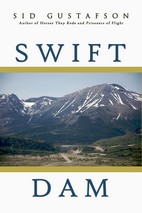
Veterinarian Fingers Vallerone, rides to find the American Indian survivors of the Flood of '64.
It had been a long snowy winter and spring. The rivers were late rising, and the mountains held onto a pure white snow-cover. Rain fell upon the deep winter snow the day before the Flood of '64. Waters rose, the rivers raged. The dam failed to hold the Birch Creek flow, and broke, giving way to a wall of water and drowning the Indians.
Veterinarian Alphonse Vallerone dreams out this novel of dreamers dreaming. He goes back 40 years to the day after the Flood, when he assisted the surviving Indians. Riding from one devastated ranch to another, he tends to the surviving yet devastated animals and tries to mend the grief wrought by the Flood.
Underpinned by the lingering and harsh reminders of the Blackfeet Nation’s heroic, tragic, and vibrant past, Gustafson’s third novel chronicles the heartrending drama of the Blackfeet people.
Swift Dam celebrates the native land and the Natives who survive as they have survived throughout time, perilously. It is the story of a veterinarian who attempts to sustain and nurture life on the land, his empathy with the living, and his sympathy for the dead and dying.
Excerpt
Above Swift, the Birch Creek drainages bear the precipitate waters that feed the reservoir. Diverse province of sheep and goat. Pristine realm of deer and grizzly. Sky of ravens and eagles⎯a wilderness spared the industry of man, a landscape once ruled by buffalo and wolves, tended by American Indians⎯the time before dams. Fingers’ mind explores the drainages. Trips in and out with horses, children, and the Catholic. The time approaches where he may not be able to explore the backwaters anymore, evermore. He runs through each flow, his aging mind sharp, his memory a horse.
The soft-flowing South Fork waltzes through a grassy cottonwood valley before its run is buried in the reservoir. His string of horses conveys his brood of children through the drainage and into the wilderness.
Limestone waters stream down the Middle Fork, splashing off majestic cirques to join the South Fork. Fingers recalls trip after trip with horses into that amphitheater of stone, a precipitous nowhere land; province of wolverine, realm of lynx. The Middle Fork represents an empire of time⎯dwelling place of the Blackfeet spirits of yore.
The North Fork of Birch Creek enters the western arm of the reservoir, a freestone stream cutting a linear path from Badger Pass. His family of man and horses and dogs traverse this eastbound route home, making the loop from the west side through Big River Meadows and up Strawberry Creek. Rocky Mountain water carves through overthrust after overthrust displaying the salty history of the world. Trilobites. Horses then and memory now carry Vallerone through beginnings of time.
Early in Fingers’ healing career, Many White Horses showed him the history of the land written in rock. Together, they spent days riding their horses and searching through rock for elusive pearls of stone. Up the North Fork, they discovered the fossilized opalescent sea-worms and the pleated clamshells of Corbicula. They searched for Baculites compressus of iniskim fame, the buffalo-calling stones used by the medicine men to lure the buffalo. Eons of Birch Creek flow have exposed the fossils the Indians still seek for guidance. Tributary streams transport windswept mountain silt, carrying the ancient seabed from mountains to plains, minerals to grow the grasses that once nourished buffalo, range now grazed by cattle and horses.
Wolves wander and pack together as they have through time, howling for lost brethren.
Fingers Vallerone howls in answer, he howls aloud the memory of the world the mountains hold, he howls for water that cannot flow. Wolves reply.
Vallerone howls in answer, he howls to know as wolves know, to learn, to see forever as wolves see, to hear. He transforms himself under the monolith, this concrete they call Swift, this pyramid they claim will be permanent this time, a construct that will not break and fold.
Professional Reviews
Swift Dam, Review and Reflection by Mary Scriver
1. Rain: The set-up begins, the “Water Dream.”
2. Water: How Swift Dam was built in Blackfeet vision dream country.
3. The Black Bag: Moon drivers and car sleepers, a demanding son.
4. Spirit: The story of Spokane, a famous race horse.
5. Pavlov: Relationship between Bird Oberly, sheriff, and “Fingers” DVM.
6. Luck: “Mardo” brings in the quilled dog of “Riel Du Pré.” Some will guess who these people really are. How a vet became a writer.
7. Medicine: About Pondera County livestock practices.
8. The Storyteller: Mardo comes through as an agent.
9. Recapitulation: Surgery under the moon.
10. Sun: Sleeping in the street, in broad daylight. Doctor Sally Jo’s intervention is nearly a seduction.
11. Shine: Interviewing the vet’s wife, Maple, leads into an early rescue story from above Swift Dam.
12. What Horses Know: How “Fingers” tried to save his friend Ivan and at least brought back his body.
13. The Living: Bird Oberly makes a double discovery.
When it comes to books, one of the more stupid on-going literary wrangles is about what is true and what is “fiction”. Stupid, because stories are always mixtures of the writer’s experience and the underlying structure of the world. Neither one is known or knowable, however entwined they are. But is it convincing? Does it move us with passion and regret? Does it recommend strategies for survival? This one does.
Especially in a place which might be called the East Slope of the Rockies, the Blackfeet Reservation, Pondera County, the Crown of the Continent, and so on, the fancy names hide the fact that around here success is really more of a narrow escape. But it sure does encourage the circulation of blood. It’s healthy if you can keep moving, which is also the secret of horse health. That and a bonded buddy.
The best novels, however one defines them and judges them, include the knowledge of something we’ve known little about on the level of expertise that the practitioners have. Consider “Moby Dick.” In this novel Moby Dick is a monumental rebuilt dam and the special knowledge is about horses and veterinary meds and instruments. Flesh of several kinds. The Gustafson family is full of veterinarians and in fact Rib was our veterinarian in the Sixties, when we presented him with the challenge of bobcat kittens and pet badgers as well as horses and occasional rodeo stock used as models.
swiftdamclose.jpg
Sid’s father Rib was colorful. (Sid is, too, but in a different way.) Imagine Max van Sydow. He was very much a family man and when he and his wife had aged, his children — Sid, Kris, Erik, Barr and Wylie — put their careers on hold and returned to the area to care for them. A few years ago, when Rib realized that I was friends with Sid, he took me to lunch to see what I was about. Of course, he was also curious about my marriage to Bob Scriver. We had a good time, telling stories.
ribkids.jpeg
Rib and kids
This book makes it clear, as though it weren’t before, that Sid’s “life-problem” has been dealing with his father, wanting to be allied without being crushed. For reasons of his own, Rib sent teenaged Sid out to be a range rider/cowboy with Billy Big Springs, a massive Blackfeet Indian whose allotment turned out to have an oil well. Billy was a second father and took that seriously. The effect was much like Bob Scriver being sent out as a teenager to the Jim Stone ranch where Mrs. Stone, Blackfeet, took him in hand. The result in both young men was a yearning affinity to Blackfeet life that cannot be challenged or thinned. But they were somehow unsettled for life. Neither found a partnership with a woman that lasted.
So this novel has in its guts something about marriage. There are two married men, a veterinarian and a cop. The cop is young enough to have been the veterinarian’s son. (The vet’s son is named Ricky.) Both have faithful, fulfilling lives in spite of the often interrupted time of such jobs when emergencies come often, at night, without warning. I love the description of the veterinarian (called “Fingers” which is the nickname of Sid’s musical brother who did NOT become a vet) returning home chilled and aroused from doing surgery under the moon that has resulted in a new creature being given life. He comes into the marital bed where his wife is just surfacing from the warm pool of her dreams, her flesh slightly swollen, and embraces her with shared love.
swiftdam1.jpg
Some of these vignettes have been published as short stories, one of them being about Fingers’ habit of sleeping in the shadow of Swift Dam, which stands like some monument to hubris and human industrialism, ignoring the life-ways ended, the suffering, the little rule-bendings. This leads to the narcolepsy of aging, sitting behind the wheel of his big old-fashioned car at the only stoplight in Conrad. The book is dedicated to Rib and is clearly in part a reconciliation with his death.
The Macguffin of the plot, to use Alfred Hitchcock’s term, is the medical black bag with contents so secret but potent that locals imagine all sort of contents, esp since they seem to be kept in the bank safety deposit at least part of the time. They think drugs. Some speculate money. None quite understand Fingers’ fascination with Swift Dam, even knowing that his best friend, Ivan Buffalo Heart was killed in the flood. Fingers took pack horses and rode along Birch Creek’s flood plane until he found him, tangled in debris in a tree, and took him tenderly home to his wife, Tess. There’s more to it than that, but you need to read the book to find out.
Since modern books constrained by time and money have stopped including a Table of Contents, I supplied my own at the top, sans page numbers. It’s a small paperback, 150 pages, but complete and coherent in spite of its many layers. It is packed with poetry, lyric images.
sid.jpg
A short story in which "Stuf" is based on Bob Scriver.
Sid’s stories are sometimes printed in small magazines composed in back bedrooms where they suffer from bad proofing. This book has half-a-dozen malapropisms, the sort of thing that escapes spell-check and perhaps many readers. None of the misfired words are among the Latinate medical terms or the cleverly trademarked drug names, or maybe I just couldn’t tell.
chinarch.jpg
Rib Gustafson's local book.
I had not heard before the term “orographic lift” which is the term for the contraction of water-laden air struggling up over the mountains, off-loading rain or snow, to become a catabatic warm wind on the other side where it can expand again, creating a rain shadow. The country of the “Chinook Arch” is one of the most apt and evocative names, a kind of empty blue rainbow that is full of sky.
Alongside the hydraulics of the land, “Swift Dam” is driven by psychological dynamics older than Freud or even the Greeks. Father and the oldest son of five share a vocation except that Sid expanded his to include thoroughbred racing horses, which brought him into a strong moral culture advocating against treating animals like machines, injecting and confining them out of greedy convenience. He has a gut-level affinity for the old ways of buffalo hunters. Rib also wrote, but only small local books illustrated by his wife. This novel begs for a screenplay.
Swift Dam "Mesmerizing
"Swift Dam," the new novel by veterinarian and writer Sid Gustafson, is a beautifully evocative exploration of memory and landscape, history and generational relationships. It is set on the Blackfeet Indian Reservation, where Sid grew up as part of the prolifically creative Gustafson clan.
The guts of the book are the ruminations of Oberly and Vallerone on life, love and mortality. Vallerone, apparently subject to some kind of sleep disorder, has trouble keeping his dreams separate from real life, or disentangling real history from myth and misremembrance.
The point seems to be that we all are disordered when we try to reconstruct the past, that we all live to some extent in a waking dream.
The book is also full of veterinary particulars, which might sound dry but are anything but. Vallerone is an old-fashioned healer who does much of his diagnosis and doctoring with his hands—hence the nickname “Fingers”—and who is a proponent of the Blackfeet way of raising and caring for horses.
Sid, who in his own practice specializes in the care of thoroughbred race horses, goes into loving detail about the proper care of livestock, and he takes several detours to damn the damage done to animals by modern ranching techniques and the scourge of using drugs to treat every ailment.
Sid writes of veterinary medicine, and much else, with a poetic voluptuousness, as in this description of the aftermath of a cesarean birth: “The new mother heaves a sigh of relief as the calf exits her incised womb. Doc elevates the calf to drain her wet lungs, and lays the neonate out and revives the baby, too long inside. He clamps her umbilicus to make her inhale, and inhale the little creature does, taking in first air, continuing to inhale, gestating nine months to inhale. Fingers threads his needle with catgut suture and the newborn sits to her sternum and issues a faint bawl. He stitches the mother back together, the newborn flapping her ears, stars singing hallelujah.”
Sid also knows the Blackfeet, whom he grew up around up on the family ranch. He writes of Blackfeet past and present with a clear understanding of the indignities they have suffered, but also with an unsentimental appreciation of what they might teach those who care to listen.
- See more at: http://lastbestnews.com/site/2016/06/swift-dam-a-mesmerizing-account-of-family-remembrance/#sthash.Hzrlm5H8.dpuf
Outside Bozeman review
Swift Dam
Local author (and veterinarian) Sid Gustafson’s latest book, Swift Dam (Open Books, $15.95), is set against the real-life tragedy of the Swift Dam collapse in 1964, when 30 people died in dam collapses and flooding in northwest Montana. Gustafson tells the story of a veterinarian and his life, work, and relationship with the Blackfeet Nation. The vet, Fingers Vallerone, mourns the losses of not just the individuals but of a culture. Gustafson embodies the storytelling culture in his distinctive style of prose. The discourse is at times sparse, and yet at others curiously insistent. It is a fast read, but tantalizing threads leave you picking through them long after you have finished. Gustafson uses landscape as the language of the Blackfeet Nation, and his intimate knowledge and sense of place shines through. Gustafson’s text seems to be a man’s book about men, with a masculine, almost patriarchal tone that probably reflects its characters. —DEBBIE DREWS
Everybody should read this. It is a particularly brutal tale which sadly, is all too true. Despite the horrific loss of life it could have been worse...or could it?
"Sid writes with a dedicated sense of change and place. Swift Dam is native lore from the poetic heart of Montana, a water manifesto."
Jim Harrison, author of Dalva, Legends of the Fall, and Dead Man's Float
May I offer you a Round the World Cruise of a lifetime for the price of a novel?
Not only do the seas roll on but two romances,a death at sea, uncovered past lives, history uncovered in Brazil, caves in Australia, poetry in Senegal, the Lux Mundi
Pieces of Eight is an eclectic collection of eight imaginative novellas/short stories. Themes represented in the work are science fiction, paranormal, psychological drama, humor, murder/revenge and astrological fulfillment. Pieces of Eight is the com