Let me put it this way right from the start: If I had had my own way, or rather if I had been in possession of my senses or in my right mind, I would never have worked on Malaysian or Singaporean literatures.
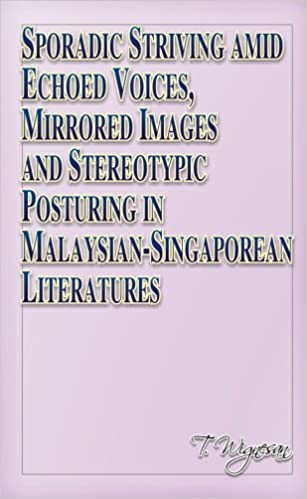
T. Wignesan. Sporadic Striving amid Echoed Voices, Mirrored Images and Stereotypic Posturing in Malaysian-Singaporean Literatures. Allahabad: Cyberwit.net, 2008, xix-244p.
Dedicated to Chair Professors René Etiemble (Sorbonne), Alexis Rygaloff (CNRS/EHESS), Jean-Marie Zemb (Collège de France) and Jean Pouilloux (Lyon/CNRS).
Excerpted from the Preface:
"The curious thing about my encounter with Malaysian-Singaporean writers and intellectuals is that I was singularly unprepared to assume the roles of critic, academic or anthologist over their productions at a time when their activity was mainly confined to the University of Malaya in Singapore. And yet, paradoxically, I became just that kind of an exegete, owing to a series of "wilful errors" on my part. Instead of choosing to settle for a career by qualifying in Singapore where the region s institutions of learning, such as, the Raffles College for the Arts or the King Edward the VIIth College of Medicine, I opted for Bar Studies at the Inns of Court School of Law in London as an external student."
Includes 27 articles and critiques on general topics and on individual authors, reviews and correspondences, etc. published in academic journals, magazines, books and newspapers between 1961 and 2008 such as:
The Journal of Commonwealth Literature (University of Leeds); Komparatischtische Hefte (Bayreuth University); The Journal of Asian Studies (Ann Arbor, Michigan); Proceedings of the ACLALS Conference (Kent University); Proceedings of the New Literatures in English Conference (Essen University); The Third World (London); "Asiatic", etc. (International Muslim University, Kuala Lumpur); Bunga Emas: An Anthology of Contemporary Malaysian Literature (London); Asia: A Handbook (London); "Malay Mail", "Straits Times Press Group/Sunday Mail/Sunday Times", "Malayan Times", etc. (Kuala Lumpur/Singapore); Radio Singapore.
(c) T. Wignesan - Paris, 1961-2008
Excerpt
The origins of the Malay Pantun with translations from other languages, together with appropriate criticism of common misunderstandings of the genre...
The Poïetics of the Pantun
By
T. Wignesan
Ex-Research Fellow,
French National Centre for Scientific Research,
C.N.R.S., Paris, France
I - INTRODUCTION
It would be quite unjust to apply the poetic norms of tropes (essentially paradigmatic relations) and those of schemes (syntagmatic relations) as they are known to us today to the poetics of the pantun. In any case, the Malay littérateur of old did not have to worry/concern himself with the technique of creative composition of the pantun, considering his subordinate literary role vis-à-vis his Arabo-Persian and Indo-Chinese counterparts in the pre-medieval era. Richard Winstedt, the foremost authority on the Malay world, seemed in any case to be convinced of this fact.
From songs of tribal origin he (the modern Malay) has evolved a number of chronicles (hikayat), and he has lapped foreign suggestion to polish village quatrains that must have been popular from time immemorial. A hunt through half a million pages of Malay manuscripts will find all that is purely indigenous in an output of histories (sejarah), the pantun and a few topical verses (sjair/sha'ir).1
Winstedt who was unsparing in his criticism of the Malay's lack of originality in many aspects of his cultural heritage was more than dithyrambic when it came to the pantun. He felt that "many of those (pantun(s)) extant today may even antedate the use of the Arabic script."2 [AHOCML: 204]
But in the pantun Malay literature is almost for the first time original, owing no debt to foreign sources, and nowhere else does it reach so high a level.3 [AHOCML: 206]
Although Winstedt's assessment of the pantun was not thorough or even penetrating, he intuitively - given his vast and incomparable grasp of classical Malay writing - came to the conclusion - despite his rather inadequate translations of a good many quatrains - that at "its best the pantun does far more than juggle with verbal assonance, (sic) is indeed 'simple, sensuous and passionate' and has the magic of inevitable phrase."4 [AHOCML: 207]
To the Malay, the metaphor, the simile, the maxim, the allusion, the proverb, etc., mean practically one and the same thing, that is to say in Malay: persamaan, tamsil, ibarat, kiasan, perumpamaan, peribahasa, pepatah, pematah, etc. 5, whose minimal differences may be put down to non-structural nuances, because at the root of the Malay's rhetorical confusion lies what is very likely a "molecular" structure which assimilates and incorporates into a globally unified structure of relations all that is rhetorically disparate and which is known as the pantun, a structure that is equally grafted onto the Madagascan hainteny, the German schnadahüpfel, the Russian tchastouchka, the Javanese wangsallan, the Norwegian fornyrjislag, the Italien stornello, the Tunisian gharobiat and so on and so forth. Of course, the Malay distinguishes the pantun from other similar specific models, such as the sha'ir, but there is absolutely no doubt that no other poetic vehicle has afforded him such a collective creative outlet of effervescence, right from the beginnings of his literary history.
"T. Wignesan, ou:
"Le monde est formidablement plus grand qu’un pantoun"
par Georges Voisset
Comment présenter l’extraordinaire figure de T. Wignesan quand il ne s’y risque pas lui-même, préférant considérer que «l’obligation de me présenter... est un acte d’auto-violation, et même d’auto-trahison. Vous pouvez lire le résultat sur ce site ».
Eh bien, puisque c’est à nous que reviennent ici les honneurs d’une trahison pour la bonne cause, allons-y. Poétiquement et scientiquement, de mon tout petit point de vue circonstancié donc, je choisis deux titres pour l’encadrer :
1) celui du recueil de poèmes réédité en 2015 par Silver Fish, grande maison d’édition de Kuala Lumpur, Tracks of a Tramp. (A First Collection of Poems 1951-1961). Réédition précédée de Bunga Emas: An Anthology Of Contemporary Malaysian Literature (1930-1963), antholo-
18 | Pantoums
logie quadrilingue initialement publiée en 1964 et s’arrêtant en 1941.)
2) le second ouvrage réédité (2008), c’est sa thèse de littérature comparée (1988), soutenue en Sorbonne, Etude comparée des littératures nationales et/ou
officielles de la Malaisie et de Singapour depuis 1940, qui initiait un champ du comparatisme «national» fort audacieux, mais qui bénéficiait alors de circonstances « internationalistes» fastes (j’y reviens plus bas).
Et maintenant, je vous invite à trahir à gogo, en suivant «les pistes du vagabond»...
Tracks of an (extremely learned) Tramp
Né sur la côte est de Malaisie, à Krai, en 1933, en plein pays ancestral malais, T. Wignesan (« no first name », « race : Tamil, Dravidian ») commence sa carrière de «travailleur» à 9 ans (sous les ordres du Japon impérial, donc) en 1942 comme cheminot ; et depuis, me dit- il, il n’a jamais cessé d’œuvrer et de cheminer un seul jour, ce que con rme une production multilingue d’une diversité impressionnante et continuellement entretenue, révisée. Un formidable cheminot de la pensée, avec interdiction de s’asseoir sous peine de perte d’humanité. J’extrapole, il faut bien trouver des raisons aux choses qui vous dépassent... Privé de sa citoyenneté malaisienne peu après l’indépendance en 1962, puis privé de son passeport britannique en Espagne et déclaré apatride en 1969, il se
retrouve citoyen du monde polyglotte, installé depuis des décennies en région parisienne, d’où il continue de rayonner, en Inde en particulier. The question is, Would I have wanted it any other way? se demande au- jourd’hui T. Wignesan, citant Sartre...
C’est à la Sorbonne, après l’Espagne, qu’il rencontrera le grand comparatiste français
René Etiemble et engage alors une carrière de chercheur en poétique comparée (il dit : poïétique) au CNRS. Il fonde le Centre de Recherches de Poïétique Comparée à l’Inalco. C’est là que s’inscrit un intérêt «professionnel» pour le genre pantoun, et qu’il com- muniquera à Etiemble (voir les traductions de pantouns d’Etiemble, dans mes Centuries Pantoun, ce qui nous vaudra en n une certaine «certication», discrète mais visible, du genre dans le parisianisme littéraire d’Etat des années 1970-1980). Bien entendu, ce que l’on doit à T. Wignesan dépasse d’emblée ce cadre, je cite son Anthologie de la poésie malaisienne contemporaine (Fresnes, 1982), ou, plus technique mais passionnant pour ceux que les «Indes orientales» intéressent, ses travaux sur la part tamoule du monde malais.
Tout le reste, accessible partout sur le Net, je ne le résume pas : quadrilingue (tamoul,
malais, anglais, espagnol), T. Wignesan poursuit sa «track» (trace) protéiforme d’universitaire aux prestigieux diplômes internationaux, de directeur de revue (The Asianists’ Asia),
Pantouns | 19
fondateur de centres de recherche (Centre de Recherche sur les Etudes Asiatiques), d’es- sayiste, romancier, nouvelliste, traducteur, poète, critique (à tous les sens du terme), et ceci dans ses «lettres natales» (dravidiennes, malaisiennes et singapouriennes, anglaises) comme d’adoption (espagnoles et françaises) sans parler de toutes les autres. Je ne dis rien de diplô mes de droit, ou dé cerné s par les Pays- Bas, l’Allemagne, de son intérêt aussi bien pour les grands classiques indiens que chinois... Ni du journaliste. Et ces dernières décennies, de sa présence protéiforme sur les sites internet, des sites américains de di usion de poésie à Cyberwit.net, qui abrite aujourd’hui nombre de ses ouvrages.
Bref, il est de ceux-là dont on se demande : «mais comment fait-il?»
Et maintenant, empoignons notre tout petit bout de la lorgnette: T. Wignesan pantounologue, traducteur de poésies brèves, puis auteur de poésies brèves.
T. Wignesan pantounologue
THE référence: «Le Pantun. Le Détour- nement Créateur » (The Journal of Comparative
Poietics, Vol. 2, n° 1 (Paris, 1992). Dans cette étude, reprise ultérieurement sous d’autres formes (cf. Sporadic Striving amid Echoed Voices Mirrored Images and Stereotypic Posturing in Ma- laysian-Singaporean Literatures, Allahabad, Cyberwit.net, 2008), et que je cite constamment depuis 25 ans, le poéticien et esthéticien rappelle d’abord que le concept de détournement est inhérent à la visée esthétique. Il rappelle ensuite que le pantoun n’est pas, d’abord, un objet littéraire, artistique, pas plus que religieux ou didactique: «Par contre, le Malais ne voit pas le pantoun comme un véhicule didactique religieux, ni comme un genre narratif ou lyrique. Pour de tels buts, il garde bien d’autres mod les: sha’ir, seloka, gurindam, etc. ». Et cependant – là réside un intérêt majeur de cette étude, qui complète ainsi la précédente, effectuée par Dulaurier sur le pantoun comme «poésie lyrique des Malais (voir Dossiers de Pantun Sayang) –, il va montrer, par divers exemples et des analyses formelles et contextuelles, combien le «détournement créateur» est comme l’essence même de cet art malais d’appréhender le réel: en mots «cadrés», à travers l’analogie, tout ce qu’elle porte en elle de profondément énigmatique. C’est que (voir Henri Fauconnier sur un autre registre)
« le pantoun est un d , un d son g nie de créateur ».
Le dé créateur du détournement, alors? Ne serait-ce pas dire, du coup, que l’art du pantoun... c’est T. Wignesan? Méditons. Ceci expliquerait-il la rareté de cela – T. Wignesan, poète multiformats, mais si peu pantouneur selon les lois d’un «pays d’origine» qui l’avait d’emblée banni, lui le ls de «coolie» qui n’était déjà pas né à sa place?
T. Wignesan traducteur de pantouns et de genres
poétiques brefs
Curieusement, en e et, le pantoun tient une place rare dans cette entreprise, dont l’am- pleur, planétaire, est pourtant remarquable. J’en ai reproduit 5 (traductions en anglais, français et tamoul) dans mon anthologie Les Centuries Pantoun (n° 12, 35, 38, 50, 57). A ma connaissance, et après échanges sur la ques-
20 | Pantouns
tion avec T. Wignesan, il faudrait en ajouter deux ou trois autres, où l’intention «subver- sive» se manifeste fortement – un peu à la fa on dont l’a fait, dans sa propre tradition, le poète malaisien également subversif Salleh ben Joned (on y reviendra un jour...). Pour ce qui est de la poésie occidentale contemporaine, pourtant, le tropisme de T. Wignesan
pour les genres brefs est évident: traducteur en anglais d’Etiemble, ses haïkus, sonnets, terza rima, par exemple, indépendamment de ses traductions «classiques» (Pierre Emmanuel, Verlaine...). Je découvre telle traduction de quatrains d’Etiemble qui, malgré l’absence de pantouns sous la plume d’Etiemble, s’en approchent beaucoup, comme ce triptyque enfantin (stade dit du miroir) dont voici la première strophe :
All ducks are Narcissuses
kissing the ends of their beaks.
Comes the solstice’s rigour,
the ice clouds the dry mirror.
Mais c’est visiblement dans d’autres genres que le traducteur s’est amusé à retrouver
quelque chose peut-être d’une «pantounie natale (impossiblement) abolie» (je continue à fabuler). Par exemple à cette suite de coplas bacchiques chiliennes du poète Nicanor Parra, dont voici une strophe traduite de l’espagnol:
The blind man with a cup
sees sparks and lightning streaks
and the lame of birth who breaks out
dancing the cueca.
T. Wignesan pantouneur
T. Wignesan pantouneur (malgré tout ?) donc, pour terminer. La verve y est profon- dément politique et satirique. Mais ne sont- ce pas là, me direz-vous, politique et satire, deux des fonctions fondamentales du pantoun abondamment pratiquées dans son milieu na- turel ? Certes, oui, mais... (à l’écrit en tout cas) dans le bon sens, là où les murs ont de très très grandes oreilles. Et cependant, là non plus, ce n’est apparemment pas le pantoun qui attire principalement le poète «subversif». Parmi nombre d’autres genres brefs expérimentés, que l’on pourra découvrir dans de nombreux sites d’accueil en libre accès, le limerick par exemple semble bien convenir à un humour noir, acide ou acerbe, à cette «rage de vivre malgré toi». Par exemple:
Once a wife Nurse and husband Doctor
Loved the meat served from Clinic larder
So they went in to see
Found morgue bodies for free
Since then stopped buying meat from (the) butcher.
Pourtant, lorsque le poète s’amuse au li- merick crocheté, inspiré directement du pan- toun lié mais avec une thématique... japonaise, on ne peut pas ne pas en revenir à mon
interrogation sur ce moteur que serait chez T. Wignesan «l’évitement créateur»
Once Japanese Robot lied about its age
To an American Robot under age
At marriage registry
Paid hermaphrodite fee
That night in shed they locked jaws in mad glad rage. Etc.
Mais je termine comme il se devait avec un pantoun, dont l’énigmatique « tropic tune » ne m’est pas peu abscons...
The Malay Pantun: Post-colonial writing
La capinera’s wintering pieces of tropic tunes
The garden warbler’s echoes of dark melodies
Post-colonial poets return by summering fortunes Learnt by rote as sacred Oxbridge duties
To be or not to be. That’s the choice. ■ Pantouns |
Want to review or comment on this book?
Need a FREE Reader Membership?
Reviews for "Sporadic Striving amid Echoed Voices..in Malaysian-Singaporean Literatures"
Hello, Ron ! Thanks all the same for the comment. That's really very kind of you. Yes, I didn't post the entire article on the "Poietics of the Pantun" for the simple reason that it appears under the rubrique "Articles" in Authorsden.com. Georges VOISSET, a renowned Professor of French and Comparative Literature at the French University of the West Indies and Guyane, however did, and if you can read French, here are the two links (I must say they are dithyrambic of my efforts not only on the pantun, but also of my other shorter poems, such as the limerick and other shorter French forms): www.pantun-sayang-afp.fr/2017/08/revue-pantouns-numero-20
www.voissetonwignesaninpantouns1820.pdf
When it comes to critiquing the literature of another country or culture, I am not up to the task. I cannot critique what I don't know. Therefore, in commenting or critiquing a book from a brief description and excerpt, with nothing to sink my mind teeth into, I can only wish you good will in getting it read by the right people.