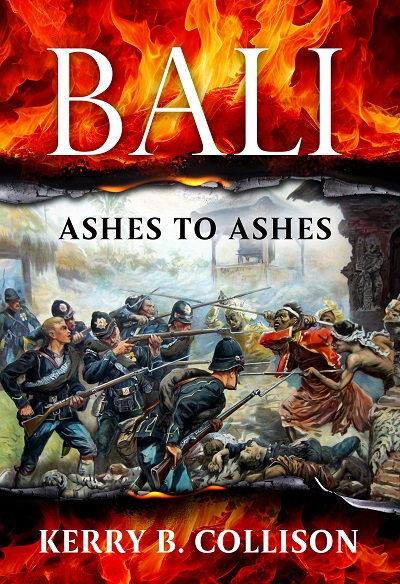
In 1904, the Sri Kumala, a Chinese schooner became wrecked off Sanur in Bali. Claiming the vessel had been sacked by the Balinese, the Dutch attack recorded in history as the brutal Puputan Wars, was to change Bali and its culture forever. Entire kingdoms perished as wave upon wave of the island’s inhabitants committed suicide.
European artists become entrenched, integrating with the Balinese. Their stories of surviving the Dutch invasion, then the Japanese and the brutal 1965 slaughter of more than eighty-thousand Balinese, reveals an unspoken image of Bali, The Island of the Gods.
In 1904, the Sri Kumala, a Chinese schooner became wrecked off Sanur in Bali. Claiming the vessel had been sacked by the Balinese, the Dutch attack recorded in history as the brutal Puputan Wars, was to change Bali and its culture forever. Entire kingdoms perished as wave upon wave of the island’s inhabitants committed suicide.
European artists become entrenched, integrating with the Balinese. Their stories of surviving the Dutch invasion, then the Japanese and the brutal 1965 slaughter of more than eighty-thousand Balinese, reveals an unspoken image of Bali, The Island of the Gods.
Excerpt
During the three centuries commencing with the formation of the world’s first multi-national corporation, Vereenigde Oostindische Compangnie (VOC) in 1602, the Dutch East India Company colonized most of the Indonesian archipelago. For more than two hundred years they chose to avoid Bali with its impenetrable jungles and perilous reefs until the locals took to plundering VOC merchant ships trapped off the island’s treacherous shores.
With the VOC falling into bankruptcy its possessions (and power) were acquired by the Dutch Colonial Government. Threatened when British trade with Bali increased dramatically between 1820 and 1830 and the possibility that the British might annex Bali, the Dutch initiated a pre-emptive strike to conquer the Balinese, sending a number of military expeditions to control the Hindu kingdoms, precipitating confrontation with the Balinese in the 1840s.
The conflict demonstrated Balinese readiness to commit puputan, or honorable suicide in battle, as they believed this selfless act would permit the soul to reach nirvana.
Towards the turn of the Nineteenth Century and having partially occupied half of Bali over a fifty-year period, the Dutch pressed further for total dominance. This resulted in the complete annihilation of the eastern Kingdom of Karangasem.
With the arrival of the Twentieth Century, Holland had control over all but the south of Bali, where rajas continued to resist foreign rule. The Dutch believed they could remove the last obstacle in the south with just one more major push. But, by this time, Europe had become horrified at reports of the puputans and the brutal and systematic cleansing of the island’s population. Diplomatic pressure prevented the colonists from initiating any further action.
And so they waited.
Then, on one fateful day in 1904, the Sri Kumala, a Chinese schooner became wrecked off Sanur in Bali’s south. and the Dutch Administration in Batavia was delivered the perfect opportunity. Claiming the vessel had been sacked by the Balinese, the Dutch attacked with a force numbering thousands. The ensuing two-year invasion, recorded in history as the brutal Puputan Wars, was to change Bali and its culture forever. Entire kingdoms perished as wave upon wave of the island’s inhabitants committed suicide, until there were very few left to resist.
Professional Reviews
Bali
Bali – Ashes to Ashes is a love letter to “The island of the Gods” by prolific author, Kerry B. Collison – an island and its people he dearly loves. “False dawn’s impressive moment blinked momentarily piercing scattered layers of tropical clouds.”
The novel is an historical recount of the annihilation of whole kingdoms, first by the Dutch invaders and later by the Japanese in World War 11. It is cleverly interwoven with the love stories of a shipwrecked American who made the island his home, and inadvertently set in motion generations of descendants who were related and fell in love with each other, not knowing how they were related. This had a transfixing effect on me as I read.
I will forever be haunted by the spectacle of a whole household of Bali royalty, dressed in white, advancing towards the marauding Dutch invaders to commit a mass suicide – called the Badung Pupatum. “At close of the bloody day four thousand Balinese men, women and children lay dead.”
Despite the centuries of swift and brutal occupation by invading marauders, the depth and strength of the Balinese people have shone through the rainbow dust over their island and retained their unique traditional culture.
Bali – Ashes to Ashes is a powerful and moving literary work of great merit.
Review by Washington’s Defense and Strategic Affairs
Collison, himself a former Australian intelligence officer who spent the "years of living dangerously" in Indonesia, has written extensively on sensitive political topics in Indonesia, avoiding punitive legal action by couching detailed historical facts in works of dramatic fiction. His newest work, Bali: Ashes to Ashes, reveals much about the origins of modern Indonesia and why the political and strategic landscape is the way it is, through colonialism, the internal kingdoms and their religious-cultural differences, and deeper modern and ancient history.
His earlier works are, like Bali, total immersions in the various cultures and languages of Indonesia, giving an understanding, too, of the political leaders and their heirs who have emerged and are, even today, influential.
Bali: Ashes to Ashes is a compelling multi-generational family saga which begins in 1904, but which introduces the important prelude of the work of the world's first multi-national corporation, the Vereenigde Oostindische Compangnie (VOC), founded in 1602: the Dutch East India Company. The VOC had colonized much of what is now Indonesia, but had hesitated for more than 200 years to conquer the many kingdoms of the island of Bali, with its impenetrable jungles, perilous reefs, and unique culture of Balinese Hinduism.
Most of the Javanese empire - which is what modern Indonesia is - is Muslim, with the notable exceptions of Bali and West Papua, where there are profound differences to the rest of Indonesia. But a reading of Collison's Bali gives a better understanding of why, even today, Bali has a disproportionate influence on Indonesian politics..
The reader of Bali, apart from being entertained on a level of escapism which sends tremors of guilt into the professional intelligence analysts who read it, emerges with a sober understanding that the island, though eternally beautiful, is not and was not the idyllic and tranquil tourist destination it is today. Many tens of thousands of Balinese died, both at the hands of their own wars or at the hands of the Dutch and during the anti-communist civil war which saw the end of the Sukarno era.
Indonesia remains profoundly important, strategically, today, and is being wooed by the West - particularly the AUKUS powers of Australia, the United Kingdom, and the US - as well as the People's Republic of China, Russia, and India. Its straits control a disproportionate volume of global trade. Reading this "novel" is profoundly satisfying, but it is also profoundly important.
SID HARTA PUBLISHERS
23 Stirling Crescent
Glen Waverley, Victoria 3150
Tralee, Ireland. September 1948.
An arrogant, and highly agitated, priest arrives home after 40 years.
Days later he's dead. Suicide? Or did his past catch up with him?
Marooned is the 1860's saga of Justin Radcliff, a young American, who is beaten and thrown overboard by his evil twin brother, Edward.
Kolya, a handsome Black man and new leader of the transplanted Zulu tribe there, finds Justin caught in hi