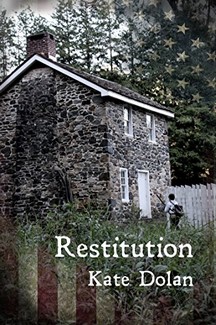

Get your Signed copy today!
Kindle Edition
Amazon
Restitution
Category:
Historical Fiction
ISBN-10: 0976940450
Type: Fiction
Pages: 332
Copyright: October 2006
Price: $3.99 (eBook)
As Maryland colonists prepare to take up arms against the English, Jack McCready discovers he can make quite a bit of money carrying correspondence back and forth, and even more money if he shares the information with other interested parties. But how long can he tread the line between both sides without getting caught?
In the beginning of 1774, Jack McCready and Mara Weingardt may have been the only two people in the colony of Maryland who couldn’t care less about the British tax on tea.
Mara, a widow with two boys to support, had enough difficulty simply keeping her small farm together so that she would not have to marry the abusive, lecherous neighbor who owned her property. And peddler Jack could only care about the tax if somehow he could profit by it, which he could not.
That is, until the day he is offered a substantial sum of money to carry correspondence from one disgruntled colonist to another. And then he's offered even more money to reveal just what those disgruntled colonists in Annapolis are planning amongst themselves.
Now the tax on tea appears to have the potential for great profit, if only he can find a boy to help with the deliveries.
Mara has two boys.
But she also has a strict Moravian background that would prevent her from ever agreeing to accompany Jack to Annapolis. Or at least it should have.
When Jack becomes more enmeshed in the dawning struggle for independence, he starts to realize that he cannot continue to betray the patriot cause. But Mara’s exposure to the cultured world of Annapolis society has led her to cherish all things English.
The world’s about to turn upside down . . .
Excerpt
Chapter One
Maryland, 1774
Lee’s Merchant Mill—four stories of stone and wood—loomed over the small settlement described as “Jerusalem” on Tom’s list. Churning water from the Little Gunpowder Falls powered the wheels of the massive gristmill, as well as a small sawmill some yards away. Jack could see little else through the misting rain and fog; the old rolling road to Baltimore disappeared into the trees across the river.
He checked the list again, just to be sure he was in the right place. Tom had sold a substantial quantity of goods to the Quakers of this settlement, and he expected to do the same. Usually, his appearance sparked an immediate and eager response from planters and their families. They were happy to welcome a peddler, if only for a change in their routine.
But as yet, no one here so much as acknowledged his presence. He tethered his horse to a tree and set out to drum up some business.
The grinding and creaking from the gristmill indicated that he would at least find someone within. Water sluiced rhythmically through two wheels in a pit below as he stepped through the main door and collided with a plainly dressed gentleman covered with a light dusting of flour.
“Your servant, sir.” Jack recovered himself and bowed. “I am Jack McCready, purveyor of the finest household goods and sundries.”
The man favored him with a wry grin. “I am Isaiah Linton. And I am in not in a fit state to be receiving visitors.” He wiped his hands on his breeches, sending out clouds of white dust. Flecks of bran clung to his woolen waistcoat. “If thee would repair to the building at the back, I believe one of the children will assist thee in setting out thy wares. I shall join thee shortly.”
No sooner had Jack unloaded goods onto the table, benches and floor of the small stone building behind the mill than Linton rejoined him. Though most of the flour had been brushed from his hair and clothing, he still bore a faint ghostly appearance.
“Does thee travel on to Baltimore?” Linton paid no attention to the items Jack had so painstakingly arranged for his benefit.
“I might.” Jack looked out the window to see if other members of the settlement would soon join them. The young boy who had helped carry his goods into the house had disappeared up the ladder leading to the floor above. He wouldn’t be purchasing much.
Turning back to face the miller, Jack issued a silent challenge to make this stop worth his while. “Or I might move along to Frederick.” Tom’s list included several settlements in that western county.
Linton’s gaze also strayed toward the window. Then he faced Jack. “I can put on the kettle, if thee would care to join me for a dish of liberty tea.”
Jack laughed. “Ah, now I thought the Friends weren’t supposed to be takin’ a stand on such issues.”
“We—" the miller cleared his throat, "some of us, that is— believe the retribution levied on the good people of Boston to be a dangerous abuse of power by the British. Does thee not agree?”
“Most definitely.” Jack smiled. Concurring with the politics of a customer often increased sales.
Linton glanced nervously toward the window again. When he spoke, his voice was lower. “In that case, would thee be willing to deliver some correspondence among certain of us concerned about this abuse of liberty?”
Jack crossed his arms in front of his chest. “What did you have in mind?”
“I have received a letter from gentlemen in Annapolis that I must answer.” The miller kept his gaze focused on the window.
“Yes, but as I said, I will probably head toward Frederick.”
Linton clasped his hands together, almost as if in prayer. “I have correspondence to return to men of that region as well.”
“I don’t know.” Jack removed his hat and scratched at an imaginary spot behind his ear. Feigned hesitance would certainly drive up the cost of whatever delivery this Quaker wanted him to undertake. With drawn out deliberation, he replaced the hat and faced his host. “If you cannot trust this correspondence to the post or a servant, I assume it must be of a dangerous nature.”
Linton nodded with obvious reluctance. “It—it could certainly be construed as such, yes.”
“Then I am not certain I should undertake the risk” Jack waited, trying to not to betray too much interest. If he read the man right, Linton was desperate enough to make the enterprise more than worth the risk.
Linton licked his lips nervously. “We will pay thee, of course.”
“How much?”
Linton named a figure, and with a handshake, Jack figured he had doubled his income for the next fortnight, at least. And with no added effort on his own part.
* * * *
It had been an “R.”
Jack McCready would have sworn that Tom’s list said “L tern at big rok.” But a left turn had set him on a circuitous path right back to where he’d started—six hours later.
Old Tom must have meant to say “R turn.” Or perhaps “don’t turn.” Either way, the better part of the day was spent before he even approached the first small farm in the Moravian community east of Mechanicstown. That first farm would be a widow with two children, who probably would not buy much, and so he’d hoped to make at least two more stops before dark – perhaps even travel far enough to deliver the first letter. If he skipped this insignificant house on the outskirts of the settlement, he might be able to rid himself of the letter by nightfall.
Ah, no, he could not simply pass by. Every new house was a new opportunity. And though it was tempting to ignore the pin trade and simply reap the profits to be made delivering letters between disgruntled worry-mongers, the flow of such correspondence could not last long. So he, therefore, could not afford to pass up any opportunity. This widow might be in need of cloth, or perhaps he could tempt her with a bit of lace or some fancy buttons.
She might know of a shortcut to Troxell’s Mill.
And she might cook an excellent dinner. The scent of wood smoke blown down through the trees hinted at all manner of wondrous foods cooked earlier in the day that might remain to grace the table at suppertime.
A few paces from the house, he tied his horse to a mulberry tree, brushing aside a spider web that stretched from the upper branches to an unknown point on the ground. He wiped the bits of web off his hands as he made his way toward the house, wondering whether the widow and her brood might be found near at this time of the afternoon or whether he’d do better to search for them in the surrounding fields.
Then something large and white, like a tall sheep with ferocious fangs, leapt toward him across the yard. He wanted to see what creature it was that assaulted him, but instinct won out over curiosity and he hit the dirt, covering his neck with his arms.
“Pay him no heed. He was just chasing a squirrel.”
Jack looked up to find a young boy, of about seven or eight years, attempting to balance a hoe across the palm of his hand. The boy nodded his head toward a tree, and Jack looked over to see that indeed, the fierce beast circled anxiously at its base, growling as a squirrel scraped its claws along the bark.
He grinned as he hopped up, and brushed the dust off both hands before bowing to the boy. “Jack McCready, purveyor of the finest household goods and sundries, at your service.”
The boy smiled with delight and offered his own fleeting bow. “Thomas Weingardt, at yours.” He beamed up at Jack with shining eyes.
Jack felt his grin widen. If the widow provided a reception half so friendly as her son, then he would really be set up for the night.
“Neun, heel.”
Jack looked away from the boy to the source of the new voice as the fanged beast that had nearly flattened him a moment ago bound over to join another boy who had just emerged from the barn. This boy, a little taller, with darker hair and a broader build, was obviously older than the first boy, but with similar features leaving no doubt of their relation. Their expressions, however, differed as much as humanly possible, the scowl on the older boy’s face seeming permanently etched into his features.
Jack turned to greet the brother as he approached. “Good afternoon. I am Jack McCready.”
“You’re not Peddler Tom.” The older boy looked around Jack with suspicion, as if he suspected him of keeping the other peddler hidden behind his back.
“No, I’m not.” Jack tried to reassure the boy with a trustworthy smile. “He retired last winter, and I took over his route.”
“He said he’d be back in June, and it’s only May.”
“Of course he did, but that was last year, right?”
“Yes.”
“Well, when winter came on, Tom wasn’t feeling so fine. He must have decided his bones weren’t up for another year o’travelin’. So he set up shop in Philadelphia, and sold his route to me.” Jack finished with his trustworthy smile again.
“He said he hated Philadelphia.” The smile did not appear to have inspired trust from the older boy.
“Yes, well, people do change their minds as they get older.” Jack looked around for a new topic of conversation and saw with relief that the widow herself appeared to be headed toward them. “This must be your lovely mother coming out of the house now.” He waited until he was certain the woman had moved within earshot. “Ah, no, I see I am mistaken. This could not be your mother, but must be a sister.” He counted to three in silence. “Please, do me the honor of an introduction to this fair maid.” Then he prepared to be charmed as he turned to bow to the boys’ mother. “My name is Jack McCready and I am … so enchanted by your beauty that I do believe I’ve forgotten every word of my sales proposition.”
“Have you?" Her voice sounded as hard as the outcropping of rocks where he'd made his wrong turn. "Then that will save us all a deal of time. Karl, please show him to the road.”
What? Jack recovered from his bow with all due haste and gestured toward his horse. “But ma’am, you have not seen what I carry with me.”
Though slight of build and short in stature, the widow evinced considerable presence as she eyed him up and down from under her straw hat. “I’ve seen enough, thank you. Thomas, I cannot believe you have finished clearing the vegetable garden already.”
“No, Mama,” the younger boy admitted with reluctance. His feet started to shuffle toward a fenced enclosure near the house, but his gaze remained with Jack. “Will we not ask him to stay like other travelers?”
Jack saw his chance. “Ma’am please, I beg you, the day is hot and my horse and I are in sore need of water and rest. May I take a drop of water from your well and rest a few moments in the shade before we start out again?”
The widow narrowed her eyes, but gave a tight nod. “Very well. But don’t trouble my boys. They’ve work to do. As do I. G’day to you, sir.”
“I have items in my pack that can save you much work, Ma’am.”
“No, thank you.” She turned and walked back up the hard dirt path leading to the small clapboard house.
So much for hospitality. Jack began to whistle absently as he lowered the bucket into the well. And from Germans, too. They weren’t usually the biggest spenders, but German families always provided a friendly reception.
“What music is that?” Thomas asked.
Well, one member of the family appeared friendly, at least. Jack smiled as the boy came up beside him. “It’s a tune o’ my mother’s. She used to hum often while she worked outside.”
Thomas leaned on his hoe. “It sounds sad.”
“Sad?” Jack paused. “Mayhap. I guess I never thought of it that way.”
“It sounds like music Brother Schlaus played for Papa. After he died.”
“Thomas!” The widow’s voice called from the house.
Jack saw the stern profile at the window and immediately turned back to the well. “Go on,” he whispered to the boy. “I’ll meet up with you later.”
Thomas winked and dashed back to the garden with a series of joyful leaps.
Poor boy. And his brother didn’t look to be any more fun than the mother. Jack poured the water from the well into a bucket and then paused to look at the sun nearing the horizon. Did he have enough time to make it to the next farm today? He obviously wasn’t going to sell anything here, and the prospect of evening entertainment looked even less promising. The widow probably wouldn’t even let him sleep in her barn—a very mean sort she seemed to be.
“You may join us for supper, if you’ve a mind to it.”
Jack whirled around to find her standing behind him holding a copper kettle.
“Are you finished?” She gestured toward the pail he still held in his hands.
" Yes, thank you.”
She started to reach for the pail, but he held it fast. “Please, allow me. It’s the least I can do.”
The woman laughed, but with a harsh, choked off sound containing no note of humor. “For what?”
“For your hospitality.” Jack pulled the water pail from the well with all the grace and strength he could muster, adding a flourish to his words.
“It is a poor hospitality I offer you,” the woman sighed as she held the kettle steady for him to fill. “I hope you’ll forgive me.” She started off back to the house, but stopped after only a few steps and turned back to face him. “I’m sure I need goods for the house, but I haven’t time to look now.” She tucked a loose strand of dark hair behind her ear. “Can you wait until after supper? You’re welcome to stay the night.”
Jack saw that she was looking at the barn as she spoke those last words. Still, there was no way of knowing how long it would take to get to the next farm. And he’d slept in barns often enough before. “I’d be pleased to wait on you after supper, Ma’am.”
“Mrs. Weingardt. Mara Weingardt. And supper will be ready sooner if you can give Karl a hand.”
Jack’s gaze followed her outstretched arm to where Karl worked near a small enclosure. Then he let his gaze travel back, up the long, thin arm, up the slender frame, and to the face of his hostess, still mostly covered by the shadow of the straw hat.
Nose a little too long, chin a little too sharp. Mouth drawn in a stern line, and an unappealing crease between her grey eyes. Intelligent eyes, not unkind, but tired. As if it had been a long time since she had laughed.
Jack took that as a challenge. Not now, but before the end of the evening, he would make this woman laugh.
Chapter Two
Mara let the smile fade from her face as she turned away from the table with a stack of pewter plates and stoneware mugs. The last thing they needed, that the boys needed, was this stranger with his fancy stories about travel. There could be no suggestion of studies tonight; lessons on ciphering could not compete with tales of eluding bears and Indians.
“Couldn’t you go back to the fort?” Even Karl had become mesmerized by the peddler’s tales. Mara saw him lean in close to the man as he waited for an answer.
“Ah, no, by that time I was two days out of Fort Augusta. Besides, that would have led all those savages right back to the fort, and there weren’t enough men to hold off an attack. No, much better to lead them away.”
“You led them away?” Karl’s face was incredulous. “You wanted them to follow you?”
The peddler nodded. “I considered it my duty.”
Mara could not keep from letting out a snort of derision. “Humph.”
“Did you say something, Ma’am?” The peddler asked.
“No, no. You go right on.”
His face flushed slightly. At least he had sense enough to be somewhat embarrassed by the doubtful veracity of his far-fetched tales.
“Since I have interrupted you,” she continued, “I need you, Karl, to fetch more water for the dishes. Thomas, please bring me the dirty napkins and so forth.”
The peddler stretched out his feet before the fire.
“And you, sir, if you’ve goods to sell, you’d best get them ready. There will be but a few moments to spare after dishes before it’s time for bed.”
Mara picked up a straw brush to rub at the crusty, charred bit of batter burnt to the edge of a pan. Where was she going to put this man to sleep tonight?
The brush suddenly slipped through her fingers, presumably falling somewhere under the bench where she set the dishes. She stooped and felt along the floorboards with no luck. So she had to bend all the way down to look under the bench. The sight of the man’s boots moving a few feet away unnerved her.
Peddler Tom never wore boots.
Peddler Tom had always been a welcome visitor. The slight, gap-toothed old peddler had never posed a threat to her or her children. Even after her husband’s death, she had allowed Peddler Tom to stay the night on his annual visits without giving the matter a second thought.
But this man was a stranger. A much younger stranger. Taller, too. With hair lightened and face tanned by the sun, he fairly exuded strength and good health. And his frequent smiles revealed straight, white teeth. He was as unlike harmless old Tom as could be.
“Ma’am, could I— um—be of assistance?”
Mara realized she was still staring at his boots from under the bench. “I’ve dropped my brush, but here, I’ve found it again.” She stood up and smoothed out her apron and skirt. “My. You’ve wasted no time, I see.”
The table, which had been littered with napkins and crumbs only a few moments before, now glittered with household treasure. Brass candlesticks, pewter pitchers, tin cups, intricately carved combs, buttons of every hue, knives, spoon molds - and even as she watched, the peddler unloaded more from his packs. The boys stood transfixed, whispering to one another without taking their eyes from the wondrous display. She reached out to touch a shiny tortoise shell comb carved with intricate patterns.
Then she tore herself away from the riches heaped on the table and went back to her plates and pans. Although she scrubbed with renewed vigor, she was determined not to show her impatience to view the goods that were just out of her reach. Because they were out of her reach. She could afford a few items, a very few items, and only those of which she stood in greatest need.
After rinsing the napkins, wringing them out, and hanging them to dry, she let out a small sigh. Only the serving platter left and then she could sit down for a few moments with the mending.
She picked up the pail of water and poured it carefully into the trenched out wooden platter she had used to serve most of the supper. She tipped the pail a little more – and sloshed water over the side and onto the floor.
“Ma’am, I believe I have just the thing.” The peddler dashed over to one of his packs and returned with a tin dishpan. “Allow me.” He poured the remaining water from the pail into the dishpan, dropped in the platter, and cleaned it with a few swipes of the brush. “Clean as new.” He held it up for her inspection.
“Thank you.”
“It’s coated with a layer of tin, so it will not rust.”
“Very nice.” Mara finished wiping up the water she’d spilled on the floor.
“Shall I set it over here for you?”
“Ah, not just yet. We’ll discuss it in a moment.” Mara stacked the dishes and cups in her cabinet and pulled the broom out from a corner. “If you’ll excuse me, Mr.—uh”
“McCready. Jack McCready.”
Mara felt herself flush a little. How rude, to forget his name so quickly. “Mr. McCready, may I ask you to move for a moment? Boys, please get the bench.”
Karl and Thomas moved smartly to opposite ends of the bench and hoisted it while their mother swept around the table, then they did the same for the bench on the other side. Mara then swept out the rest of the room, taking less care with the corners than she might perhaps have done. After all, a guest must not be kept waiting too long, even if he was a peddler.
At long last she seated herself on the bench beside Karl.
The peddler waved toward the goods spread out on the table. “Now, Ma’am, what items did you say you were needing?”
Thomas leaned toward her across the table. “Mama, did you see the clock?” He nodded toward an ornately carved wooden clock with a white dial and shiny brass handle at the top.
“Yes, Thomas, it’s a fine piece of work.” Mara picked up her sewing basket and selected a shirt to mend. “Can you tell us the time?”
The smile on the boy’s face melted into a look of intense concentration. He counted in the air in front of the clock, paused for a moment, then announced, “It’s twenty minutes past.”
“Very good.” Mara picked up her thread winder. “Twenty minutes past what?”
Thomas bit his lip. “Twenty minutes past v-i-i-i?”
“That’s an eight, Thomas. It is the Roman numeral for the number eight. I see we need to spend a little more time on our mathematics.”
“Yes, Mama.” The boy looked properly chastened.
“Now, Mr. McCready, do tell us about what you’ve brought.” Mara threaded her needle and started to stitch up a ripped seam.
“Thank you, Mrs. Weingardt. Now, since you’ve already observed my shelf clock, do you see how the brass trim matches the candlesticks?”
“So I noticed.” Mara continued to sew without looking up.
“These are imported from England, made for a fine family in Boston.”
“Then how do they come to be in your possession?”
“Oh, a stroke of luck, I suppose. Now these ivory combs were made by a friend in Boston. He carves them by the fireside in the evenings while his wife reads from the Bible. I do believe it inspires his work. Will you look at the detail on this one? And the shine?”
“Yes, quite so.” The first short seam finished, Mara tied off the end of her thread. “Now, have you anything else to show me?” Mara tested the knot to see if it would hold, and then lifted it to her lips to bite the thread loose.
“Scissors, Mrs. Weingardt.” Firelight reflected dully in the blades of a small pair of scissors as he held them out for her to use. “It looks as if you could use a new pair.”
“I might perhaps, at that. Mine broke two months ago, and I cannot find anyone to fix them.”
“I’ll set these aside then, with the dishpan.”
“No, I won’t be needing the dishpan.”
“Won’t be needing it? But haven’t I seen you need it this very night?”
“No. I do not need a dishpan, thank you just the same. I do need new needles, you may put three with the scissors.”
“And buttons?”
“We’ve enough for this year.”
“How about pins and thread?”
“I do need those.” Mara stood to make her selections from a pouch the peddler held open for her inspection. When she sat down to take up her work again, she noticed a shaking sensation from the bench. Karl fidgeted with the impatience of a boy half of his thirteen years, while across the table Thomas fairly bounced with excitement. They pointed and exchanged whispered comments. She peered closely at the shirt in her hands, certain she had noticed a second rip somewhere.
“Spoons?" The peddler continued his sales pitch. "Knives? I even carry forks.”
Mara looked up, despite her resolve to appear disinterested in the fancy items. The boys, too, watched with eager eyes. Could they be interested in the same thing? “May I see the forks, please?”
Thomas sighed. It had probably been a knife that captured their attention. But she might still try to interest them in learning to use forks.
The peddler unrolled a small piece of rich blue cloth to reveal four bone-handled implements similar in size to a spoon. But the business end, instead of having a rounded bowl, boasted two sharp tines.
“Do you see how they are like little swords?” he asked.
Both boys sat forward.
Thomas’s eyes gleamed with anticipation. “Are they sharp?”
“May I see?” Karl asked as he reached out.
“Be my guest.” Mr. McCready held out the cloth so each boy could select a fork for closer examination. “And you, Mrs. Weingardt? Feel the heft of each piece.”
After a moment, Mara reached out and picked one up, holding it up to the light of the fire for closer inspection. The polished bone felt unbelievably smooth in her hand and the steel tines sparkled where they caught the light. “These are magnificent.”
Thomas bounced with almost as much enthusiasm as he had exhibited for the knife a few minutes before. “May we get them. Please?”
Mara examined the utensil in her palm. She had used forks during her days in the Single Sisters House in Bethlehem. But Ulrich had thought them vain. Her husband had seen no need to mimic the ways of gentlemen. She, on the other hand, thought the devices offered a practical means to eat without dirtying the hands so much. Surely there could be no harm in teaching the boys to eat with the manners of gentlemen?
Thomas made his fork walk across the table as if it were a bone doll tottering on tined feet. Karl started to use his to pick his teeth.
“Ahem.” She eyed them each in turn. “Boys, we use forks to eat our food.”
“You can spear your meat right on the plate, just like a savage.” The peddler demonstrated with the last of the forks.
She rolled her eyes. “Thank you for that helpful bit of advice, Mr. McCready. You use the tines of the fork to hold your meat steady while you cut with your knife. Then your hands stay clean.” Perhaps they might buy one fork, and take turns practicing with it.
Both boys jammed their forks into the wood of the table, in imitation of their guest.
Mara sighed. It would be a waste to try to teach them to use refined utensils this year. Perhaps next year, if they had a better harvest.
“I broke mine.” Thomas held up the bone handle in one hand and the tines in the other.
“What?” Mara glared at him in disbelief.
“Me, too, I think.” Karl examined the bent tines of his fork with concern. “Oh, Mama, I am so sorry.”
Mara squeezed her eyes shut and struggled keep from raising her voice in front of a guest. “Set them down now and do not touch another thing on this table! Do you hear me?” Then she opened her eyes and directed a stern gaze at each of them.
“Yes, Mama,” they answered meekly.
She turned her attention back to the table with a heavy sigh. “Well, Mr. McCready, I suppose I will take those two forks, as well. And that will be all.”
“Four forks will make a complete set.”
“I only wish to purchase these two.” Mara picked up the two damaged forks.
“Have you need of spoons or knives?”
The boys looked as if they would burst at the mention of the knives. Thankfully, they had the sense to keep quiet.
“Nothing else, thank you.”
The peddler looked a little sheepish as he wrapped up the remaining forks, but he kept silent.
“I believe it is time for our Bible lesson, then off to bed with you—boys.” She still did not know where the peddler would sleep. A chilly west wind rattled at the windows, so it seemed cruel to send the man outside to bed down in their tiny barn. And there was not room for him in the loft with the boys. “We’ll move over here to give you room to pack up your things.” She motioned for the boys to join her on the bed in the corner near the fireplace. “Fetch a lamp, will you Karl?”
“Now, where did we leave off?” Mara opened her Bible to the Book of Nehemiah. “Thomas, you read first.”
“Chapter Eleven. And the rulers of the people dwelt at Jerusalem: the rest of the people also cast lots . . .”
While Thomas read, Mara pictured the ivory comb in her mind, gleaming like pearl. Like the bone handles on the forks. Two useless forks. She hadn’t even the money for those; she would have to come up with something to barter for them. And the scissors and other goods. But she had needed those, and could part with her few remaining coins for those purchases. The forks—a mistake to have ever mentioned them. She had no need of forks for her table. So God had punished her for her vanity, making her part with something as restitution for broken forks she would not even be able to use.
“Amariah, the son of Shep, Shep-pha-ti-pha-tiah, the son of Malha-ha-ha-ha-la-ha-ha-la-la...” Thomas dissolved into a fit of giggles, but cringed when he saw that she was staring at him.
“Are you poking fun at the Lord’s word?”
“No, Mama. I’m sorry, Mama.”
“Very well, that’s enough for tonight. Remember that the words of the Bible are holy, and you are to treat them with respect.”
“Yes, Mama,” Karl interceded. “But the names are so difficult.”
Mara looked at her oldest son with surprise. It was rare for him to defend his brother.
“And funny,” Thomas ventured, apparently emboldened by his brother’s support.
“The word of the Lord is not meant to be received with humor!" Mara shook her head. "Oh, if your father had heard you say that.”
Confusion and fear vied for space on Thomas’s young face. “But Mama, he did hear me. He is up there, remember? He can hear everything.”
Mara stopped and looked up at the wooden boards of the ceiling. “Yes, I know.” But the truth was that she’d forgotten.
Thomas looked up, and obviously saw more than the interior of their house. “Will he come down and give me a thrashing, do you think? I didn’t mean to poke fun at the Lord.”
“Well, just remember to guard what you say, and even what you think at all times.”
“Yes, Mama.”
"Now, off to bed with you both. We’ve a lot to do tomorrow, and our visitor has put us behind some.”
"Goodnight, Mama.” Thomas flung his arms around her waist and Mara leaned over to plant a kiss on the top of his head. Karl reached up to give her a peck on the cheek and she patted his shoulder, then she suddenly pulled them in and hugged both boys with a fierce embrace, remembering, as she only seemed to when it was time to part for the night, that nothing else mattered so long as they remained together.
She savored their closeness, their warmth, the freshness of their skin, the salty scent of their hair. Through their devoted embrace, she could draw strength and ward off the choking sensation that arose whenever she thought of losing them. “Goodnight, my lambs.” Then she allowed them to pull away, grateful that they did not yet feel themselves too old to allow her such displays of affection.
“Goodnight, sir.” Karl walked over to shake the peddler’s his hand.
“And a pleasant night’s rest to you, too, Master Karl.”
Thomas eagerly held his hand outstretched while still several paces away. “G’night Mr. McCready!”
“Goodnight, Thomas. ”
Mara shooed the boys up the ladder to the loft.
“Thank you for the supper, Mrs. Weingardt.”
She turned back to the peddler with a growing sense of unease. “You’re welcome, of course. I’m sorry it wasn’t much.”
“Wasn’t much? Why, that was the best supper I’ve had in months.”
“I do appreciate the effort, really I do.” Mara forced a smile. “But I’m still going to buy only two forks.” She sat down on the bench and stared into the fire, suddenly overcome with weariness. “Frankly, I must tell you I don’t know how I will even pay for those. I hope you will take something in trade.”
“Well, first, I cannot have you trading for ruined merchandise.”
She looked up to see the peddler holding the two forks, which he had somehow managed to mend. The tines on one still looked a little crooked, and the handle on the other did not fit exactly as it had, but both implements now appeared presentable.
“Thank you.” Mara felt her face relax, as if she had been clenching her jaw all day without knowing it.
“And that smile is worth something in trade, too. It really makes a man feel welcome.”
Mara was not aware that she had smiled, but somehow she knew she had better stop— it was giving this man ideas.
“I have some cheeses, and eggs, of course, but I suppose you can’t carry those in your packs.”
“No, but I can eat them here.”
“Surely you won’t be here long enough to eat that many eggs?” It would take scores of eggs to pay for bone-handled forks. “My husband carved knot bowls…”
“That would make a fine trade…”
“But I believe I traded the last of those to Peddler Tom.”
“Ah, well, then.” He looked into the fire, forehead wrinkled in thought. “Perhaps you might do me a service?”
Mara sat bolt upright. “What did you have in mind, sir?”
“A small service, a trifle, really, but it would save me a deal of time.”
“What?” She clutched the edge of the bench. What sort of services did he think she was in business of providing to travelers?
“There is a gentleman of an area not too distant. I have an item he ordered from Boston that I was going to deliver, but perhaps you might send your son to deliver it for me instead.”
“Why?” She blinked. He wanted help from her son?
“Oh, I am headed in a different direction. The detour would take too far from my route.”
“Who is this gentleman?”
“Frederick Troxell.”
Mara’s breath caught in her throat. “At Troxell’s Mill?”
“Why, yes. You know him, then?”
“I know of him. There was a protest some years back, rumored as violent as those in sixty-five. And now, with the news from Boston…”
“These are restless times, Ma’am. But mild unrest over the port closure in Boston, while perhaps inevitable, is no more likely to occur in the vicinity of Troxell’s home than any other.”
“No,” she shook her head. “It is a dangerous association. I cannot send my boy to such a place.”
“Very well.” The peddler loosened the stock around his neck and stretched his long legs toward the fire. Then he gazed around the room as if taking inventory. “Can you think of some other item—or service—you can offer in payment for the damaged merchandise?”
Mara followed his gaze—it seemed that his eyes lingered on the bed rather longer than was necessary—and then looked back at him. Perhaps she could send Karl to deliver that package. No one else need know. And he would be safe, certainly, wouldn’t he?
But what if he wasn’t? She looked over toward the bed and sighed. Surely her boy’s safety was more important than her virtue. On the other hand, her virtue was worth more than the price of two forks. She sighed again.
“Mrs. Weingardt, your boy will not come to harm if he delivers the package. I swear to it. Mr. Troxell is as loyal to his country as any man.”
Mara let out a deep breath. “Very well then, Mr. McCready. I believe we have a deal.”
Only later did she think to ask what country Mr. Troxell considered to be his.
Chapter Three
Well, he had not made her laugh, as he had vowed to do. In fact, he’d brought her close to tears of rage. And he’d sold only a few small items. But, on the plus side, he’d had a good supper and a warm, dry place to sleep before the fire, and the boys . . . the boys had been quite entertaining. And useful.
Jack smiled as he led his horse out of the small barn toward a patch of grass near the house.
With Karl delivering the letter to Troxell, he could get to Williams and Brice much sooner. It had been a marvelous stroke of luck really—an easy way to earn money. If these men continued to plot with one another, he could carry correspondence among them all—and pay boys to complete the deliveries.
He could almost believe that the packs he carried out of the house to tie to Drumcondra’s saddle were filled with gold, rather than scissors and pins.
As he glanced back at the weathered clapboard house, he debated whether to ask for the widow’s broken scissors. He could fix them and sell them at another farm. Now that he thought of it, she hadn’t paid him for the new scissors, either. The boy’s delivery services were to pay for the forks only.
He smiled as he walked in the door, ready to rest and enjoy a bit of breakfast before starting out for the day. “Mmm. Something sure smells wonderful in here.”
“What?” The widow wrinkled her forehead in confusion as she looked up from her place near the fire. “Oh, breakfast.” Dark circles hung under eyes, as if she hadn’t slept all night. “I’ll have the food out in a minute.” She yawned. “About the time the boys are done with their chores.”
The doorframe rattled as the two boys dashed in.
“Or not too long after that.” She yawned again.
“Mr. McCready, do you think you might meet up with Indians today?” Karl started in, his attempt at nonchalance betrayed by the excitement in his voice.
“Do you expect you’ll meet up with any bears?” Thomas added eagerly, as he edged in front of his brother.
“Yes—" Karl stepped around Thomas "—and when you see bears, how do you keep from getting your horse spooked? If she ran off with all your goods, you’d have nothing to sell.”
Jack held up his hand. “Hold on a minute, boys. One question at a time please.”
“And I get to ask my question first,” Mrs. Weingardt interposed. “Have you boys washed up?”
The boys shook their heads, bounded out the door, then stampeded back in again with dripping faces and hands.
“We didn’t see any Indians or bears,” Thomas announced in solemn tones.
“Should we walk with you a while? We can keep watch,” Karl offered.
“As a matter of fact, boys, I do have two important jobs for you.” Jack seated himself on the bench against the wall and motioned for the to sit on the bench opposite.
The widow ladled hominy onto four plates and remained by the table, still holding the skillet handle wrapped in a towel as she watched him with an expression akin to suspicion.
“Karl, do you remember the clock?” Jack asked.
The boy nodded eagerly.
“Good. I need you to deliver the clock to Mr. Frederick Troxell.” Jack paused, waiting to see if the boy would react as unfavorably as his mother had done.
Karl's forehead wrinkled in confusion. “But we do not know a Mr. Troxell.”
His mother sighed. “I know where he lives, though I’m not properly ‘quainted with him. You will ride there today, stay the night, and return tomorrow.”
Karl jumped up to a half-standing position, his knees still pinioned under the table by the bench. “Should I start now?”
“Finish your breakfast first, please,” his mother admonished.
“But Mama!”
“I’m sure you’ll want to say a farewell to Mr. McCready, too.”
Karl sat back down and attacked his mush and salt pork with fury.
“What am I ‘posed to do, Mr. McCready?” Thomas looked at him with eager eyes.
“You?" Jack turned to the younger boy. "You, Thomas, have the most important job.”
“Important? Good. I was afraid you were going to tell me to watch Mama and the farm while Karl is away.”
“Yes, well . . .” Jack struggled to think of another answer.
The widow seemed vaguely amused at his sudden loss for words.
"You will keep watch over things too, won’t you?” He said at last.
Thomas pushed his mug around the oak-planked tabletop. “Course I will. But what is the really important job you have for me?”
He wanted to say make your mother laugh once in a while. But of course, he could not. He paused another moment. “You must keep watch out for the mole people.”
“The mole people?”
“Aye, Thomas, the mole people. They live in the ground, and rise up when you’re not watching to steal your buttons.”
"They do?”
"And if they snatch ‘em, you’re left with your clothes hanging open and everyone will know you’ve not kept watch.”
“Oh. What do they look like?”
“Well, they’re small, of course, and most people never see ‘em. In fact, it’s best to keep ‘em away before they even get out of the ground.”
“How do I do that?”
“Make noise in the earth – that rattles ‘em up.” He looked at the widow. “A hoe does the job rather well.”
“A hoe! Well, I know how to use a hoe.” Thomas stood and headed for the door.
“Finish your breakfast first, please,” His mother called as she scraped at a pan near the fire.
Thomas sat back down and picked up a biscuit, but his hand paused midway to his mouth. “What if the mole people attack while we’re in here?”
“Yes, Mr. McCready, what happens then?” Mrs. Weingardt rocked back on her heels and looked over at him. “Here we’ve been blissfully taking our meals at this table for years without giving a thought to the menace waiting outside to prey on our buttons.”
Karl smiled at his mother’s sarcasm, but did not slow the rapid progress of his meal to offer a comment.
“Ah, you’ve no need to fear the mole people while you’re eating. The smell of human food makes ‘em ill.”
“That is convenient.” Mara covered the crock of honey on the table with a piece of cloth and tied it secure.
Karl drained the cider from his mug and plopped it to the table with finality. “May I go, now, Mama?”
“You may saddle Ezekiel, but come back inside before you go. I’ll fix up some food for your journey.”
“Can you give me pocket soup for my journey, Mama?” Karl asked.
She grimaced. “I might have some, but you’ll not need it. You will not be gone that long.”
“Please, Mama?”
“Very well, but why?”
“Yes, why?” Jack found himself echoing his mother’s question. If the boy had ever tasted pocket soup, he’d want nothing to do with it again.
“All travelin’ men eat pocket soup.” Thomas finished chewing and swallowed, biscuit crumbs clinging to his lips. “Mr. McCready said so.”
“Hmmn.” The widow turned to her eldest son. “So you want to be a traveling man, do you, Karl? A peddler with no land of your own?”
“No, Mama. It’s in case I get in trouble.”
A look of alarm flashed across her face and she turned to Jack with glare of accusation though she addressed her words to her son. “Surely you can get in no trouble on this short journey? You’re not afraid you’ll get lost, are you?”
“No.” Karl looked down at his empty plate.
“Now, Karl, if you want a lump of hide glue for your pocket, for that’s all that pocket soup is, I shall fetch it for you. But I think you’ll be much happier with the supper they provide at the Troxell home, don’t you?”
“Yes, Mama.” The older boy rose from the table and disappeared swiftly out the door.
“Pocket soup is hide glue?” Thomas leaned across the table toward him. “And you have to eat it? Eeww.”
“Not to worry, Thomas. As long as I meet with fine hospitality and good cooking like your Mama’s, I have no need of the pocket soup.” Jack stood up, thinking he’d better go before his welcome wore any thinner. “I just carry it for rough spots in the road.”
Thomas nodded. “Like when you’re surrounded by marauding Indians?”
“Er, yes.” Jack looked at the boy’s mother to see if she were still listening.
“And don’t forget the ferocious bears.” She handed him a small bundle wrapped in a scrap of faded blue cloth. “I’ve packed you ham, forc’d meat in cabbage and biscuits for your journey. That should pay for the needles. What more do I owe you for the scissors, pins, and thread?”
“One and one.” He was relieved that he would not have to remind her.
“I have the penny, but not the shilling, I’m afraid. You’ll have to take goods.”
“What do you have?” Something in the way she looked at him made Jack blush as soon as he’d said the words. “To barter?” That didn’t help. “Uh, you mentioned wooden bowls?”
“I’ve no more of them left. Will you take this?” She held out a small brooch of silver, with a circle of red stones and a small braid of hair looped inside. “It’s real, not German silver.”
He took the piece of jewelry, examined it for a moment, and then tossed it lightly in his hand to ascertain the weight. The widow looked horrified.
“Ah, this will be fine.” He put the brooch in his pocket.
She frowned. “I believe the piece is worth more than a shilling.”
“Indeed, I’m sure it is. I’ll have it appraised in town and bring you change on my next visit.” Hopefully, on that next visit, he could persuade her to take the remainder in merchandise.
“I see.” The widow looked disappointed, and he couldn’t blame her, but he also couldn’t afford to go around handing out change at every farm.
“Should I go get my hoe now, Mr. McCready?” Thomas asked.
“What? Oh, yes.” Jack grinned. “We’ve finished our meal and the mole people will be getting restless.”
The boy clutched at the buttons on his pants. “What if they get me before I can start?”
“Never you mind, Thomas. I know for a fact they will not,” his mother said curtly. “But you’d better get started, just the same. We’ll all go out and see Karl and Mr. McCready off first, of course.” She stopped, obviously waiting for Jack and Thomas to step out ahead of her.
But Jack, instead of walking through the door, stepped to the side and bowed. “After you, Mrs. Weingardt.”
Thomas looked uncertain what to do.
And so did his mother. “You want me to go out first?”
“Ladies always precede gentlemen through a door.”
“Hmph.” But she did walk out ahead of him. And she seemed to hold her head a little higher than she had before.
Chapter Four
Jack knocked on what he hoped was the door to Jericho House. His legs were stiff after the long ride back up north to the Quaker community and as he waited he shifted his weight from side to side to try to limber up.
Isaiah Linton was not, as he had first supposed, just the miller but the millwright who built and owned the grist mill. From the prosperous appearance of the substantial two and a half story stone dwelling and well-kept outbuildings of the millwright’s house, Jack expected a servant or negro to open the door. Instead, a young girl of about eight years answered his knock. Her eyes widened at the sight of him.
“Good morning.” Jack doubted that even his best disarming smile would do much to assuage her uncertainty. “I was told I might find Mr. Linton at this address.”
She nodded. “He is within.”
“Might I have a word with him, then?”
She pursed her lips. “Thee are a stranger.”
“Laura," a woman's voice admonished from inside the house, "when a gentleman calls for thy father, thee must let him answer the door.” A fair-complected woman came up behind the girl and opened the door wider. She smiled. “I do apologize.” Then she stepped back and gestured for him to enter. “Isaiah will be down shortly.”
“Thank you—er— thee. Thank thee.” Jack stammered. Quakers, for some reason, made him rather awkward. Their old fashioned speech left him feeling stupid, while their astute business sense made him feel old fashioned.
With a quick bow of her head, the woman—Linton's wife, presumably—disappeared into a side parlor. While he waited, Jack divided his time between examining the contents of the simple room and watching the solemn faces of the girl and her two younger brothers who eyed him warily from their perch on a long, finely polished bench of dark wood. The fireplace mantel was adorned with simple but substantial silver candlesticks with wax candles rather than tallow. A generously-sized wooden cupboard displayed a wealth of pewter and stoneware, and even a few pieces of china. Some of the smaller pewter cups shone so brightly they might well have been silver—he stifled the urge to pick them up to look for a hallmark.
The sound of heavy footsteps on the stairs to his right made him take a step back from the finery on display.
“Jack Mc Cready, it is good to see thee in health.” Linton smiled as he descended the stairs. “Have thee a letter for me?”
“I have.” Jack pulled the folded paper from his pocket and handed it to the millwright. “Will you—thee— wish me to deliver an answer?”
“I think, probably, yes,” Linton mused as he cracked the seal to unfold the page. He read through the letter, and then refolded it carefully. “Would thee be so good as to wait? Laura will bring you some refreshment.” He nodded toward the girl, and she set off at once for the adjoining kitchen. “If thee will excuse me, I have need of a word with my wife.”
Linton stepped into the parlor and carefully closed the door behind him.
The two boys still watched Jack in silence, as if they expected him to abscond with all the room’s furnishings should their eyes stray for but a moment.
Laura returned with a mug of small beer, half a loaf of bread, and a generous wedge of cheese. These she set down on a small table at the far side of the room. She curtsied, but said nothing before retreating out the way she had come, motioning for the boys to follow. They did so with obvious reluctance.
After devouring this welcome repast, Jack found himself drawn to the bits of conversation coming from the parlor next door. He edged closer to the door to listen, watching against the return of the children.
“I cannot be so certain as I once was.” Linton’s voice conveyed as much doubt as his words. “Remember, Christ told Peter that ‘he that hath no sword, let him sell his garment and buy one.’ Perhaps there is a time when man is called to use force to resist.”
“I do not think it so.” His wife spoke in calmer tones. “The Lord also counseled Peter against using the sword, even in defense of his master, warning him that they who take the sword shall perish with the sword.”
“But in that instance, Peter would thwart the divine plan by use of the sword. Surely there might be other instances—”
“The kingdom of Christ is not of this world.” Again, Mrs. Linton’s voice provided a soothing contrast to the agitation in her husband’s tone. “And the kingdom will flourish not by might nor by power of the sword but by the spirit.”
“Thee must admit, there have been instances—”
She raised her voice to interrupt. “The Word of God’s power and its operation in the hearts of men will bring all men to unity and fulfill Isaiah’s prophecy: ‘Nation shall not lift up sword against nation, neither shall they learn war anymore.’”
His voice rose to match hers. “And Joel later told the Isrealites that they must do the exact opposite. They must beat their plowshares into swords, and their pruninghooks into spears.” He paused. “And to everything there is a season. Perhaps this is the season to prepare arms.”
Her voice grew almost shrill. “But wars proceed from the lusts of men—”
“Perhaps those lusts need to be curbed by threat of force, then. I cannot say for certain without much more prayerful discernment. But we have a capacity to assemble muskets here, and I will inform them of that much.”
There was another pause. “Do not look so downcast,” he continued. “I have not actually agreed to such an undertaking. We will proceed as way opens.”
“Very good, husband.” Choked with suppressed sorrow, her voice nonetheless bespoke of resignation.
“And besides,” his millwright's tone brightened, as if he were about to make a joke. “The money might provide a means to pay for the new mill without selling or mortgaging any property.”
Jack could almost hear her eyes narrow. “I hope greed does not color thy decision on such a grave matter.”
Her husband sighed. “I hope so, too.”
“If thee have no further need of my counsel, I must return to the kitchen.”
“My thanks to thee, Sarah.”
Jack backed away from the door so she would not catch him eavesdropping. She favored him with a tight-lipped nod as she wordlessly passed through the door.
She shouldn’t blame him. He was only the messenger.
As he sat down on the bench to wait for Linton to pen his answers, he began to calculate just how to coax the most possible profit from his upcoming journeys.
|