Kindle Edition
Audiobook
Amazon
Category:
Self-Help
Publisher: Amazon KDP
Type: Non-Fiction
Pages: 87
Copyright: Dec 31, 2023
Price: $3.99 (eBook)
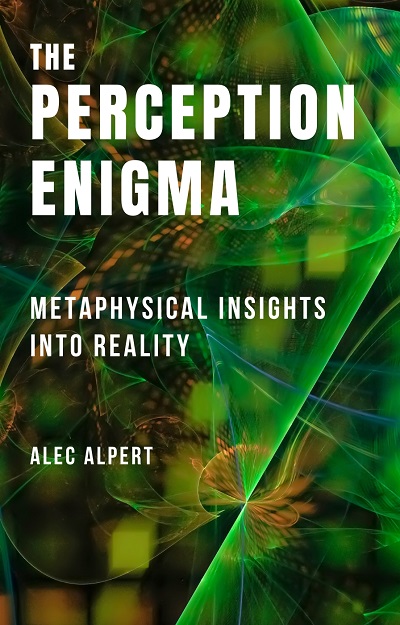
The Perception Enigma is an insightful book that invites readers to contemplate the transformative potential of metaphysical thinking in shaping the understanding of reality.
The Perception Enigma is an insightful book that invites readers to contemplate the transformative potential of metaphysical thinking in shaping the understanding of reality. Author Alec Alpert delves deep into the intricacies of our cognitive processes and their profound impact on all aspects of our lives.
The book concentrates on the prevalent influence of dualistic thinking, where choices are made by contrasting and choosing from opposing elements. From the simplest decisions to the most profound considerations shaping our worldviews, the book reveals the complexity of navigating dualities.
The narrative progresses from elemental binary dualities to complex existential dualities, challenging conventional assumptions and prompting readers to reevaluate their chosen realities from a metaphysical perspective. The book provides practical insights and encourages a sophisticated understanding of decision-making processes.
Structured as a comprehensive path, The Perception Enigma combines meticulous metaphysical analysis with unconventional yet pragmatic insights. It offers a discerning perspective on the intricacies that govern our perception of the world, fostering a deeper understanding of the multifaceted nature of reality. By transcending the limitations of scientific materialism, readers are encouraged to contemplate the visible and invisible realms of existence, unlocking answers to existential questions often overlooked.
Excerpt
INTRODUCTION
This book delves into how metaphysical thinking can profoundly enhance our perception and interpretation of the world. Our thoughts significantly impact our lives and influence every aspect of our existence. Considering the wide range of possible interpretations of reality, it is crucial that we fully understand the process of interpretation in order to embrace the most suitable version of reality.
Typically, we interpret reality through dualistic thinking, where we juxtapose things against each other and select one while rejecting the other. This type of thinking is based on contrast and the interplay of opposites. Often, we don't even realize that we're constantly comparing and choosing. While our choices are vast, they all boil down to choosing between dualities. When we think, we continually create dualities with our minds.
Dualities can be simple, such as black versus white, big versus small, hot versus cold, up versus down, life versus death, etc. Dualities can also be multifaceted, with dualities within dualities. With multifaceted dualities, our choices become complex, and more advanced skills and knowledge are required to make the appropriate choices. That is especially true when developing a personal worldview, which involves evaluating existential dualities determining our life course. How we perceive the world significantly affects how we feel.
This book examines many dualities, from the simple binary to the complex existential dualities, to see how they impact our lives. Some dualities we take for granted as indisputable truths are not always the case when viewed from a metaphysical perspective. It's essential to ensure that the reality we choose to live with is not fake.
I structured the book as a path gradually taking you from simple dualities to complex existential dualities, with a detailed metaphysical analysis of the subject. Many insights may be unconventional, but they are practical and can help you better understand the world around you and why certain things happen the way they do, as well as sharpen your critical thinking skills. The metaphysical insights presented in this book will help you answer many existential questions that most people usually never ask.
You'll learn that metaphysics encompasses not only the physical, visible realms but also the invisible realms and dimensions of existence well beyond the scientific materialism that currently holds the monopoly on reality perception.
Chapter 1
THE DUALISTIC NATURE OF REALITY
Let's begin our exploration of reality by acknowledging that existence is rooted in dualities. In metaphysics and philosophy, duality is the concept that two opposing and interconnected aspects or principles underlie the nature of reality or existence. We routinely compare things and events in our daily lives, reflecting our inherently dualistic thinking.
Picture, for instance, a sleek, beautiful, and expensive car, such as a Ferrari. Our admiration for it arises from a comparison with an ordinary, everyday vehicle, like a Chevy Impala. While we may acknowledge the Impala as a decent car, it falls short of the allure of a Ferrari. Thus, we establish a duality between Ferrari and Impala.
Though we may not always be aware of it, we are constantly immersed in dualities. The presence of contrasts shapes our perception and interpretation of the world. We attune all our senses to contrasting perceptions, and these dualistic frameworks inherently influence our understanding of ourselves and the surrounding world.
We employ dualities in thinking, speaking, writing, communicating, and engaging in scientific or intellectual activities. Dualities serve as the means through which we grasp the entirety of the universe. Every concept we encounter has a definition in relation to its opposite. Regardless of the context, at least two conflicting interpretations invariably coexist, forming a web of relative terms defined by mutual dependence.
While agreements may arise between individuals or groups, it is more often the case that opposing interpretations or viewpoints persist. In larger congregations, the diversity of interpretations expands beyond binary opposition, leading to arguments, debates, and, under certain circumstances, significant tensions or even violence. The enduring presence of wars, revolutions, rivalries, and riots in human history is a testament to the prevalence of dualities and complete opposites.
Dualities can be grouped into binary, scientific, and existential. A random sample of binary dualities may be hot versus cold, black versus white, night versus day, sad versus happy, man versus woman, war versus peace, life versus death, and so on; the list is endless.
Let's examine binary dualities. In this case, "binary" means obvious, with only two opposite interpretations, leaving no room for doubt, ambiguity, or straightforward, apparent dualities. It is akin to 1 and 0 in computers. Without its opposite, it would not and could not have an identity. One is one because there is zero.
Hot versus Cold
How do we know when something is hot and something is cold? By comparing the two and feeling their differences. When we put our hand in a bonfire, it starts to burn, and intense pain tells us that the flames are hot since we know what occurs when we put our hand in ice. Even without the ice experience, we know that nothing happens to our bodies at normal room temperature. The heat effect produced by fire is accurately associated with pain and hand damage in our brain. The survival instinct kicks in, and the brain sends electrical signals to the muscles that control the hand, allowing it to be pulled out of the campfire and saved. Fire is defined/labeled as "hot." The term "hot" refers to a high temperature, according to the dictionary. We all know what it's like to be hot when we hear "hot." In the other case, if we immerse our hand in ice for an extended time, we will notice that our hand gets numb, our fingers barely move, and pain develops. Like a bonfire, the brain sends impulses to lift the hand out of the ice to save it. We define/label ice as "cold," as defined by a dictionary. We all know what it's like to be chilled when we hear "cold."
Understanding hot versus cold dualism and reacting appropriately helps us survive. Indeed, our brain and the organs linked with our life have DNA algorithms that instantly respond to dangerously hot or cold temperatures - the extremes of duality - ensuring our survival. As a result, in life-or-death situations, those algorithms react immediately and instinctively without us having to overthink. For example, we will flee as quickly as possible from a raging inferno or avoid becoming trapped in an industrial meat freezer.
Universal consciousness created our DNA algorithms on a metaphysical level, which controls and determines everything. As we continue our exploration, we'll look at this part of metaphysics.
Black versus White
We exercise binary duality when we use a black pen to write letters on white paper. Only the contrast between a black pen and white paper allows us to see our notes. We couldn't see the lettering if the paper was black. We wouldn't be able to see letters if the paper and pen were both white. The same duality principle applies to each visible object - one must be lighter or darker than the other. Contrast is required for our eyes to see. We can't see anything in a dark room but can after the light turns on. We couldn't see anything if there was only darkness and no light. We would be unable to detect items if there was only light and all objects were not darker than light since contrast would be absent.
Night versus Day
It is simple to compare night and day. The sun rises in the morning, replacing darkness with light and raising the temperature. In the evening, the opposite occurs: the sun sets, night takes over, and the temperature drops. We get tired and go to bed. We see this daily and take it for granted, never suspecting it is nature's duality at work. Imagine there was no night; we would believe that day was all. We wouldn't call it "day" because there would be no contrast, opposition, or darkness to compare it to. Only around o'clock would there be daylight. Our lives would be different if we didn't have the night versus day duality. There would most likely be no life at all. This dichotomy is necessary for our survival. It is a creation of nature.
Happiness versus Sadness
Happiness is when we are elated, in a good mood, calm, and control our lives. Sadness is the polar opposite of happiness and occurs when we are unhappy, worried, apprehensive, or in a bad mood. Again, as in other situations, we would not understand happiness without understanding sadness. We need something to compare ourselves against. Contrast is required. You can't have happiness without sadness because the way we define happiness is only one pole of this duality, so as we go through life, we'll have a lot of sadness while simultaneously creating lots of happiness. At some point, we'll get tired of sadness. If only happiness existed, we would take it for granted, and we would not even have a designation for "happiness." It would be a typical emotional state of perpetual bliss. We can only appreciate happiness if we understand its polar opposite, sadness.
Man versus Woman
If we look at the naked bodies of a man and a woman standing next to each other, we will observe noticeable anatomical differences. Their body features are expressions of duality. Both have reproductive systems that nature has created to produce offspring. If only women existed, they would not know the concept of man. In a female-only society, they would be going through life unaware that they could produce babies. The same applies to men: they would not know the concept of a woman and that their sex organs can create other humans.
Humanity would not exist without the duality of a man and a woman. These two opposites are needed for propagation. The same duality applies to all other species; males and females are required to propagate species.
War versus Peace
We all know what war entails from direct experience, books, and hearsay information—any war results in widespread death, destruction, and sorrow. Humanity's history is one of never-ending warfare, great or small. There was never a day when there wasn't a war somewhere. Violence is deeply ingrained in the human psyche. Peace is simply a pause between wars. That is why, when there is a conflict, people cannot wait for it to end to enjoy peace.
But what if there was no peace as a component of duality and people only knew war? Humanity would then annihilate itself because people would kill each other until no one remained. However, because people understand that there is an opposite of war called "peace," it is worthwhile to fight to win the war and live in peace.
Life versus Death
At some point, we will all die. Human life has a specific life span. In the US, an average life span is around 78 years. We have done many things in 78 years. We have moments of happiness and sadness. But the duality is there, and life's opposite, death, replaces life eventually. If death did not exist, we would live forever. We would not know that we had to die. And if only death existed, there would be no life on Earth.
Let us broaden our understanding of the duality principle beyond binary, where many other interpretations of reality might exist between two polar opposites. To do so, we need first to touch upon the basics of dialectics: unity and the struggle of opposites.
Yin and Yang Principle
The unity and the struggle of opposites is the central theme of dialectics, which is related to the concept of non-duality on a deeper level. It denotes a situation in which the existence or identity of a thing (or situation) is contingent on the coexistence of at least two opposed conditions that depend on and assume each other within a realm of conflict. In the cases we discussed, hot cannot exist without cold; they are opposites but complement one another. A woman would not be a woman without a man since there is no contrast by which to designate her as a "woman" relative to any other condition; it would not and could not have any identity until its absolute opposite exists to make the opposing condition exist. Their unity is that either one exists because the other requires the opposite to exist. One manifests simultaneously with the other, which is the oneness, unity, and principle of any opposite's mere existence. One's identity is the contradictory principle that requires the other.
An excellent representation of unity and the struggle of opposites is the Yin and Yang concept that comes from Chinese philosophy and symbolizes the balance and interrelationships in the universe, particularly within the framework of Taoism and Confucianism. It provides a holistic understanding of the universe's fundamental nature, emphasizing the interplay of opposing forces and their inherent unity. This concept extends beyond dualism, aiming to reveal the intricate relationships that shape existence. It's symbolized by a circle divided into two halves, one dark (Yin) and the other light (Yang), with a small dot of the opposite color in each half.
Yin and Yang are complementary opposites, and their interaction creates harmony and equilibrium. It is like two sides of the same coin. Yin is associated with darkness, passivity, and coldness, while Yang represents light, activity, and warmth. However, they are not separate or static; they constantly transform into each other, and their balance is crucial for the natural order and well-being. This concept highlights that within every aspect of life, there is a bit of its opposite, and their dynamic relationship influences the world around us.
In essence, the Yin-Yang concept offers a profound understanding of the world as an interplay of opposites, a dance of balance and change that underlies the fabric of existence. It serves as a guiding principle for living by the natural rhythms of the universe and recognizing beauty in diversity and transformation.
The Yin-Yang principle points out that duality can be multifaceted, with duality within duality within duality. It can contain multiple parts and multiple categories. Binary duality is only one of the possible combinations, the most basic one. In real life, we typically encounter numerous dualities. We can see this in ideologies, dogmas, fads, concepts, postulates, and theories that contradict each other, keeping humanity constantly debating and often fighting physically. For instance, hundreds of Christian denominations exist worldwide. There are many scientific theories, models, and assumptions. The United States alone is home to a wide range of political, social, and cultural ideologies. We exist in the sea of infinite dualities under the Yin-Yang umbrella.
Moreover, to better understand metaphysics, we need to understand infinity. Within metaphysics, infinity is defined as follows:
Infinity extends beyond its mathematical connotation and assumes a broader, abstract significance. Metaphysical interpretations of infinity delve into the nature of reality, existence, and consciousness. Within this context, infinity denotes an immeasurable and boundless aspect of the cosmos—an enduring, limitless continuum that transcends the observable or quantifiable.
Metaphysical concepts encompass eternal recurrence, the interconnectedness of all things, and the timeless nature of visible and invisible realities. Infinity symbolizes the all-encompassing potentiality or possibilities inherent in existence. Metaphysical explorations of infinity go beyond mathematical formalism, seeking to comprehend reality's fundamental and transcendent aspects that elude finite categorization, as we will explore.
Whenever there is cooperation between two or more nations, eventually, this cooperation will fall apart to be replaced with either open animosity or some agreeable concessions. So, we have the duality of cooperation versus animosity. Animosity duality, in turn, can have three dualities: mild animosity, medium animosity, and severe animosity. The Cold War is an example of medium animosity duality where two superpowers were at odds with each other for forty-five years and, at some point, transitioned into severe animosity of the Cuban missile crisis, narrowly escaping the nuclear war.
Another common duality is when warring nations may become allies, and allies may become enemies. For example, the Chechens were at war with the Russians between 1994 and 2009. Then, they became allies in the war in Ukraine—the duality flipped from one extreme to another.
Here is another prominent duality: after a country's leader implements his policies, the next leader reverses most previous policies. Such actions produce a duality of creating versus destroying.
There may be a revolution or a civil war that establishes a particular political system, only to be replaced eventually with another one, the opposite of the previous one. Hence, we have dualities of monarchy versus federal republic, capitalism versus socialism/communism, democracy versus tyranny, etc. Like a pendulum, these dualities constantly flip from one extreme to another, none ever staying permanent. These flips can take decades or even centuries. The Roman Empire, for example, existed for approximately 507 years, from 27 BC to 476 AD. It was replaced by a series of successor states and kingdoms in Europe, such as the Kingdom of the Ostrogoths, the Vandal Kingdom, the Kingdom of the Visigoths, the Kingdom of the Franks, the Kingdom of the Anglo-Saxons, various Germanic and Barbarian Kingdoms, and the Byzantine Empire. So, we have eight dualities associated with the Roman Empire. Almost all those dualities no longer exist and have transformed into many other dualities that represent modern Europe today. And we can rest assured that today's Europe will be replaced with many new dualities. The current European Union will cease to exist within the next few years.
A multi-party democratic society can quickly flip into a one-party, brutal regime. Nazi Germany and the Soviet Union are good examples. And we also witnessed the reverse metamorphosis when the murderous regimes of Nazi Germany and the Soviet Union were replaced with democratic societies. So, within a few decades, dualities swapped from one extreme to another. We need to note that while the democracy versus dictatorship duality was swinging back and forth in those two societies, millions of associated dualities were swinging back and forth, too. One can read history books from the perspective of dualities to see how they interact. It would be a great exercise in mastering dualities and how they affect our lives.
Indeed, dualities affect us, especially human-invented dualities. We live in a world filled with endless dualistic interpretations of reality that are not necessarily rooted in nature. Inverted reality duality is a common component in any society that may become predominant. Generations can live life, never realizing they live in an inverted reality. Emotional problems such as loneliness, anxiety, and depression can result from choosing to live in a duality that resides at the opposite point of bliss, which is the misery versus bliss duality. Of course, serious medical issues that cause severe emotional problems may require treatment by licensed healthcare providers. To many, drug addiction and alcoholism have become a way to temporarily shift from a miserable to a happier state, a forced shift that will bounce back to misery once the substance wears out. On the other hand, one can be happy most of the time through natural metaphysical approaches, but that requires some work and dedication, like cultivating mindfulness, practicing meditation and introspection, studying the teachings of prominent thinkers and sages, raising self-awareness, etc.
|