For over ten years, car manufacturers have been building engines that are computer controlled, fuel injected, electronic marvels that just keep going and going and going. No auto enthusiast can argue with these facts, it's just true. Unfortunately, understanding carbs and points is a helluva lot easier than auto electronics. Therefore no one would be surprised to learn that many hot rod projects, even today, are being planned with carbs and points in mind.
EEEEEUUUUURRRRGGGG!
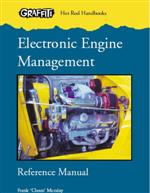
If the Auto Electronic Reference Manual was a tutorial, then the Electronic Engine Management Systems Reference Manual will be a hands on tour through the maze of electronic wizardry available from after market companies such as Kalmaker, MSD, Accel and Painless Wiring.
Chapter 1 Introduction Hot Rods in the New Millennium
Balancing Environment with Horsepower
EFI Safety
Chapter 2 An Overview of Engine Management Systems
Introduction
Why Not Stick with Points and Carbs?
What Is EFI?
Fuel Delivery
Throttle Body Injection
Multi-Point Injection
Batch vs. Sequential Injection
Putting EFI and EMS to Work
Chapter 3 Controlling Fuel
The Basics
Introduction
Open Loop and Closed Loop
Sensors and Actuators
Fuel Control
Engine Control at Idle, Cold Starts, Cruise and WOT
Controlling Nitrous Oxide
How Does Nitrous Oxide Work?
Why NO2?
Nitrous Management
Chapter 4 Controlling Ignition
The Basics
Introduction
Electronic Ignition Management
Distributor Control
Crankshaft Trigger Control
Distributorless Ignition (Coil Packs)
Converting Electronic Ignition for use with Delco/Kalmaker ECM
Magnetic Distributor
Hall Effect Distributor
Kalmaker and Distributorless Ignition Systems
Chapter 5 Sensors and Actuators
Sensors, Actuators
Fuel Pump Relay
Fuel Pressure Regulator
Fuel Injectors
Injector Types
Injector Choice
Fuel Transfer and Sealing
Flow Rates/ Pressure
Chapter 6 The Engine Control Module
Which System?
Programming your EMS for Engine Modifications
Choosing an Engine Management System
Kalmaker
The Software
Using the Delco ECM and Kalmaker Street Pro 3
Tuning the Engine Management System
Chapter 7 Wiring and Auto Electronics
The Alternator
Alternator Rating
Starter Motors
Wiring, RFI and EMI
Wiring Harness
Relays
Tachometers
Chapter 8 Converting to EFI
Convert to EFI
Conversion Alternatives
Choosing a Manifold
Converting a Carb Manifold
Adapting Throttle Bodies
Chapter 9 Appendix
Fuel Rail Extrusion
O2 sensor bungs
Mopar Performance Electronic Ignitions
Calculations, Estimates and Equations
Throttle Bodies and Adapters
Remote IAC Valves
EFI and EMS Businesses and Groups
Kalmaker
GM Engine Management System ECM usage
Further Reading
Wire Gauge Tables
Oxygen Sensor Wire Colours
Fuel Injector Data Table
Injector Flow Rate
List of Abbreviations
Alphabetical Index
Excerpt
Welcome to another production of Hot Rod Handbooks.
This book is an attempt to bring to modified car enthusiasts information and guidance on modern, efficient, auto electronic and electrical systems that will work well in our cars. It expands on the previous books to provide a practical guide to converting, installing and maintaining the following systems:
Electronic Fuel Injection Systems
Electronic Ignition Systems
Engine Management Systems
New, compact, high output alternators
High torque starter motors
Modern wiring systems and kits
This book examines the practical application of these systems and covers most of the available technologies. The author acknowledges that there are many players in the aftermarket field, but only the stand out leaders are mentioned.
Hot Rods in the New Millenium
It’s no secret that today’s cars are doing more with less. Gone are the muscle cars of the late sixties and early seventies, but the good news is that, in limited numbers, we are returning to the days of one horsepower per cubic inch, all on 90 octane fuel! However, one look inside the engine compartment of a 21st Century V8 powered car, and the average hot rodder goes dizzy trying to find a way through the maze of hoses, wires and pipes. With many, it’s back to the old carb/points setup for simplicity’s sake - a waste of technology! The fact is, there are more EFI engines around now than the old carb/points engines. The prices are good, the blocks themselves are the same, so there’s no reason why we can’t make them fit. Then there’s some of the more interesting new power plants, such as Dodge/Chrysler’s Viper V10, the Ford SOHC 5.0L and the DOHC Cobra 5.0L V8, the Toyota quad cam V8 and even the humble small block chev has a V12 cousin on the market, all controlled and monitored by a computer.
Balancing Environmental Issues with Horsepower
First of all, let’s just clear the air (no pun intended) of a couple of issues. I do not subscribe to the scams perpetrated by oil companies and (well meaning) environmentalists, that our modified cars are gross pollutants. A well tuned, well maintained V8 carbureted engine will emit as much pollution (in fact, probably less) as an average five year old car. That’s because catalytic converters have a life span of about 4 – 5 years – after that, they allow some pretty gross stuff to leak from our exhausts, far nastier than the lead that governments had us believing would kill us all! We also know that the “ozone holes” of a few years ago is a scam, and that what was happening over the poles was a naturally occurring phenomenon. Having said that, there is still a lot of junk in the atmosphere that is gradually being reduced through the application of sensible, realistic and scientifically endorsed methods.
Like electronic fuel injection. (EFI).
So why are modern cars being built this way? Well, to start with, the seventies was the era that brought us the anti-pollution movement. World governments introduced tough new laws to reduce the threat of pollution from the hundreds of thousands of cars manufactured each year. This meant more efficient combustion methods had to be invented. No way can a carburettor and points system efficiently reduce pollution. Fuel Injection and Electronic Ignition were the only avenues for the car manufacturers to take in order to make their products compliant with the new laws. Engine designers were no longer allowed to focus on performance above all else. Engines had to be clean and efficient, so performance had to suffer, and suffer it did. But with today’s technology, we can now squeeze 300HP from a small block chev and you can blow dry-your hair with the exhaust gas! What’s even better is the car manufacturers spent millions getting all this right so we could have:
Better fuel economy - Fuel economy has doubled in the same size engines over the last twenty years or so.
More torque and power - Intake manifolds perform at their best with a dry flow.
Improved throttle response and drivability - No hesitation or off-idle stumble when cold, no vapor lock when hot.
Engine life increases - Decreased oil dilution results in less engine wear.
Factory, computer controlled engines can be modified. They can be supercharged, turbocharged, nitrous injected or just rebuilt with bigger cams, better balancing, more efficient heads - just the way we’ve always done it. But there is a downside.
Engine peripherals - Single wire alternators that pump out sufficient electricity to handle huge stereo systems, electrically operated water pumps, oil pumps, power steering, fuel injection and other devices.
Wiring systems - Wiring MUST be of the highest quality.
Computers - The ECM needs to be shielded from power surges and spikes, the grounding must be perfect and each connection must offer the least electrical resistance possible.
Knowledge Overflow - There’s just so much you need to know when it comes to putting it all together.
Hot Rod Handbooks shall attempt to remove the mystery and give the average hot rodder the right amount of information required to build an EFI engine and wire it up in a non-factory environment.
This book is NOT about improving the performance of a late model car by fiddling with the engine management system, although readers will be capable of doing so with the aid of the information provided in these pages. Rather, it is about converting/updating from older carb/points engines to a more efficient version using today’s technology.
By the time you finish this book, you will be too embarrassed to look inside the engine bay of your Hot Rod, Custom, 4WD, or Street Machine because it’s got a carb. The only reason to have such a dinosaur system is when we decide to “restore” an old Hot Rod (the nostalgia look) but even in these areas we can use a bit of modern technology.
Want to review or comment on this book?
Need a FREE Reader Membership?
Reviews for "Electronic Engine Management Reference Manual"
Reviewed by den= pol
12/22/2006
I made me very curious, the convertion part specially, so how can I get the book, greetings den= fr. amsterdam,
Complete Troubleshooting & Repairing guide to hot air furnaces * Complete operation, maintenance, and repair * Covers gas, oil, and electric forced air systems * Includes flowcharts and highlighted tips and solutions to common furnace problems