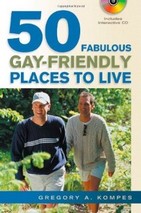
Category: Gay/Lesbian/Bi Publisher: Career Press
ISBN-10: 1564148270
Type: Non-Fiction
Pages: 385
Copyright: December 2005
ISBN-13: 9781564148270
If you're looking for a gay-friendly place to call home but can't decide among the urban hustle of New York, the laidback seaside of Key West, or the open, daily life of Minneapolis, this book is for you! Travelers, Urban Pioneers, gay families and those searching for a new hometown now have an easy-to-read book that profiles 50 of America's gay-friendliest cities from coast to coast.
Most guidebooks reduce coverage of the local gay community to lists – lists of bars, lists of dance clubs, lists of hotels, lists of resources. 50 Fabulous Gay-Friendly Places to Live surveys each location from a "local’s point of view". It features cities that are fun places to live, work, and visit because they encourage and nurture diversity. Each location is described in detail, with special attention paid to information the gay community most wants to know.
Life is more than facts and figures, so you won't find a lot of confusing charts and rankings in these gay-friendly profiles. Each contains a vivid description, an overview of the gay community, and practical daily-life information on climate, housing costs, taxes, the local business environment, and much more. Interviews with local gay residents, community leaders, business owners, and cultural leaders create an intimate description of each location. You'll also find helpful phone numbers and websites to make exploring and planning your vacation or relocation easier. Rounding out the book are tips and national resources that will assist in making your own life and city more gay friendly. The book also includes an easy-to-use, interactive CD containing a wealth of information to make your search that much easier—and a lot more fun!
Excerpt
Creating a Gay Friendly Life
It's important to develop a personal philosophy that supports and encourages your gay-friendly life. For some that means being out and political activists, while others might choose to keep their personal lives to themselves. The majority of our GLBT community falls somewhere in between. Whether we choose to live in a gay-friendly place or turn our current hometown into a gay-friendly place, it's important to know that we're not alone. The GLBT community spans our nation and the world and has for a very long time.
History tells us world leaders, artists, business moguls, sports figures and countless uncounted citizens of the world are members of our GLBT community. A few clicks at the GLBTQ (www.glbtq.com), an online encyclopedia of gay, lesbian, bisexual, transgender, queer culture, leads to a discovery of thousands of GLBT community members who have had an impact on the last three centuries of western culture, science and society. While some community members have visible impact on the world, others, like unnamed local activists, politicians and community members living and enjoying their gay-friendly lives, have a more subtle influence on their local GLBT communities.
America continues to evolve into a more gay-friendly place. More employers offer domestic partner benefits. More elected officials are gay and gay-friendly. There are more publications, groups, and events for the gay communities around the country. Cities and towns, big and small are not only gay-friendly places, but encouraging and catering to their creative and diverse populations.
With these shifting and encouraging attitudes, it's easier to live your life as an out gay person in America and the world. And, as more people continue to come out of the closet, more attitudes will shift. It's much harder to promote hate when you know someone who is gay.
It's been a right of passage for young members of the GLBT community to leave their hometown for a larger city to come out. Big cities, like Los Angeles, New York City, and Chicago make the transition out of the closet easier. These cities provide large gay communities and general environments where a person can literally get lost in the crowds. This helps make some parts of the self-discovery process easier. If no one knows you, you don't have to worry so much about what they think.
Because of their large gay communities, big cities create a sense of safety in numbers. These cities offer support groups in many forms. Just seeing lots of different people happy and comfortable with their own sexuality provides a sense of safety. Large communities also offer more formal support systems through gay and lesbian community centers, organized sports and recreational groups and social clubs. The big gay-ghetto or gay Mecca provides dwellers and visitors a safety net as they explore and grow through self-discovery.
The country's economy is shifting to high-tech, personal services and entrepreneurial start-ups. It's becoming understood that creating and supporting a gay-friendly, diverse community, supports this economic growth. Smaller cities and towns have begun to actively court the GLBT community. They don't want to loose their creative, diverse work-force to the big cities, but instead hope to draw creative companies to their cities.
As Richard Florida discusses in his book, The Rise of the Creative Class (2002), companies seeking creative, diverse work forces are now moving their operations to cities with large creative-class populations. These companies are coming to better understand and support the needs of their work forces by creating supportive environments for the GLBT community.
Businesses recognize the benefits of employing a diverse and create staff. A growing number of companies are now gay-friendly. They offer domestic partner benefits, "sensitivity training" for all employees and support groups, both social and emotional for their gay employees. By taking advantage of all the benefits these companies offer, you not only improve the quality of your own life, but prove to your company that offering such programs is a positive thing. Such encouragement leads to more companies offering similar benefits. It's important to participate. And, if your company doesn't offer these benefits, approach your boss, human resources contact, or even the owner and ask for the benefits you deserve.
The Human Rights Campaign (HRC) puts out the Corporate Index Report (CEI: www.hrc.com). The CEI is a business survey that collects data on company's gay-friendly policies. The result is a list of the most gay-friendly employers in America. HRC also tracks domestic partner benefits and policies.
There are thousands of gay-owned businesses in the country. Maybe you own or work for one of them. While it's impossible to actually estimate the number of GLBT community dollars spent, it is estimated that the community spends approximately $48 billion annually on travel alone. Considering this figure, there are many billions more spent on day-to-day living. In our commercial based democracy, money talks.
It's important to spend your dollars within the GLBT community whenever possible. Purchasing goods and services from within the community supports, enhances and increases visibility for the community. GLBT community centers, chambers of commerce and gay publications frequently compile a "Gay-Yellow Pages" or "Pink Pages" publication listing area businesses that are gay owned or gay supportive.
If you're interested in exploring and acting on your own entrepreneurial spirit there are many organizations to help. The National Gay & Lesbian Chamber of Commerce (NGLCC: www.nglcc.org) is the only national not-for-profit advocacy organization specifically dedicated to expanding the economic opportunities and advancements of the LGBT business community. NGLCC offers a wide array of services and advice for helping you start, expand, or support gay-owned businesses. NGLCC also maintains a current list of GLBT chambers around the country.
Financially supporting the GLBT community is one form of activism. Political activism is another important aspect of support. There are GLBT groups that go to extremes such as Act/Up (www.actupny.org). In the spirit of the Stonewall drag queens, radical groups are important groundbreakers for our community. Someone going to an extreme first helps define the middle ground. But, creating a definition is useless if no one steps into that open space. It's important that those middles are filled by supportive community members living average, everyday lives. Being someone who fills in that middle ground and lives a normal, gay-friendly, day-to-day life is the position most of us take. After all, the vast majority of us are simply normal in our own extraordinary ways.
Part of that everyday life includes supporting political candidates from the local to the national level who believe in the ideals of equality and inclusion. Voting for such candidates is an excellent way to support the GLBT community. Making financial contributions or volunteering for those same candidates or other organizations that support gay-friendly policies is another. And, running for office as such a candidate is another great option.
Positive political change that supports the GLBT communities refines the equality levels enjoyed by individuals and families within our communities. Families come in all shapes and sizes. Many of us have a personal goal of belonging to a group that loves and supports us just the way we are. We all have the families we are born into and those we create. In the best of worlds, these two types mix and blend to form a safe, loving environment where you can grow into the person you're meant to be. Your family can be whatever you want it to be and filled with whomever you choose.
The current debate about legalizing same-sex marriage is the latest request by our GLBT community to achieve equality. It's the latest sign that our community and its members are actually just like everyone else. This position may be the most threatening to conservative society. That realization that we are like the majority, that we love and need support just like everyone else is the greatest realization our community can share with society and the world at large.
Along with this realization comes the need for support. If you're spiritually inclined you have many gay-friendly options. The first is to travel your own path of spiritual self-discovery by reading any of the thousands of texts on the subject. Another choice is to join a group that promotes and supports your spiritual being without judgment. There are groups like Dignity (www.dignityusa.org) and the Metropolitan Community Church (www.mccchurch.org) that provides spiritual direction for the GLBT community. The Unitarian Universalists (www.uua.org) are another. There are also gay Jewish and Muslim congregations, Pagan groups and gay atheists, too.
This desire to find and feel support, whether spiritual, emotional or social, that's possibly the most important factor determining whether GLBT community members choose to stay or leave their hometowns.
Relocation is a big step. It's important to understand why you're moving, what you're looking for, and to do your homework when choosing your new hometown.
1. Do your homework. What needs, dreams and desires do you have for your new hometown? Every place is different, with varying services, opportunities, attitudes, and styles. Decide what factors are important to you: community, economy, climate, location. Make a list and use it to narrow the field of possible locations. If you don't find the perfect city among the 50 presented here take your list and the criteria used in these city profiles and use them to search for other cities.
2. Decide why you're moving. If your goal is to find a gay-friendly place to live, the 50 city profiles in this book are a fabulous place to start. The descriptions, details and resources provided in each profile provide an overview of what each city has to offer. If retirement is your plan, your additional needs or requirements will be met by "50 Fabulous Places to Retire in America" (ISBN: 1564142604). Likewise, if your goal is to find a family-friendly place, check out "50 Fabulous Places to Raise Your Family in America" (ISBN: 1564142612).
3. Do more research. When you've decided on a few potential cities contact their convention and visitor's bureau, chamber of commerce, and city hall. It's their job to sell their cities and they'll be happy to provide detailed information and guides. Local realtors can also provide a wealth of information and contacts. Head to the Internet. The 50 city profiles each contain dozens of web addresses to start your search. You'll find huge amounts of information online for just about any town or city. Just remember, the reliability of information you find on unofficial websites might be questionable.
4. Get a feel for daily life. Subscribe to your potential hometown's Sunday newspaper for a few weeks. The newspaper will provide current information about jobs, housing, community priorities, shopping, local arts and recreation. Many cities and states have glossy magazines that promote them. Check if your local library already has a subscription to these publications or if there's an online version available for free.
5. Visit. Plan to visit your new hometown. From your research you might have some potential neighborhoods. Seeing how your future neighbors live might help narrow your search. A local realtor will be willing to give you a tour of these neighborhoods, too. Visit the areas of town you might work or spend your recreational time. Stop into a few grocery stores and the nearby restaurants and businesses to discover your comfort level. Remember, no city or town is perfect. Every place has its drawbacks. But, what's a negative to someone else might be your most desired attribute.
Professional Reviews
The Advocate
Super helpful resource!
Publishers Weekly
"Once they're hitched—with or without the "m" word—...gay men and lesbians can take advantage of...50 Fabulous Gay-Friendly Places to Live by Gregory A. Kompes."
Gary J. Gates and Jason Ost, authors of The Gay & Lesbian Atlas
"While gay men and lesbians truly live everywhere, some places stand out as more fabulous than others. Kompes' entertaining and insightful book provides evidence for why fifty American cities rise to the top of the gay heap."
Martin Powers wanted an ironing board for Christmas. Instead, he got . . . Matthew Kieler, a non-returnable gift, but a gift that kept on giving. A powerful tale of survival, compassion and unapologetic love in the time of AIDS.
When the powers-that-be make the decision to return a selfish party-girl, Zara, to Earth on three missions of redemption, can romance and mayhem be far behind? One hot and trendy gay nightclub, two bickering angels and three unlikely pairs add up to