The authors bring a unique geological perspective to the contentious global warming issue, a view that has been notably missing far too long. Sensationalized media accounts portray climate change as abnormal and human-caused. In fact, geology shows clearly that climate changed in the past, it is changing now, and it will change in the future.
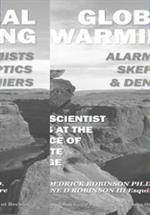
Global Warming:-Alarmists, Skeptics & Deniers: A Geoscientist looks at the Science of Climate Change, brings a unique geological perspective to this politically charged issue, a perspective that has been ignored far too long. Written by a father-son team of geoscientist and attorney, it is the concise guide to the global warming controversy that has been long needed. As a university professor and research geologist for thirty years, Dr. Robinson knows that geological science is essential for placing the global warming controversy in proper prospective. One cannot hope to understand how humans might be causing climate change without an understanding of the magnitude and speed natural processed are capable of when it comes to climate change. Earth history is the only yardstick we have to determine whether recent climate change is unusual or not. Yet, inexplicably, a vast repository of geologic data has been ignored in this contentious issue. Global Warming: Alarmists, Skeptics and Deniers was written to correct this oversight.
This book has been years in the making. It follows the outline Dr. Robinson used successfully for many years in a college classes taken by large numbers of students. Using an easy-to-understand question and answer format, the fourteen chapters of the book cover systematically all the major scientific issues of global warming. With more than three hundred references to peer-reviewed science journal articles and numerous illustrations, it shows how the scientific underpinnings of the global warming theory are actually weak and uncertain
.
Dr. Robinson is the author of numerous scientific articles in national and international journals. His background in teaching a wide variety of geology courses has shown him how to present difficult scientific concepts in a way that is understandable and interesting to non-scientists. He has chaired sessions at scientific conferences, led seminars for science teachers, served as the head at two different college geology departments and was interviewed on a television network. His co-author and son, an attorney experienced in argumentative rhetoric, has helped him hone in on the erroneously based assumptions underlying activists' arguments. He has also served as a sounding board for areas where the writing, intended for a general audience, needed to be less technical. Together, this unique father-son team present a well thought out and fully documented discussion of the global warming theory without impugning anyone's sincerity, motives or personal integrity. Global Warming: Alarmists, Skeptics and Deniers covers the science of global warming, but unlike many other books, not the politics.
Show Less
Excerpt
As a young geology instructor in the 1970s, I informed my students of satellite images showing expanding snow cover in North America compared to previous years. I advised them to remain skeptical of the claims then being made in the popular media that this heralded the beginning of the next ice age. A few years later, sensationalist articles about the coming ice age began to be replaced by others saying the earth was growing dangerously warm and we humans were to blame. Why the continuing exaggerations about climate change I wondered, but duly brought this new scare to the attention of my classes with the same caveat as before. I thought it was just more media hype that would fade as quickly as the recent ice age scare. I was wrong. Instead of fading, global warming alarmism increased.
As a geologist and student of earth history, I knew that climate has always changed. Some of the changes had been disastrous, such as the mountains of ice that moved into mid-latitudes during cold phases of the great Pleistocene ice age depopulating millions of square miles. Mostly, however they were just inconsequential changes of a degree or two. The warming we were then experiencing seemed just the latest in a large number minor undulations of climate, not unusual and not unexpected after the frigid temperatures that lasted several hundred years during the recently ended Little Ice Age. Yet, people were on TV acted like climate change was unusual, something that hadn't happened before. Obviously, they had never taken a historical geology course.
For a while, not many people promoted such a view, but the few who did knew how to get attention. And other people were listening. Little did I know a mindset had taken root and started to grow.
A great many people, particularly liberal politicians and most journalists, act as if climate change is odd, strange, extraordinary. Part of this belief system seems to be that yesterday's climate, the preindustrial climate, was ideal, the best of all possible climates, the way nature intended it to be. It was good because it was natural, and we prospered. But now we have strayed far from the natural way, and with our meddling, have upset the balance. We are the reason climate is changing and since it is not natural, it is bad. Nature gave us a stable climate, an ideal climate, but we messed it up
I still have trouble coming to grips with this. Do these people not realize that the preindustrial climate was the Little Ice Age chill? Have they not heard of all the crop failures and famine over large areas of Europe? The glaciers moving down into villages, the frozen rivers, the ice-choked harbors? The year without a summer when snow fell in New England during each summer month? The slow starvation of the Viking villages in Greenland?
My answer is that either they do not know these things because they were never exposed to historical geology, or they ignore it in favor of ideology. They either do not know what came before or don't care.
The new climate alarmism that is an offshoot of the green movement, a movement I understand and in some ways, sympathize with. I became a geologist because I love the grandeur of nature and the outdoors and hate the stifling congestion of cities. However these global warming people turned it all around. Staid and unchanging is not nature's way. The most basic thing about the earth, the first thing geologists learn, is that the only thing constant in nature is change. It can be at such a languid pace that, even over one's full lifetime, it's hard to detect, but it can also be catastrophic. Whether hare or tortoise, geologic change can't be stopped, yet it seemed to me that's what global warming alarmists sought.
Earth history clearly teaches that a static earth has never existed. Our planet is one of the most active bodies in the solar system. All kinds of things constantly change, including weather patterns and climate. Still, natural change does not preclude the possibility that human activities might also cause change. Perhaps, I thought, my own predisposition toward natural change was preventing me from impartially assessing the global warming theory. Maybe powerful evidence supported it. With this in mind, I began to study the scientific literature. To my surprise, I found very little direct evidence that humans were influencing climate. Most of what was offered as evidence was based on the predictions of computer climate models, rather than actual observed data or experimental results. It was as if a weather forecast saying sunny skies for the weekend had been elevated to a greater importance than the rain that actually fell. What was going on here?
Geologists apply the principle of uniformity to learn about earth history. It has proven to be a reliable guide for what is likely to happen in the future. For global warming alarmists, instead of the past that is living, it's the future. All their dire warnings are based on computer climate model predictions of things that might or might not happen.
To geologists like me, something vital is missing in this procedure, what we know happened in the past. A vast amount of this sort of data is available, but computer models use none of it to churn out their predictions. Real information, won at great cost and effort, is ignored in favor of predictions. This is not how science is supposed to work. I learned during my years in graduate school that many things in science are important, but above all is the data. We must honor the data, treat it impartially, let it lead us where it will, allow it to illuminate our way toward better theories. This is the only path that will lead to the light of real knowledge, real progress. This new method of science elevates computer predictions above real data. If the data doesn't agree with the computer forecast, then something must be wrong with the data. Better check it again and find out what's wrong.
Along with my discovery that a paucity of evidence supporting global warming was being hyped and stretched almost beyond belief came the realization that studies running counter to the theory were being ignored. Even worse, an entire group of scientists were not being heard, geologists, the very people who have the most knowledge about earth history. The science with the knowledge that should be most helpful in predicting future trends in climate was being ignored. Meteorologists, climatologists, physicists, chemists, biologists, even economists and politicians were making their view known, but where were the geologists?
I finally decided that this oversight needed correcting. This book is the result.
My goal in writing it is to summarize the science of global warming in a way that is understandable to ordinary people. For those desirous of learning more, references to cited peer-reviewed articles are provided. Throughout, I take a geologic point of view, intentionally elevating data above predictions and forecasts, for this is what has made the scientific method so successful in advancing the human condition. I do not discuss the politics of global warming, the economics, the merits of any particular policy direction or any point of view intentionally meant to favor one political party over another, whether liberal or conservative. Plenty of other books cover these topics.
There might be those who say I have failed at one or more of my objectives because they do not like what I say, while others might recommend the book because they do like my viewpoint. This is the unfortunate result of turning an important scientific question into a political piņata. Science and politics mix even worse than oil and water. Each needs to be kept in its cage completely isolated from the other. This is perhaps the most important lesson of the entire global warming controversy. It is in everyone's interest to try to keep it from happening again.
See all Editorial Reviews
Where do viruses, such as Ebola and HIV, come from and why they are so aggressive? This book changed tenets of evolutionary virology, developing the concepts of aggressive symbiosis and plague culling, which explain much of the horror of plague virus
Our human genome is full of viruses similar to HIV-1. These have played an important role in human evolution and still play an important role in human embryology and day-to-day chemistry. Just how important are they to our evolution past and future?