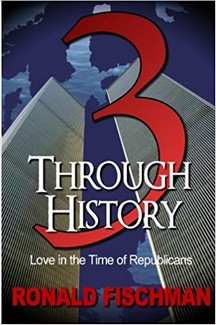
A love triangle unfolds under the shadow of empires tumbling and within earshot of the drumbeat of war.
Dimitri, the callow scion of Soviet emigres meets Rafi, the paradigm of the New Socialist Man on a Kibbutz and remain good friends for two decades. Then they meet and fall in love with the same woman. this woman, Frida, is truly the captain of her own ship, brising ot the top of Mexican business circles. But S. S. Frida ran aground on the shoals of alcohol and a broken heart. Which man will get to right the ship/ Is love and friendship enough to fill the hole in her soul that alcohol could not close?
The love triangle that ensues serves to explore the great social movements of our time. At the same time, Dimitri and Rafi represent polar opposites, exploring the question of what it means to be a man. Frida is a true rarity - a woman hero in a world of machismo. Our lovers are old enough that their lives serve as commentary to the fall of the Soviet Union, the unbridling of corporate greed, and the rise of Islamic extremism. Relive the turn of the millenium with these flawed, but deeply human, characters.
Just as Dimitri escapes Socialism and is nothing if not an opportunist, Rafi eats himself alive for his ideals.
Excerpt
https://www.smashwords.com/books/view/239509
Graduation (1986)
“OK, fuck you, cretin!”
With that, Dimitri slammed the door to the row house that huddled behind a façade of Wissahickon schist on Harbison Street. The green duffel bag with the black trim and more than one fibrous scrape or snag had come from a classmate at Central High. Rather, it came from the older brother of said classmate, swiped while the sibling was off at tennis camp. For the day. At whitebread Philadelphia Cricket Club, on grass courts so thick that, from a distance, you could be forgiven if you thought that the cross-hatched pattern on the forest-green carpet had been painted, not mowed. Dimitri’s friend was right. His brother wouldn’t even notice that it was gone until fall, when it was time to head back to college. Dimitri wasn’t going to college, really, although he had matriculated, by scholarship, at the Jezreel Valley College in the Galilee, Israel. He was going away. If he had won a competition to accompany the Sidney Opera Company in Australia, he would have gone there.
“Chortyonok!” You will never listen. Disrespectful sukin ..”
Dimitri’s mother, Fanya, shot an icy blast over her husband’s furious tongue, freezing it to the roof of its cage in an incipient sibilant. This was not the first time that Maksim had used this epithet, impugning the species of the mother of his children, but the last time she didn’t talk to him for three days. There was no time for silence this time. Fanya threw the door back open – BANG! with a report as staccato as in its closing.
“Dimya, you cannot leave with your father beset with grief. Give me minute…”
Dimitri broke his stride angrily, like a tight end breaking off a pass route in front of a defensive back.
Dimitri’s father, Maksim, never had any use for his son’s passion for music. Dimitri’s mother, Fanya, pushed all the children to learn the piano. Dimitri paid for his studio time with a G. P. A. that never fell below 3.5, even though he had to do some first-class sucking up to his physics teacher to get that B he didn’t earn. He harvested nine college credits by taking the Advanced Placement tests, but he told Maksim that the subjects were biology, chemistry, and math, but he had taken English, history, and Russian. Russian! They believed him! They paid for his testing fees, and they snapped it up like matza balls eat salt.
“Trust me, my little durak, you could go be lawyer, doctor, President, but piano? We coming to America to make you MUSIKANT? Nyet! For last time, you come back here and you go to Temple and you become surgeon like your brother!”
Now, Maksim had just banned his youngest son from returning to the house, even though Dimitri’s older brother and sister were free to come and go as they pleased. She was beautiful, and he was in medical school.
Dimitri half-strode, half-stumbled to the bus stop at Frankford and Hawthorn, unzipped the duffel just a bit, and took out a thick paperback book with the tattletale yellow and black cover. War and Peace. The Cliff’s notes version – in English. Dimitri flipped through the pages like a fresh deck of cards. He had written quotes from class in Russian so that he could read the quotes before the test. Now he hit a page describing a society party in which the patroness discoursed in nothing but French. “SKUCHNAYA!!” Dimitri had buried the text under four colors of highlighter. “Boring!” The 66 bus appeared a few blocks away. Dimitri tore the book in half at the spine, and tossed it in the trash can, one half at a time, first like a basketball, then like a Frisbee.
Getting on the bus, Dimitri could have glanced back at the block he wouldn’t see for twenty-five more years. He would have seen a row of freshly planted ginkgo trees, mercifully all male, standing between six and eight feet high – a class of leaf-bound preschool children in a line going to the bathroom, or the playground, or the lunchroom, with the row houses standing like teachers and administrators, fully grown and dour. The sidewalks would have been impossibly smooth, freshly laid to accommodate the expected foot traffic to the new shopping areas on Frankford Avenue. After all, there was a new concept in town, Chickie’s and Pete’s, the sports bar. Dimitri’s neighbors, the Cohens, wouldn’t have been caught dead there – it wasn’t kosher – but their freier family members often showed up after having more than one or two before Jewish holidays. As it was June, the men would have been out mowing, or the women out sweeping. Except the Cohens. It was Shabbes, and you didn’t work on Shabbes. Dimitri might have noticed that the front door that he had abjured just moments ago, slamming it with a force that echoed through each of his eighteen years, had revealed his mother, sobbing openly as if she were still in Czarist Russia and Dimitri had just left for America. Dimitri thought, just for a moment, that he heard an automatic garage door opener creak open, banging every eighteen inches as the aluminum failed to fold over itself as neatly as had been advertised by the Sears salesman. Or was that the manual lawn mower banging in Maksim’s angry hands?
Dimitri didn’t look back. Instead, he slung the heavy duffel bag onto the baggage shelf of the number 66 bus. Then he unzipped the end pocket – damn, other end pocket - and extracted the score to Joel Engel’s opera The Dybbuk. In it, he had placed his round-trip plane ticket to Israel, departing New York’s LaGuardia International Airport in six and a half hours. Passport? He thought he had stuffed it in the envelope with the ticket. Not there? A note in the score Dimitri had opened might have sung, “Panic!” but only if it were an eighth note. Before a beat had passed, Dimitri slapped himself in the butt with his left hand, and feeling the solid rectangle he had stuck back there, though he might as well have put a “Kick me” sticker on himself, as he enjoyed doing to the nerds, misfits, and Orthodox Jewish boys at school. Satisfied that he had no need to look back to that block that taunted him with the life he loathed, he sat on the stippled vinyl bus bench, working out passages with his left hand while holding the score in his right. Later, on the train from Frankfort Terminal to Trenton, he held the score with his left hand while making sure of the melodies in the right. In each phrase of the music, Dimitri found the shape of his life to come. Israeli? Well, maybe, let’s see how the girls are. If I can handle the opera company, and I can get laid, maybe I’ll say I’m a sabra.
Professional Reviews
Different Nrrators, One Voice
Angella Graff on Dec. 26, 2012 :
I was fairly confident that I'd love this book the moment I started looking into it. I'm a history addict, and even though this book isn't quite what I'd consider "contemporary lit" it's closer to the category than most books I've been reading lately, and I was excited for the shift.
Well I wasn't disappointed, I can tell you that much. From a technical standpoint, the book is very well told. Often when a book is being told from two different view points, the characters can become muddled or interchangeable, but Fischman handles both characters with great care. The writing is very well done, tight and the prose is detailed enough to wrap you in his world, but not so full of unnecessary information that you get lost in the paragraphs and forget where you are.
The book was also funny at times, which was a delightful surprise. It's not what I'd consider a comedy, but there's enough small smiles and little chuckles in there to keep you going.
I read the book fast, and it's not a small book by any means, but I couldn't put it down. It was a nice treat during the hectic holiday season, and I would absolutely pick something up from Fischman again. This book is getting a very well deserved five of five stars!
A teenage boy struggling with the coming-of-age issues of sexuality, religion, and peer approval is overwhelmed, but soldiers on. After several years, he comes to understand the family forces that have left him so deeply troubled, and the process of
Celts and Kings: The story behind the mystifying disappearance of the Celtic Earls in 1607. The story of a lost love and Celtic Spirituality.
The story of a forbidden love going back 400 years.
The story steeped in Irish history, Ce