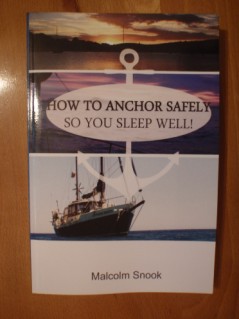
Comprehensive advice from anchoring a boat for lunch to living aboard. Everything you need to know about anchoring that's not covered in the majority of sailing courses.
Having lived on a boat and traveled extensively for a decade I decided to share my experience of life at anchor with other sailors and those who want to live the dream and become boat gypsies.
Sailing courses don't have the time to cover every specialist subject in this kind of detail. Storms at anchor, dragging or being dragged on to, having your anchor picked up by someone else, assessing anchorages, swinging, security and much more are covered in this book.
If you want to be a live aboard sailor and anchor here there and everywhere, often in remote places, then this is essential reading - unless you want to learn the hard way!
Excerpt
Contents
ABOUT THE AUTHOR
INTRODUCTION
ANCHORING EQUIPMENT
ADVANCE PLANNING CONSIDERATIONS AND TYPES OF ANCHORAGE
ASSESSING THE ANCHORAGE ON ARRIVAL
BASICS OF ANCHORING – HOW TO PHYSICALLY GO ABOUT IT
ANCHORING ETIQUETTE
GETTING THE ANCHOR UP
USE OF MULTIPLE ANCHORS AND ANCHOR ANGELS
USE OF LINES ASHORE
STERN OR BOWS TO MOORING WITH OWN ANCHOR
DEALING WITH OTHER BOATS DRAGGING AND CROSSED ANCHORS
WHERE TO ANCHOR FOR FREE
ANCHORING FOR EXTENDED PERIODS
ANCHORING A LARGE YACHT
ANCHORING A DINGHY OR TENDER
BUREAUCRACY AND INSURANCE
ATTACKS, THEFT AND SECURITY
TIDES AND CURRENTS/ANCHORING IN RIVERS
GETTING TO AND FROM YOUR BOAT
STORM PREPARATION
WHAT TO DO IF YOUR ANCHOR DOES DRAG
UNEXPECTED PROBLEMS AND OTHER CONSIDERATIONS
QUICK REFERENCE GUIDE
And tongue in cheek sailing in version!
AUTHOR'S AFTERWORD
INTRODUCTION
When I set out to purchase a boat to live on, travel and explore I considered a whole
range of factors. The subject of choosing and buying a boat for the liveaboard
lifestyle will probably be the topic of my next sailing book in fact. However whilst I
prioritised strength, safety, adequate accommodation, fuel and water capacity and
manageability I rather took anchoring for granted. I mean all yachts the size of mine,
and smaller, carry anchors and generally a winch and well, that's that isn't it?
Well, no actually. A lot of better off sailors simply travel from marina to marina. I
have no idea how often the previous owner of my boat anchored but not often judging
from the equipment he left. There was nothing wrong with the anchor itself, a forty
five pound CQR, but it was attached to a mere thirty metres of eight millimetre chain
and the winching arrangement was farcical, something my surveyor totally failed to
mention.
I was reassured to find a second anchor, an old Danforth in the locker attached to
about sixty metres of very thick and strong anchor rope, or rode if you prefer and a
few metres of ten millimetre chain. Now I'd been sailing dinghies from the age of
about ten and although I'd been on other people's yachts quite a few times,
particularly the small Vivacity owned by my mother and stepfather, plus larger
Westerlies they chartered for longer trips, I knew I would need some training to
prepare myself for my new liveaboard lifestyle.
I took the RYA's excellent Day Skipper Tidal theory and practical courses, diesel
engine maintenance, sea survival, first aid, VHF radio and finally the radar course. I
also bought a couple of celestial navigation books and messed about with an old but
newly calibrated and restored ex Royal Navy sextant. I'd run out of money for further
courses, especially after buying a new liferaft, danbuoy, flares, charts, lifejackets,
sails, rigging and a multitude of other things but felt confident that with the
experience I already had, and the training I had done, that I could sail long distances
in reasonable safety and without being a risk to others.
So it has turned out to be, no serious accidents and no rescues, but the aspect that
proved in many ways the most fascinating and where I still had the most to learn was
anchoring, hence this small tome. The RYA Day Skipper course does include
anchoring and the book shows a number of illustrations of common anchors and
recommends how much chain to put down and basically tells you how to anchor.
Look on-line and there are many, many articles about anchoring on all sorts of
websites, some blogs, some sailing advice sites, some from equipment manufacturers
trying to guide you towards their, anchors, rodes, winches etc. Most of these articles
are about one page, long sometimes two, so how can it be a subject worth a small
book?
Hopefully a quick glance at the contents list of this book will suggest to you how
much there is to consider if you really do want to anchor safely and sleep well, and
believe me a good night's sleep is worth having; even one night of tossing, turning
and worrying is debilitating and if all does go pear shaped you could lose your boat
or cause someone else to lose theirs, at worst there could even be loss of life.
In no way am I criticising the training courses that are available, in the great scheme
of things there are many, many things to learn about if you want to sail far and sail
safe. Luckily for me I'd been taught the principles of sailing from an early age so
more anchoring practice and imparted knowledge would have been helpful for me,
but for others on the courses I undertook, who had to learn things I already knew and
given that not everyone anchors frequently anyway, the time devoted to anchoring
was in keeping shall we say. If you intend to anchor off a lot, then this book is
definitely for you and frankly even if you anchor out only once in your life, the
information here could save you from embarrassment, financial loss or even injury.
I'd like to take the time if I may, feel free to skip to the meaty bits if you wish, to
illustrate that last claim with a few anecdotes from my own experiences.
Having bought my boat in Ireland I brought it back to London with few stops and no
anchoring out, this was a journey made in winter and after a sojourn in the canal
basin at Gravesend I spent a greater amount of time preparing my boat for longer
travels whilst in the calm of South Dock Marina, London. I experimented with
dropping and winching the anchor in the marina and discovered that because of my
high gunwhales and the conversion from a Danforth anchor that used to be winched
up close to the outside of the bow, to a CQR anchor on a roller projecting forward
that the winch had been reversed in order to fit the new location. This meant that the
chain came under the gypsy and around, crossing itself before going down into the
locker, cack handed to say the least, a pretty stupid arrangement really.
Not having much anchoring experience at this point I practised a few times and
figured I could handle my predecessors arrangement. When I left London to sail to
the Northern Baltic, I had a friend with me who was crewing for the first leg to
Scotland. We dropped anchor the first night at the mouth of the Medway, got some
sleep and in the morning commenced winching up the anchor. The first time it was
put under any load the old winch broke. Thank goodness there were two of us to pull
up the chain and the CQR hand over hand.
We moved on to Harwich where we looked into the cost of getting a new anchor
winch and sorting out some other teething problems, the previous owner had secured
the staysail with a shackle up the mast so it could not be dropped, without going up
the mast, if the roller reefing failed. I didn't like that either, but that's another story.
An electric anchor winch was too much money and I would also have had to consider
whether I would run heavy duty electrical cables from the engine bay to the bow, or
install dedicated batteries up front. Given space, money and time considerations I.....
"HOMEGROWN: The Making of the 1972-73 Providence College Friars" is a retrospective of that remarkable season as well as a history of the school's basketball program, which was responsible for drawing the local talent that propelled that team to succ
This book tells the story of the 1999 Providence College Friars baseball team, the last season that the sport was played at the institution. Baseball was set to be eliminated after that season in order for the school to comply with Title IX regulatio
This book tells the story of the 1999 Providence College Friars baseball team, the last season that the sport was played at the institution. Baseball was set to be eliminated after that season in order for the school to comply with Title IX regulatio